Índice9 secciones
In the current credit environment of 2025-2026, with interest rates stabilizing at elevated levels and covenant breaches accelerating across leveraged portfolios, creditors face a critical question: should they extend additional credit to a struggling borrower, or begin recovery proceedings? The answer hinges on a rigorous viability assessment—a structured evaluation that determines whether a business can realistically service its debt obligations and return to sustainable profitability.
For distressed companies seeking refinancing, understanding how banks and creditors conduct these assessments is not merely academic—it directly impacts survival. A well-prepared viability case can mean the difference between a successful restructuring and insolvency proceedings. This article examines the technical frameworks creditors employ, the key metrics they scrutinize, and how companies can position themselves for favorable refinancing decisions.
01 The Evolution of Viability Assessment in Modern Credit Markets
Viability assessment has evolved significantly since the 2008 financial crisis. Regulatory frameworks like Basel III and IFRS 9 have imposed stricter requirements on banks to assess credit risk prospectively, moving beyond backward-looking metrics. The European Banking Authority's guidelines on loan origination and monitoring, updated in 2023, explicitly require lenders to conduct forward-looking viability assessments for any material credit exposure showing signs of distress.
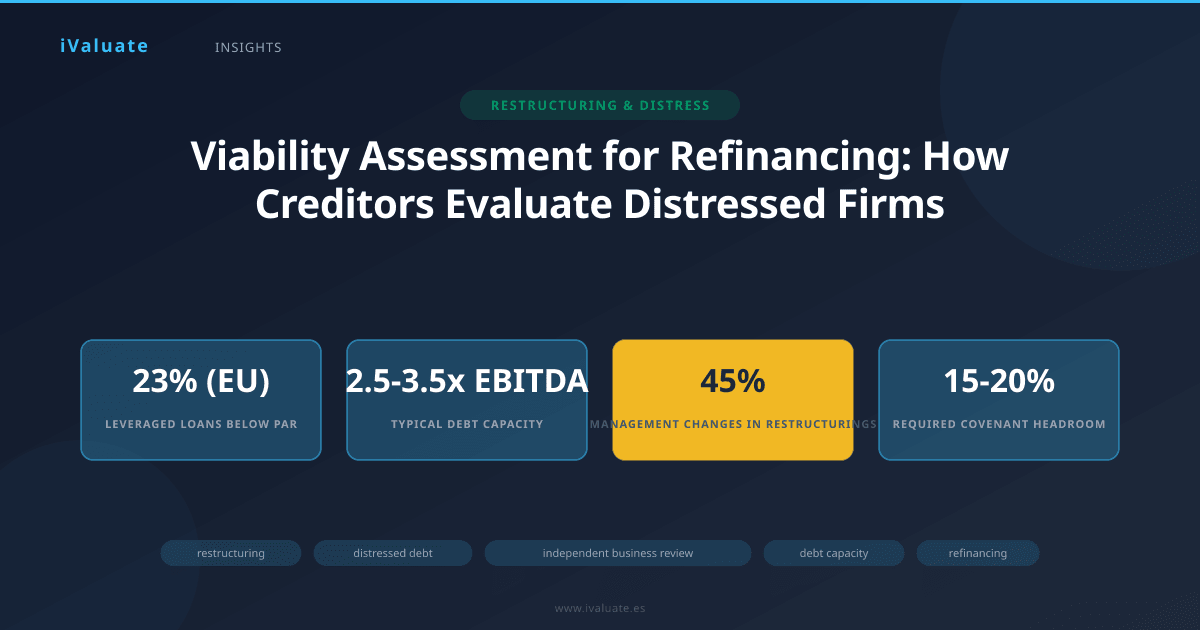
In 2025, approximately 23% of leveraged loans in Europe and 19% in North America are trading below par, indicating market concerns about borrower viability. This represents a 340 basis point increase from 2023 levels, driven by the cumulative impact of higher interest rates on companies that refinanced during the zero-rate environment of 2020-2021. Creditors are consequently conducting viability assessments at unprecedented volumes.
The assessment process typically triggers when a borrower exhibits one or more distress signals:
- Covenant breach or imminent breach within 12 months
- Liquidity concerns with cash runway below 6 months
- EBITDA decline exceeding 20% year-over-year
- Debt service coverage ratio (DSCR) falling below 1.2x
- Material adverse change in market position or competitive dynamics
- Management turnover or governance concerns
When these triggers occur, creditors must decide whether to support the business through refinancing or restructuring, or to accelerate recovery efforts. This decision rests on a comprehensive viability assessment.
02 The Independent Business Review: Framework and Methodology
The Independent Business Review (IBR) has become the gold standard for creditor-led viability assessments. Typically commissioned by the lead lender or steering committee, an IBR is conducted by an independent advisory firm with no prior relationship to the borrower. The independence is crucial—it provides creditors with an objective assessment free from management bias and establishes a defensible basis for credit committee decisions.
Core Components of an IBR
A comprehensive IBR examines five critical dimensions:
1. Historical Performance Analysis
The review begins with a forensic examination of historical financial performance, typically covering 3-5 years. Advisors normalize EBITDA by removing one-time items, related-party transactions, and aggressive accounting treatments. In our experience, normalized EBITDA often differs from management-reported figures by 15-25% in distressed situations. Key focus areas include:
- Revenue quality and customer concentration (customers representing >10% of revenue)
- Gross margin trends and cost structure sustainability
- Working capital efficiency and cash conversion cycles
- Capital expenditure requirements versus depreciation
- Off-balance sheet obligations and contingent liabilities
2. Market and Competitive Position Assessment
Viability cannot be assessed in isolation from market dynamics. The IBR evaluates the company's competitive position through Porter's Five Forces analysis, market share trends, and customer feedback. In 2025, particular attention is paid to technological disruption risk and ESG-related market shifts. For example, a traditional automotive supplier's viability assessment must now incorporate the accelerating transition to electric vehicles and the corresponding obsolescence risk of internal combustion engine components.
3. Operational Review
Operational viability extends beyond financial metrics. The IBR team conducts site visits, interviews management and key employees, and assesses operational capabilities. Critical questions include: Can the business operate efficiently at current and projected volumes? Are there operational bottlenecks limiting performance? Is the management team capable of executing a turnaround?
A 2024 study by the Turnaround Management Association found that 67% of successful restructurings involved management changes, highlighting the importance of leadership assessment in viability determinations.
4. Financial Projections and Scenario Analysis
The heart of any viability assessment is the financial forecast. Unlike management's often-optimistic projections, the IBR develops three scenarios: base case, downside case, and upside case. Each scenario is stress-tested against key assumptions:
- Revenue growth rates benchmarked against market data and historical performance
- Margin assumptions validated against operational capabilities and cost structure
- Working capital requirements modeled based on historical patterns and industry norms
- Capital expenditure needs assessed against asset condition and competitive requirements
Creditors typically focus on the downside scenario, which should reflect a 75th percentile adverse outcome. If the business remains viable under this scenario, refinancing becomes more palatable.
5. Debt Capacity Analysis
The ultimate question: how much debt can this business sustainably support? This analysis forms the foundation for refinancing negotiations.
03 Determining Debt Capacity: Technical Approaches
Debt capacity represents the maximum amount of debt a business can service while maintaining adequate liquidity buffers and operational flexibility. Creditors employ multiple methodologies to triangulate appropriate debt levels.
Cash Flow-Based Debt Capacity
The most fundamental approach calculates debt capacity based on sustainable free cash flow generation. The formula:
Debt Capacity = (Sustainable EBITDA - Maintenance CapEx - Cash Taxes - Working Capital Requirements) × Debt Service Coverage Factor / Interest Rate
The Debt Service Coverage Factor typically ranges from 1.25x to 1.50x for refinancing situations, providing a cushion for volatility. For example, a business generating €10 million in sustainable EBITDA with €2 million in maintenance CapEx, €1.5 million in cash taxes, and €1 million in working capital needs produces €5.5 million in available cash flow. At a 1.35x coverage requirement and 8% interest rate, debt capacity would be approximately €46 million (€5.5M × 1.35 / 0.08).
EBITDA Multiple Approach
Creditors also reference market-based leverage multiples, adjusted for company-specific risk factors. In 2025, median secured debt multiples for refinancing transactions range from 2.5x to 3.5x EBITDA for stable businesses, declining to 1.5x to 2.5x for companies in operational turnaround. Total debt capacity (including subordinated facilities) typically ranges from 3.5x to 5.0x EBITDA.
These multiples have compressed significantly from the 2021 peak, when covenant-lite structures and aggressive lending pushed total leverage to 6.0x-7.0x EBITDA. The current environment reflects creditor caution and regulatory pressure on bank leverage ratios.
Asset-Based Lending Constraints
For asset-intensive businesses, debt capacity may be constrained by collateral values rather than cash flow. Asset-based lending (ABL) facilities typically advance:
- 85-90% against eligible accounts receivable (aged <90 days)
- 50-65% against eligible inventory (finished goods, adjusted for obsolescence)
- 70-80% against appraised orderly liquidation value of equipment
- 60-75% against real estate (commercial properties)
The borrowing base calculation determines maximum availability, which must be reconciled with cash flow-based capacity. In distressed situations, the lower of the two figures typically governs.
Covenant Headroom Analysis
Even if a company can technically service debt, creditors assess whether it can maintain adequate covenant headroom. Modern refinancing facilities typically include:
- Maximum Total Net Leverage ratio (typically 4.0x-5.5x stepping down over time)
- Minimum Interest Coverage ratio (typically 2.5x-3.5x)
- Minimum Fixed Charge Coverage ratio (typically 1.15x-1.35x)
- Maximum CapEx limits
- Minimum liquidity requirements (often €5-10 million or 10% of facility)
Debt capacity must allow for at least 15-20% covenant headroom under downside scenarios. Breaching covenants immediately after refinancing destroys credibility and triggers technical default.
A viable business must demonstrate the ability to service debt obligations, maintain covenant compliance, and fund operations under reasonably adverse scenarios—not just in management's base case projections.
04 Real-World Case Studies in Viability Assessment
Case Study 1: European Industrial Manufacturer
In early 2024, a €250 million revenue industrial manufacturer faced a covenant breach on its €85 million term loan (3.4x leverage). The company had experienced margin compression due to energy cost inflation and customer destocking. Management projected a return to 12% EBITDA margins within 18 months, supporting a refinancing request.
The creditor-commissioned IBR revealed several concerns:
- Normalized EBITDA was €18 million, not the €25 million management reported (adjusting for one-time gains and unsustainable cost cuts)
- Three of top five customers (representing 42% of revenue) were actively qualifying alternative suppliers
- Required maintenance CapEx was €4 million annually, not the €2 million management projected
- Working capital would require €6 million cash injection to normalize payment terms
Under the IBR's downside scenario (15% revenue decline, 10% margins), debt capacity was calculated at 2.2x EBITDA or approximately €40 million—less than half the existing debt. The creditors ultimately agreed to a refinancing at €50 million with a €15 million equity injection from sponsors and operational covenants requiring monthly reporting and consent for capital expenditures exceeding €500,000. The company successfully stabilized and is now operating within its debt capacity.
Case Study 2: Retail Chain Refinancing
A specialty retail chain with 85 locations sought to refinance €60 million in debt coming due in 2025. The company had been profitable historically but faced pressure from e-commerce competition and changing consumer preferences. Management's projections showed modest same-store sales growth and margin expansion through cost reduction.
The IBR process included store-level profitability analysis, revealing that 28 locations were cash flow negative and another 19 were marginally profitable. The advisor's base case assumed closure of unprofitable locations, resulting in a 35% reduction in store count but improved overall profitability. Sustainable EBITDA was assessed at €8 million (versus management's €12 million projection), supporting debt capacity of 2.5x or €20 million.
Rather than refinance, creditors negotiated a comprehensive restructuring: €25 million in new secured debt, conversion of €20 million existing debt to equity, and a store rationalization plan. This outcome, while painful for existing equity holders, preserved business viability and provided creditors with an appropriate risk-adjusted return profile. The company emerged as a smaller but profitable operation.
Case Study 3: Technology Services Firm
A business services company with strong recurring revenue sought to refinance €40 million in debt despite recent EBITDA declines. The IBR revealed that customer churn had increased from 8% to 14% annually, driven by competitive pressure and service quality issues. While management projected churn would normalize, the IBR team's customer interviews suggested structural issues requiring 18-24 months to address.
The viability assessment calculated debt capacity at 3.0x sustainable EBITDA of €11 million (adjusting for expected continued churn), supporting €33 million in debt. Creditors agreed to refinance €35 million with stringent operational covenants including maximum monthly churn rates, minimum customer satisfaction scores, and mandatory quarterly business reviews. The company met its operational targets and successfully stabilized its customer base, validating the viability assessment.
05 Critical Success Factors in Viability Assessment
Based on analysis of over 200 refinancing situations between 2023-2025, several factors consistently differentiate successful viability assessments from those that fail:
Quality of Financial Information
Companies with robust financial reporting systems, monthly management accounts, and detailed operational metrics receive more favorable viability assessments. Creditors can underwrite with greater confidence when data is reliable and timely. Conversely, companies with poor financial controls face skepticism and higher risk premiums.
Management Credibility and Capability
Management teams that acknowledge problems, present realistic assessments, and demonstrate operational competence earn creditor trust. In our experience, management changes occur in approximately 45% of successful refinancings, often as a precondition for creditor support. The IBR process specifically evaluates whether existing management can execute a turnaround or whether external expertise is required.
Market Position and Competitive Dynamics
Companies with defensible market positions, differentiated products, or high customer switching costs demonstrate stronger viability. Conversely, businesses in declining markets or facing technological disruption struggle to convince creditors of long-term viability regardless of near-term financial performance. The IBR must address the fundamental question: will this business exist in five years?
Stakeholder Alignment
Successful refinancings typically require alignment among multiple stakeholders—senior lenders, junior creditors, equity sponsors, and management. The viability assessment provides a common factual foundation for negotiations. When stakeholders dispute the underlying business assessment, refinancing negotiations often deadlock, leading to formal insolvency proceedings.
06 The Role of Professional Advisors and Analytical Tools
The complexity of modern viability assessments has driven demand for specialized advisory services and analytical tools. Independent business reviews are typically conducted by firms with restructuring and turnaround expertise, often involving teams of 3-5 professionals over 6-10 weeks. Costs range from €150,000 to €500,000 depending on company size and complexity.
These advisors employ sophisticated financial modeling techniques, industry benchmarking databases, and operational assessment frameworks. The analysis must be defensible to credit committees, boards of directors, and potentially courts if the refinancing fails and insolvency proceedings follow.
For creditors and companies navigating these situations, access to professional-grade valuation and analysis tools has become essential. Platforms like iValuate enable financial professionals to conduct preliminary debt capacity analyses, scenario modeling, and covenant compliance projections efficiently. While these tools don't replace comprehensive IBRs for major refinancings, they provide critical capabilities for ongoing portfolio monitoring and early identification of viability concerns.
07 Regulatory and Accounting Considerations
The viability assessment process operates within a complex regulatory framework. Under IFRS 9, banks must assess expected credit losses over the life of a loan, requiring forward-looking viability judgments. A negative viability assessment triggers Stage 3 classification (credit-impaired), requiring specific loan loss provisions and potentially forcing the bank's hand toward restructuring or recovery.
Similarly, directors of distressed companies face legal obligations regarding wrongful trading and creditor duties. In many jurisdictions, continuing to trade while insolvent exposes directors to personal liability. A credible viability assessment—even if ultimately negative—provides important legal protection by demonstrating that directors made informed decisions based on professional advice.
The European Banking Authority's 2023 guidelines on loan origination and monitoring explicitly require banks to conduct viability assessments when borrowers show signs of financial difficulty. These assessments must be documented, reviewed by independent credit risk functions, and updated at least quarterly for distressed credits.
08 Looking Forward: Viability Assessment in 2025-2026
As we progress through 2025 and into 2026, several trends are reshaping viability assessment practices:
Increased Scrutiny of ESG Factors
Environmental, social, and governance considerations now materially impact viability assessments. Companies in carbon-intensive industries face transition risk that affects long-term viability regardless of current profitability. Creditors increasingly require climate scenario analysis as part of IBRs, particularly for loans with tenors exceeding five years.
Technology and Disruption Risk
The accelerating pace of technological change requires viability assessments to address disruption risk explicitly. Artificial intelligence, automation, and digital transformation are reshaping competitive dynamics across industries. A company may be operationally sound today but face existential threats within 3-5 years if it fails to adapt.
Supply Chain Resilience
Post-pandemic supply chain vulnerabilities remain a critical viability consideration. Companies with concentrated supplier bases, long lead times, or exposure to geopolitically sensitive regions face heightened scrutiny. The IBR process now routinely includes supply chain mapping and resilience assessment.
Private Credit Market Dynamics
The explosive growth of private credit markets—estimated at $1.6 trillion globally in 2025—has created alternative refinancing sources for distressed companies. However, private credit lenders often conduct even more rigorous viability assessments than traditional banks, given their fiduciary duties to institutional investors. The higher cost of private credit (typically 400-600 basis points above bank debt) also affects debt capacity calculations.
09 Conclusion: Navigating the Viability Assessment Process
Viability assessment for refinancing represents a critical inflection point for distressed companies and their creditors. The process is technically complex, requiring sophisticated financial analysis, operational assessment, and market evaluation. For companies facing refinancing challenges, understanding how creditors evaluate viability is essential for positioning the business favorably and maximizing the probability of successful restructuring.
The key takeaways for financial professionals navigating these situations:
- Viability assessment is a structured, multi-dimensional process extending far beyond financial projections
- Debt capacity must be calculated conservatively using multiple methodologies and stress-tested under adverse scenarios
- Independent Business Reviews provide creditors with objective assessments that form the foundation for refinancing decisions
- Management credibility, quality of information, and realistic planning are critical success factors
- Early engagement with creditors and professional advisors improves outcomes significantly
As credit markets navigate the elevated interest rate environment of 2025-2026, viability assessments will only increase in importance and frequency. Companies that proactively address viability concerns, maintain robust financial reporting, and engage constructively with creditors position themselves for successful refinancing outcomes. Those that delay or present unrealistic assessments face increasingly limited options as creditor patience wanes.
For financial professionals managing these complex situations, access to sophisticated analytical capabilities is essential. Tools like iValuate provide the modeling, scenario analysis, and debt capacity assessment capabilities required to navigate viability assessments efficiently and credibly. In an environment where the difference between refinancing and insolvency often hinges on the quality of financial analysis, professional-grade tools have become indispensable for creditors, advisors, and companies alike.