Índice7 secciones
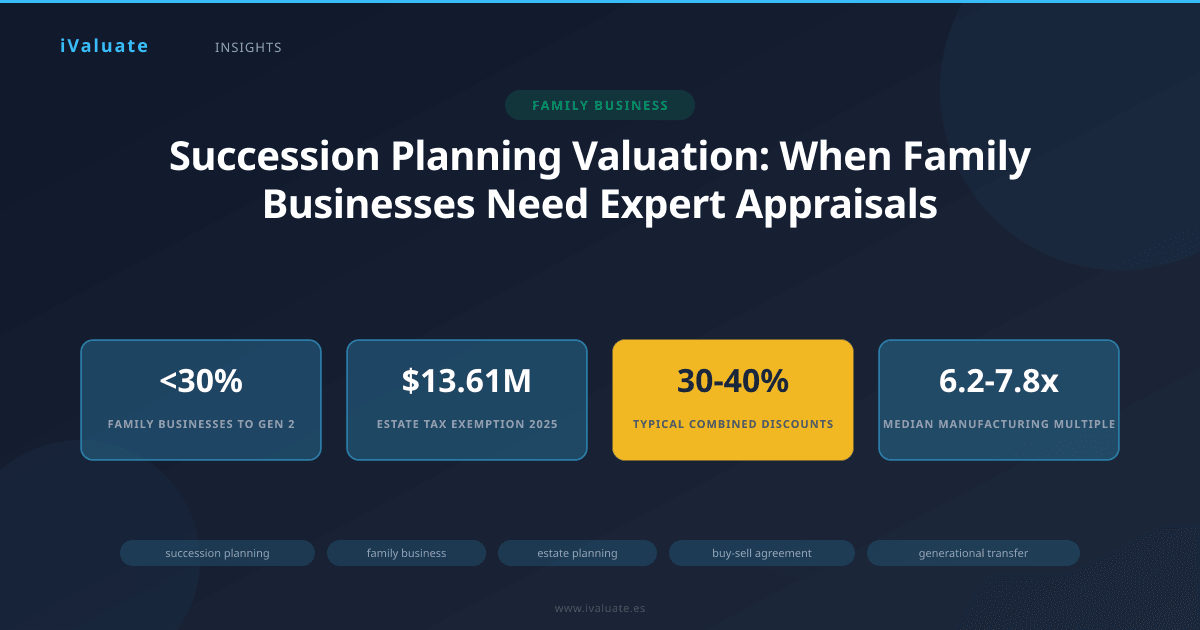
Family businesses represent the backbone of the global economy, accounting for approximately 70-90% of annual global GDP and employing roughly 60% of the workforce worldwide. Yet despite their economic significance, fewer than 30% of family enterprises successfully transition to the second generation, and only 12% survive to the third. The primary culprit? Inadequate succession planning coupled with poorly executed ownership transitions that lack proper valuation foundations.
As we navigate 2025-2026, family businesses face unprecedented complexity in succession planning. Rising interest rates have compressed valuation multiples, new tax regulations demand greater scrutiny of related-party transactions, and generational wealth transfers are accelerating as Baby Boomers retire. Professional business valuations have evolved from optional exercises to mandatory risk management tools that protect families, satisfy regulators, and ensure equitable transitions.
01 The Critical Role of Valuation in Family Business Succession
Unlike publicly traded companies with transparent market prices, private family businesses operate in an information vacuum. Without daily trading activity to establish fair market value, ownership transitions require formal valuation processes that withstand scrutiny from multiple stakeholders: family members, tax authorities, lenders, and potential buyers.
Professional valuations serve four fundamental purposes in succession planning:
- Establishing defensible fair market value for tax compliance and regulatory purposes
- Creating objective reference points that reduce family conflict during ownership transfers
- Enabling informed decision-making about timing, structure, and financing of transitions
- Documenting value for legal agreements including buy-sell provisions and estate plans
The stakes have never been higher. The IRS has intensified scrutiny of family business valuations following several high-profile cases where aggressive discounting strategies resulted in significant tax deficiencies and penalties. In 2024, the Tax Court upheld IRS adjustments exceeding $45 million in one estate case where the family's valuation expert applied inappropriate methodologies to a closely-held manufacturing business.
02 Eight Valuation Triggers in Family Business Succession
1. Initiating Formal Succession Planning
The succession planning process should begin with a baseline valuation, ideally 5-10 years before anticipated ownership transfer. This initial appraisal establishes a reference point for measuring value creation and provides founders with realistic expectations about enterprise worth.
Consider a third-generation distribution company in the Midwest with $85 million in revenue. The founding family assumed the business was worth approximately $120 million based on informal industry conversations. A professional valuation in early 2025 revealed the actual fair market value was $78 million, reflecting margin compression from e-commerce competition and aging infrastructure requiring $12 million in capital investment. This 35% gap between perception and reality fundamentally altered the family's retirement planning and succession timeline.
Early baseline valuations enable families to identify and address value gaps before they become succession obstacles. Common value detractors discovered during initial assessments include customer concentration, key person dependencies, inadequate financial controls, and deferred capital expenditures.
2. Structuring Buy-Sell Agreements
Buy-sell agreements represent the constitutional documents of family business ownership, governing what happens when shareholders die, become disabled, divorce, or wish to exit. These agreements require clear valuation mechanisms that produce defensible, predictable results.
Three primary valuation approaches appear in buy-sell agreements:
- Fixed price mechanisms — predetermined values updated annually (simple but often outdated)
- Formula-based pricing — mechanical calculations using financial metrics (consistent but may not reflect market conditions)
- Professional appraisal — independent valuation by qualified experts (accurate but more expensive and time-consuming)
Recent market volatility has exposed the limitations of fixed price and formula approaches. A family-owned construction firm in Texas learned this lesson when a 45-year-old shareholder died unexpectedly in 2024. Their buy-sell agreement used a formula based on 6.5x trailing twelve-month EBITDA. However, the company had just completed a transformational acquisition that temporarily depressed margins while significantly enhancing long-term prospects. The formula produced a value of $42 million, while a contemporaneous professional appraisal indicated fair market value of $61 million. The resulting dispute among family members required costly litigation and nearly destroyed the business.
Best practice in 2025-2026 involves hybrid approaches: formula-based pricing with mandatory professional appraisals triggered every 3-5 years or when material events occur (acquisitions, divestitures, major capital investments, or significant market disruptions).
3. Estate Planning and Gift Tax Compliance
Generational wealth transfer represents perhaps the most consequential valuation trigger for family businesses. The current federal estate and gift tax exemption stands at $13.61 million per individual ($27.22 million per married couple) in 2025, but this historically high exemption is scheduled to sunset in 2026, potentially reverting to approximately $7 million per person adjusted for inflation.
This impending reduction has created urgency among family business owners to transfer ownership interests before the window closes. However, the IRS scrutinizes related-party transfers intensely, requiring valuations that reflect fair market value without regard to family relationships.
Professional valuations for gift and estate tax purposes must address several technical considerations:
- Minority interest discounts — reductions for lack of control (typically 15-35%)
- Lack of marketability discounts — reductions for illiquidity (typically 20-40%)
- Key person dependencies — adjustments for concentration risk around founders
- Normalization adjustments — removal of discretionary expenses and non-market compensation
The application of discounts has become particularly contentious. Section 2704 regulations, while not finalized, signal IRS intent to limit aggressive discounting. In 2024-2025, we've observed increased IRS challenges to valuations claiming combined minority and marketability discounts exceeding 45%, particularly when family members retain effective control through voting agreements or management positions.
A California wine producer provides a cautionary example. The patriarch transferred 40% of the company to his three children in 2023, claiming a 50% combined discount that reduced the gift value from $28 million to $14 million. The IRS challenged the valuation, arguing that the children's participation in management and guaranteed distributions negated marketability concerns. After examination, the IRS assessed additional gift tax of $3.8 million plus penalties and interest. A more conservative valuation approach with 35% combined discounts would have avoided this costly dispute.
4. Management Buyouts and Internal Transitions
When family businesses transition to non-family management or facilitate buyouts by key executives, professional valuations establish fair pricing that satisfies both sellers' financial needs and buyers' financing capacity.
Management buyouts (MBOs) present unique valuation challenges because the buyers possess intimate knowledge of the business, creating information asymmetries. Independent valuations level the playing field and provide lenders with confidence to finance transactions.
In 2025, we're seeing increased MBO activity as Baby Boomer business owners without family successors seek exit options. A representative transaction involved a $45 million EBITDA manufacturing company in Ohio where the founder's children pursued other careers. The management team, led by a 15-year veteran CFO and COO, proposed an MBO at 5.8x EBITDA ($261 million enterprise value).
The independent valuation commissioned by the family's advisors indicated fair market value of 6.4x EBITDA ($288 million), reflecting the company's market position, customer diversification, and recurring revenue model. The $27 million gap created tension, but the professional appraisal provided an objective foundation for negotiations. The parties ultimately agreed on $275 million with an earnout tied to three-year performance, structured to bridge the valuation gap while aligning incentives.
5. Divorce and Shareholder Disputes
Marital dissolution involving family business owners triggers mandatory valuation requirements in virtually all jurisdictions. These valuations must withstand adversarial scrutiny, as divorcing spouses often retain competing experts who advocate for divergent values.
The technical challenge in divorce valuations centers on the appropriate standard of value. Most jurisdictions require fair market value, defined as the price at which property would change hands between a willing buyer and willing seller, neither being under compulsion and both having reasonable knowledge of relevant facts. However, some states apply fair value standards that eliminate minority discounts, significantly impacting valuation conclusions.
Shareholder oppression cases present similar dynamics. When family members deadlock or majority shareholders squeeze out minorities, courts often order buyouts at judicially determined values. These forced transactions typically receive fair value treatment without marketability discounts, recognizing that the minority shareholder is being compelled to sell.
A 2024 case in Illinois illustrates these principles. Three siblings inherited equal stakes in a family logistics business worth approximately $90 million. When two siblings voted to cease distributions and increase their own compensation, the third sibling sued for oppression. The court-appointed valuation expert determined the business's fair market value at $90 million, applied a 25% minority discount and 30% marketability discount to arrive at a pro-rata value of $20.25 million per sibling. However, the court rejected the discounts given the oppressive conduct, ordering the majority siblings to purchase the minority stake at $30 million (one-third of enterprise value without discounts).
6. Recapitalizations and Capital Structure Changes
Family businesses often recapitalize to facilitate succession, creating multiple share classes with different economic and voting rights. Common structures include:
- Voting vs. non-voting shares — separating control from economics
- Preferred equity — providing senior family members with fixed returns
- Phantom equity — granting economic participation without ownership
Each recapitalization requires valuation to allocate value among share classes and ensure transactions occur at fair market value for tax purposes. The IRS scrutinizes recapitalizations under Section 2701, which contains anti-abuse rules preventing artificial value shifts to younger generations.
A fourth-generation retail chain in New England executed a recapitalization in 2025 that created three share classes: Class A voting common (retained by the 72-year-old CEO), Class B non-voting common (distributed to four children), and Class C preferred (held by the CEO with 6% cumulative dividend). Professional valuation allocated 15% of enterprise value to the preferred shares, 25% to the voting common, and 60% to the non-voting common, reflecting control premiums and dividend preferences. This allocation withstood IRS scrutiny because it was supported by rigorous option-pricing models and market-based discount rate analysis.
7. ESOP Transactions
Employee Stock Ownership Plans (ESOPs) have gained popularity as succession vehicles that provide liquidity to family owners while preserving company independence and creating tax advantages. However, ESOP transactions face intense regulatory scrutiny requiring annual independent valuations.
The Department of Labor (DOL) requires that ESOPs purchase employer securities at no more than fair market value, with valuations performed by independent qualified appraisers. The definition of "adequate consideration" under ERISA demands rigorous valuation processes that consider multiple methodologies and market conditions.
ESOP valuations differ from standard business appraisals in several respects. They must be performed annually, cannot rely solely on control premiums (since ESOPs often acquire minority stakes initially), and must carefully consider the ESOP's impact on company capital structure and cash flows.
A family-owned engineering firm in Colorado provides a relevant example. The founders sold 30% to an ESOP in 2024 at a valuation of $67 million (implying $20.1 million for the 30% stake). The independent valuation considered the company's backlog, client relationships, and technical expertise, but also accounted for the debt service burden created by the ESOP loan and the dilutive effect on existing shareholders. The DOL reviewed the transaction and found the valuation methodology sound, but this scrutiny underscores why ESOP valuations require specialized expertise beyond general business appraisal skills.
8. Strategic Sale Preparation
When family businesses ultimately decide to sell to third parties, professional valuations inform pricing expectations, identify value creation opportunities, and support negotiations with potential acquirers.
Pre-sale valuations serve multiple purposes: establishing realistic price ranges, identifying and addressing value gaps, and providing negotiating leverage with buyers. The gap between internal valuations and market offers often surprises family owners who overestimate their businesses' worth.
In 2025, we're observing valuation compression in certain sectors as higher interest rates impact buyer economics. A family-owned distribution business in the Southeast illustrates this dynamic. The owners assumed their company would command 8-9x EBITDA based on 2021-2022 transaction multiples. However, a quality of earnings analysis and market valuation in early 2025 indicated a realistic range of 6.0-6.5x EBITDA, reflecting current financing costs, competitive pressures, and buyer return requirements.
This $18-22 million valuation gap (on a $65 million expected price) prompted the family to delay the sale and implement a value enhancement program addressing customer concentration, management depth, and operational efficiency. Eighteen months of focused improvement increased EBITDA by 22% and diversified the customer base, ultimately supporting a sale at 7.2x EBITDA—higher multiple on a larger base, generating $25 million more than the original market value.
03 Valuation Methodologies for Family Business Succession
Professional valuations employ three primary approaches, with the weight assigned to each depending on the business's characteristics, industry, and purpose of the valuation.
Income Approach
The income approach, particularly the discounted cash flow (DCF) method, dominates valuations of profitable, mature family businesses. This approach projects future cash flows and discounts them to present value using a risk-adjusted discount rate.
For family businesses, DCF analysis requires careful normalization of historical financials to remove discretionary expenses, non-market compensation, and one-time items. A typical normalization might adjust:
- Owner compensation to market rates (often reducing expenses by $200,000-$500,000 annually)
- Related-party rents to fair market lease rates
- Discretionary perquisites (personal vehicles, travel, country club memberships)
- Non-recurring professional fees, litigation costs, or restructuring expenses
Discount rates for family businesses in 2025 typically range from 15-25%, reflecting the risk-free rate (currently 4.2% for 10-year Treasuries), equity risk premium (approximately 6-7%), size premium (2-5% for small businesses), and company-specific risk factors (3-8% depending on customer concentration, management depth, and competitive position).
Market Approach
The market approach derives value from comparable company transactions or public company trading multiples. This method provides market-based reality checks on income approach conclusions.
In 2025-2026, we're observing the following median transaction multiples by sector for lower middle-market family businesses ($10-100 million enterprise value):
- Manufacturing (industrial): 6.2-7.8x EBITDA
- Distribution: 5.5-6.8x EBITDA
- Business services: 7.5-9.5x EBITDA
- Healthcare services: 8.2-11.5x EBITDA
- Technology-enabled services: 9.0-13.5x EBITDA
These multiples reflect control transactions and require adjustment for minority interests and marketability when valuing non-controlling stakes. The market approach works best for businesses in industries with robust transaction activity and available data.
Asset Approach
The asset-based approach, which calculates value as the difference between fair market value of assets and liabilities, sees limited application in succession planning except for holding companies, real estate-intensive businesses, or distressed situations.
For most operating family businesses, the asset approach produces values below income and market approaches, serving primarily as a floor value or sanity check rather than a primary methodology.
04 Common Valuation Pitfalls in Family Succession
Two decades of experience reveals recurring mistakes that undermine family business valuations:
Outdated valuations: Using appraisals more than 12 months old for tax or transaction purposes invites IRS challenges and family disputes. Market conditions, company performance, and industry dynamics change rapidly, rendering old valuations obsolete.
Inadequate documentation: Valuation reports must thoroughly document assumptions, methodologies, and data sources. Conclusory reports lacking supporting analysis fail under scrutiny from tax authorities, courts, or transaction counterparties.
Inappropriate discounts: Aggressive minority and marketability discounts exceeding market norms trigger IRS audits and challenges. Conservative, well-supported discounts in the 30-40% combined range for true minority, non-marketable interests generally withstand scrutiny.
Ignoring tax affecting: S corporation valuations must address the tax benefit of pass-through status. Failure to properly tax-affect earnings or provide S corporation premiums can result in material valuation errors.
Overlooking control implications: Family members who collectively control a business cannot claim minority discounts on individual stakes when they act in concert through voting agreements or family governance structures.
Key Takeaway: Professional valuations are not optional luxuries but essential risk management tools that protect family wealth, ensure tax compliance, and facilitate equitable ownership transitions. The cost of a proper valuation—typically $15,000-$75,000 depending on complexity—pales in comparison to the tax penalties, legal fees, and family conflict that result from inadequate appraisals.
05 Selecting Qualified Valuation Professionals
Not all valuation professionals possess equal expertise in family business succession. When selecting an appraiser, family businesses should prioritize:
- Credentials: ASA (Accredited Senior Appraiser), CFA (Chartered Financial Analyst), ABV (Accredited in Business Valuation), or CVA (Certified Valuation Analyst) designations indicate specialized training and ethical standards
- Experience: Demonstrated expertise in family business valuations, particularly for the relevant purpose (estate/gift tax, transaction, litigation)
- Industry knowledge: Familiarity with the specific industry's economics, multiples, and value drivers
- Independence: No financial interest in the valuation outcome and no prohibited relationships with the family or business
- Litigation experience: Track record of defending valuations in tax court or commercial litigation demonstrates technical rigor
The selection process should include interviews with multiple candidates, review of sample reports, and reference checks with attorneys and CPAs who have worked with the valuators.
06 The Changing Landscape: 2025-2026 Considerations
Several macroeconomic and regulatory factors are reshaping family business valuations in 2025-2026:
Interest rate environment: The Federal Reserve's maintenance of rates in the 5.25-5.50% range has increased discount rates and compressed valuation multiples compared to the 2020-2021 period. Family businesses valued at 8-10x EBITDA in 2021 may now trade at 6-7x EBITDA, creating wealth transfer opportunities but complicating succession financing.
Estate tax exemption sunset: The scheduled 2026 reduction in estate tax exemptions is driving accelerated gifting strategies. Families should complete valuations and transfers in 2025 to maximize the current exemption, but must ensure valuations withstand inevitable IRS scrutiny.
Increased IRS enforcement: The Inflation Reduction Act provided $80 billion in additional IRS funding, with significant resources directed toward high-net-worth taxpayers and business valuations. Families should expect more frequent examinations and challenges to aggressive valuation positions.
Market volatility: Economic uncertainty, geopolitical tensions, and sector-specific disruptions create valuation challenges. Appraisers must carefully consider how current volatility affects long-term value versus representing temporary fluctuations.
07 Conclusion: Valuation as Strategic Foundation
Family business succession represents one of the most complex financial and emotional challenges that families navigate. Professional valuations provide the objective foundation that enables successful transitions, protecting family wealth while preserving business continuity and family harmony.
The eight valuation triggers discussed—baseline succession planning, buy-sell agreements, estate planning, management buyouts, divorce and disputes, recapitalizations, ESOP transactions, and strategic sales—represent critical junctures where professional appraisals transition from helpful to essential. Each trigger demands specialized expertise, rigorous methodology, and defensible documentation that withstands scrutiny from regulators, courts, and family members.
As we progress through 2025-2026, the stakes have never been higher. Tax law changes, increased enforcement, market volatility, and generational wealth transfer create a perfect storm requiring sophisticated valuation expertise. Families that invest in professional valuations early in the succession planning process—and update them regularly as circumstances change—position themselves for successful transitions that preserve wealth across generations.
The alternative—informal valuations, outdated appraisals, or aggressive positions lacking professional support—exposes families to tax penalties, legal disputes, and fractured relationships that can destroy both family wealth and business enterprises built over generations.
Modern valuation technology has made professional appraisals more accessible and efficient than ever before. Platforms like iValuate enable families and their advisors to access sophisticated valuation tools and expertise that streamline the appraisal process while maintaining the rigor required for tax compliance and transaction support. Whether you're beginning succession planning, updating buy-sell agreements, or preparing for ownership transition, professional valuation represents not a cost but an investment in your family's financial future and legacy preservation.