Índice9 secciones
The global energy transition is fundamentally reshaping corporate balance sheets, forcing unprecedented revaluations of fossil fuel assets that were once considered crown jewels of industrial portfolios. As of early 2026, institutional investors managing over $47 trillion in assets have committed to net-zero targets, while regulatory frameworks increasingly price carbon emissions into financial models. This seismic shift has elevated the concept of "stranded assets" from academic theory to boardroom reality, with material implications for valuation professionals, CFOs, and M&A advisors across the energy sector.
Stranded assets—resources that suffer from unanticipated or premature write-downs, devaluations, or conversion to liabilities—represent one of the most significant valuation challenges of our generation. For fossil fuel companies, the question is no longer whether assets will be stranded, but when and to what extent. Understanding the mechanics of this transition and its valuation implications has become essential for anyone involved in energy sector transactions, financial reporting, or portfolio management.
01 Defining Stranded Assets in the Energy Transition Context
Stranded assets emerge when external factors—regulatory changes, technological disruption, shifting market preferences, or environmental constraints—cause assets to lose economic value well before the end of their anticipated useful life. In the energy sector, this phenomenon manifests across multiple asset classes:
- Proven reserves: Oil, gas, and coal deposits that become economically unviable to extract
- Production infrastructure: Wells, platforms, pipelines, and refineries facing premature obsolescence
- Power generation assets: Coal and gas-fired plants unable to compete with renewable alternatives
- Transportation and distribution networks: Infrastructure designed for fossil fuel delivery losing throughput
- Exploration and development investments: Sunk costs in projects that will never reach production
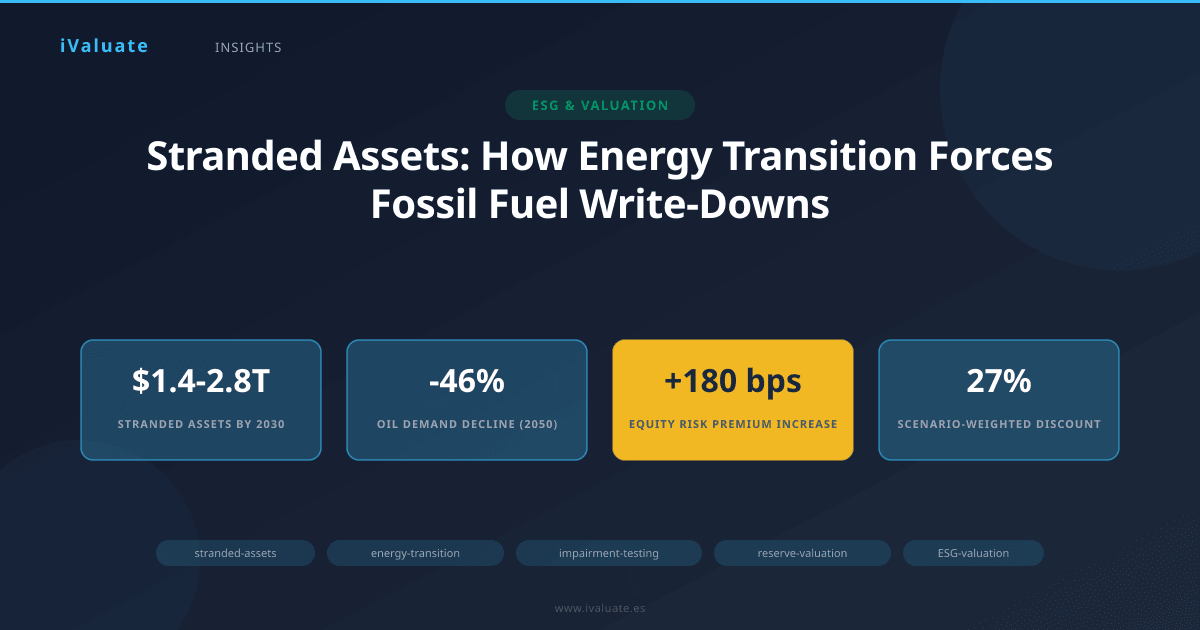
The Carbon Tracker Initiative estimates that between $1.4 trillion and $2.8 trillion in fossil fuel assets could become stranded by 2030 under various climate scenarios aligned with the Paris Agreement's 1.5°C target. This range reflects uncertainty around policy implementation, technological advancement rates, and demand trajectory shifts—all critical inputs for valuation models.
The transition from book value to fair value accounting for fossil fuel assets represents a fundamental repricing of energy sector balance sheets, with implications extending far beyond the oil and gas industry to banks, pension funds, and sovereign wealth funds with significant energy exposure.
02 The Mechanics of Reserve Value Erosion
Traditionally, oil and gas companies valued their reserves using standardized methodologies that assumed consistent demand growth and stable price environments. The SEC's reserve reporting framework, for instance, requires companies to calculate Proved Developed Producing (PDP) reserves based on 12-month average prices, while Proved Undeveloped (PUD) reserves must demonstrate economic viability within five years.
The energy transition fundamentally challenges these assumptions. Consider the valuation implications:
Demand Destruction and Price Pressure
Global oil demand, which reached 102.2 million barrels per day in 2023, is projected by the International Energy Agency to plateau by 2029 and decline thereafter under stated policy scenarios. More aggressive net-zero scenarios suggest demand could fall to 55 million barrels per day by 2050—a 46% reduction. This demand destruction directly impacts reserve valuations through multiple channels:
- Price compression: Oversupply conditions as demand weakens faster than production declines
- Cost curve implications: High-cost reserves (Canadian oil sands, Arctic offshore, ultra-deepwater) become economically marginal
- Shortened economic life: Reserves previously valued over 20-30 year horizons may only generate cash flows for 10-15 years
A major European integrated oil company reported in its 2025 annual filing that adopting a 2°C-aligned demand scenario reduced its proved reserves by 18% and required a $4.2 billion impairment charge. The company's reserve life index fell from 11.2 years to 9.3 years, materially impacting its enterprise value multiples.
Discount Rate Adjustments
The weighted average cost of capital (WACC) for fossil fuel assets is rising as investors demand higher returns to compensate for transition risk. Analysis of 47 publicly traded oil and gas companies shows equity risk premiums have expanded by an average of 180 basis points since 2020, while debt costs have increased by 120 basis points for companies without credible transition strategies.
This discount rate expansion compounds over time. A reserve asset valued at $100 million with a 10-year cash flow profile discounted at 8% yields a present value of $67.1 million. Increasing the discount rate to 11% to reflect transition risk reduces the present value to $58.5 million—a 13% haircut from discount rate adjustment alone, before considering any changes to cash flow projections.
03 Impairment Testing Under Accelerating Transition Scenarios
Financial reporting standards (IFRS, US GAAP) require companies to test long-lived assets for impairment when indicators suggest carrying values may not be recoverable. The energy transition has made such indicators ubiquitous across the fossil fuel sector, forcing companies to conduct impairment assessments with unprecedented frequency and rigor.
IAS 36 and ASC 360: Framework Application
Under IAS 36 (International Accounting Standards), an asset is impaired when its carrying amount exceeds its recoverable amount—the higher of fair value less costs of disposal and value in use. For fossil fuel assets, calculating value in use requires:
- Cash flow projections based on management's best estimates of future conditions
- Discount rates reflecting current market assessments of time value and asset-specific risks
- Assumptions about commodity prices, production volumes, operating costs, and regulatory requirements
The challenge lies in determining which climate scenario to adopt. Using a "business as usual" scenario may understate impairment risk, while adopting an aggressive 1.5°C scenario could trigger write-downs that prove premature if policy implementation lags. Leading practice now involves sensitivity analysis across multiple scenarios, with disclosure of the assumptions driving material differences.
Case Study: North American Coal Portfolio Impairment
A diversified mining company with significant thermal coal operations provides an instructive example. In Q3 2025, the company announced a $2.1 billion impairment charge across its coal portfolio, representing 34% of the segment's carrying value. The impairment reflected:
- Accelerated coal plant retirements in key export markets (India, Southeast Asia)
- Carbon border adjustment mechanisms reducing demand for high-emission coal
- Inability to secure long-term offtake agreements beyond 2032
- Rising rehabilitation and closure costs as regulatory requirements tightened
The company's valuation approach involved discounting remaining cash flows at 12.5% (up from 9.0% in the prior assessment) and truncating the economic life assumption from 2045 to 2035. Sensitivity analysis disclosed that each one-year reduction in assumed mine life resulted in approximately $180 million in additional impairment.
This impairment had cascading effects: the company's debt covenants came under pressure, its credit rating was downgraded one notch, and its equity valuation fell 23% in the week following the announcement. The case illustrates how stranded asset risk translates directly into shareholder value destruction.
04 Valuation Methodologies for Transition-Exposed Assets
Traditional valuation approaches require significant adaptation when applied to assets facing stranding risk. The following methodologies have emerged as best practice for energy transition contexts:
Scenario-Weighted DCF Analysis
Rather than relying on a single base case, leading valuation professionals now construct multiple scenarios with assigned probabilities:
- Delayed transition (20% probability): Policy implementation lags, demand remains robust through 2040
- Orderly transition (50% probability): Gradual policy tightening, demand peaks 2028-2030
- Accelerated transition (25% probability): Aggressive policy action, demand declines sharply post-2027
- Disorderly transition (5% probability): Abrupt policy shifts, stranded asset cascade
Each scenario generates distinct cash flow projections, which are then probability-weighted to derive an expected value. This approach explicitly quantifies tail risk and provides transparency around valuation sensitivity to transition pathways.
A 2025 analysis of 32 oil and gas assets using this methodology found that scenario-weighted valuations averaged 27% below single-scenario base case valuations, with the discount ranging from 12% for low-cost, short-cycle assets to 41% for high-cost, long-development-cycle projects.
Real Options Valuation
For assets with significant operational flexibility—the ability to accelerate production, defer investment, or switch uses—real options valuation captures value that DCF approaches may miss. In the energy transition context, key options include:
- Abandonment options: Value of exiting operations early if conditions deteriorate
- Expansion options: Value of accelerating production if near-term demand exceeds expectations
- Switching options: Value of converting assets to alternative uses (e.g., gas storage, carbon sequestration)
A North Sea oil field operator used real options analysis to value its portfolio in 2025, finding that operational flexibility added approximately 8% to base DCF values. However, this value was highly sensitive to volatility assumptions—higher uncertainty around transition timing increased option value, partially offsetting the negative impact of lower expected cash flows.
Comparable Transactions Analysis
M&A transaction data provides market-based evidence of how buyers are pricing transition risk. Analysis of 67 upstream oil and gas transactions completed between January 2024 and December 2025 reveals clear patterns:
- Transactions involving assets with reserve life under 8 years traded at an average of 3.2x EBITDA, versus 5.8x for longer-life assets
- High-cost assets (operating costs above $35/barrel) traded at discounts of 35-50% to comparable low-cost assets
- Assets in jurisdictions with aggressive climate policies traded at 15-20% discounts to similar assets in less regulated environments
- Transactions increasingly included contingent consideration tied to commodity prices, with caps limiting upside exposure
These transaction multiples provide valuable calibration points for valuations, though care must be taken to adjust for deal-specific factors such as buyer synergies, distressed seller situations, or strategic premiums.
05 Regulatory and Disclosure Implications
The stranded asset phenomenon has prompted significant regulatory attention, with implications for financial reporting, securities disclosure, and prudential supervision.
Climate-Related Financial Disclosures
The International Sustainability Standards Board (ISSB) issued its climate disclosure standards (IFRS S2) in 2023, with adoption accelerating through 2025-2026. These standards require companies to disclose:
- Climate-related risks and opportunities, including transition risks
- Scenario analysis showing resilience across different climate pathways
- Financial impacts of climate risks on financial position and performance
- Assumptions used in impairment testing and asset valuations
For fossil fuel companies, this means transparent disclosure of stranded asset risk has become mandatory in many jurisdictions. Companies must explain which climate scenarios they use for strategic planning versus financial reporting, and reconcile any differences.
The SEC's climate disclosure rules, finalized in modified form in 2024, require U.S. registrants to disclose material climate risks and their financial impacts. While less prescriptive than ISSB standards, the SEC rules have prompted increased scrutiny of fossil fuel companies' reserve valuations and impairment testing assumptions.
Banking Supervision and Capital Requirements
Financial regulators increasingly view stranded asset risk as a prudential concern. The European Central Banking Authority's 2025 climate stress test found that banks with significant exposure to fossil fuel assets could face capital shortfalls of €87 billion under a disorderly transition scenario, driven primarily by loan impairments as borrowers' assets lose value.
This has prompted banks to reassess their energy lending portfolios, with several major institutions announcing plans to reduce fossil fuel exposure by 25-40% by 2030. For energy companies, this translates to higher borrowing costs, stricter covenants, and reduced availability of project finance for long-life fossil fuel developments.
The repricing of stranded asset risk in credit markets is creating a feedback loop: higher capital costs accelerate the economic obsolescence of marginal assets, which in turn increases credit risk and further tightens lending conditions.
06 Portfolio Strategy and Capital Allocation
For energy companies and their investors, managing stranded asset risk requires fundamental rethinking of portfolio strategy and capital allocation frameworks.
High-Grading and Portfolio Rationalization
Leading companies are actively culling their portfolios, divesting high-cost, long-life assets while concentrating capital on short-cycle, low-cost resources. This "high-grading" strategy aims to maximize value extraction before demand deterioration accelerates.
A major international oil company announced in early 2026 that it would divest $15 billion in assets with breakeven costs above $40/barrel and reserve lives exceeding 15 years, while increasing investment in assets with sub-$30/barrel costs and sub-10-year reserve lives. The company's analysis showed this reallocation would reduce its portfolio's carbon intensity by 32% while improving free cash flow generation by 18%.
Optionality and Flexibility
Companies are increasingly valuing operational and strategic flexibility. This manifests in several ways:
- Modular development: Phasing projects to preserve abandonment options if conditions deteriorate
- Technology hedges: Investing in carbon capture, hydrogen, or renewable integration to preserve asset utility across scenarios
- Geographic diversification: Balancing exposure across regulatory regimes and demand centers
- Contract structures: Favoring shorter-term commitments and variable pricing over long-term fixed-price arrangements
Diversification and Transition Investment
The most aggressive response to stranded asset risk involves portfolio diversification into low-carbon energy. European integrated oil companies have led this shift, with several now allocating 25-35% of capital expenditure to renewable energy, hydrogen, and other transition technologies.
However, this strategy faces its own valuation challenges. Renewable energy assets typically trade at higher multiples (8-12x EBITDA) than oil and gas assets (4-6x EBITDA), making the transition capital-intensive. Moreover, many oil and gas companies lack competitive advantages in renewables, raising questions about whether diversification creates or destroys shareholder value.
07 Implications for M&A and Transaction Structuring
Stranded asset risk has fundamentally altered the M&A landscape in the energy sector, affecting deal structures, valuation negotiations, and risk allocation.
Valuation Gaps and Deal Complexity
Buyers and sellers often hold materially different views on transition timing and asset longevity, creating valuation gaps that can be difficult to bridge. A 2025 survey of energy M&A advisors found that 68% of transactions experienced valuation disagreements of 30% or more related to climate assumptions, up from 23% in 2020.
To bridge these gaps, deal structures have become more sophisticated:
- Earnouts and contingent consideration: Tying a portion of purchase price to future production or commodity prices
- Price collars and floors: Limiting downside exposure while capping upside participation
- Staged transactions: Initial acquisition of partial stakes with options to increase ownership based on performance
- Asset-backed financing: Structuring transactions to ring-fence risks and match financing terms to asset life
Representations, Warranties, and Indemnities
Transaction documentation increasingly addresses climate and transition risks explicitly. Key provisions include:
- Representations regarding climate-related liabilities, including decommissioning and rehabilitation obligations
- Warranties concerning reserve estimates and the assumptions underlying them
- Indemnities for environmental liabilities that may emerge as regulations tighten
- Specific carve-outs from general warranty packages for climate-related impairments
The negotiation of these provisions has become a critical value driver, with indemnity caps and survival periods often determining whether transactions proceed.
08 The Role of Technology and Data in Valuation
The complexity of valuing transition-exposed assets has driven demand for sophisticated analytical tools and data platforms. Modern valuation approaches require integration of:
- Climate scenario modeling and carbon price forecasting
- Asset-level technical and cost data across global portfolios
- Real-time commodity price and market intelligence
- Regulatory tracking across multiple jurisdictions
- Comparable transaction databases with transition risk adjustments
Professional valuation platforms have evolved to incorporate these requirements, enabling analysts to model multiple scenarios simultaneously, conduct sensitivity analysis across dozens of variables, and generate documentation that meets increasingly stringent disclosure requirements.
For CFOs and corporate development teams, having access to robust analytical infrastructure is no longer optional—it's essential for making informed capital allocation decisions, defending valuations to boards and investors, and maintaining credibility with rating agencies and lenders.
09 Looking Ahead: The Next Phase of Asset Revaluation
As we progress through 2026 and beyond, several trends will shape the ongoing revaluation of fossil fuel assets:
Acceleration of demand decline: Electric vehicle adoption, renewable energy deployment, and energy efficiency improvements are all tracking ahead of consensus forecasts from just two years ago. If this acceleration continues, even current impairment levels may prove insufficient.
Policy tightening: The EU's Carbon Border Adjustment Mechanism, now in full implementation, is being replicated in other jurisdictions. Carbon prices in compliance markets have reached $95-110/tonne in Europe and $75-85/tonne in California, well above levels assumed in many companies' valuation models.
Technology disruption: Breakthroughs in battery storage, green hydrogen, and direct air capture could accelerate the transition beyond current expectations, further compressing the economic life of fossil fuel assets.
Financial market repricing: As stranded asset losses materialize, investors are demanding higher returns and greater transparency. Companies that fail to adapt face rising capital costs and valuation multiples compression.
For valuation professionals, the imperative is clear: traditional methodologies must evolve to incorporate transition risk explicitly and rigorously. This requires not just technical skill but also judgment about which scenarios are plausible, how to weight them, and how to communicate uncertainty transparently.
The energy transition represents the largest revaluation of industrial assets since the shift from coal to oil in the early 20th century. Those who master the analytical frameworks and develop the judgment to navigate this transition will be well-positioned to advise clients through what promises to be a turbulent decade. Tools like iValuate are helping professionals perform these complex analyses efficiently, integrating scenario modeling, sensitivity analysis, and regulatory compliance into streamlined workflows that meet the demands of this challenging environment.
The question facing energy companies, their investors, and their advisors is not whether fossil fuel assets will be revalued, but how quickly and how extensively. Those who anticipate and adapt to this reality will preserve value; those who delay will see it destroyed. In this context, rigorous, transparent, and forward-looking valuation has never been more critical to strategic and financial decision-making.