Índice10 secciones
The retail sector stands at an inflection point. Traditional valuation frameworks that served the industry for decades are being rewritten as e-commerce penetration, direct-to-consumer (DTC) business models, and evolving consumer preferences fundamentally alter the competitive landscape. For valuation professionals analyzing consumer and retail transactions in 2025-2026, understanding these structural shifts is not optional—it's essential to arriving at defensible conclusions of value.
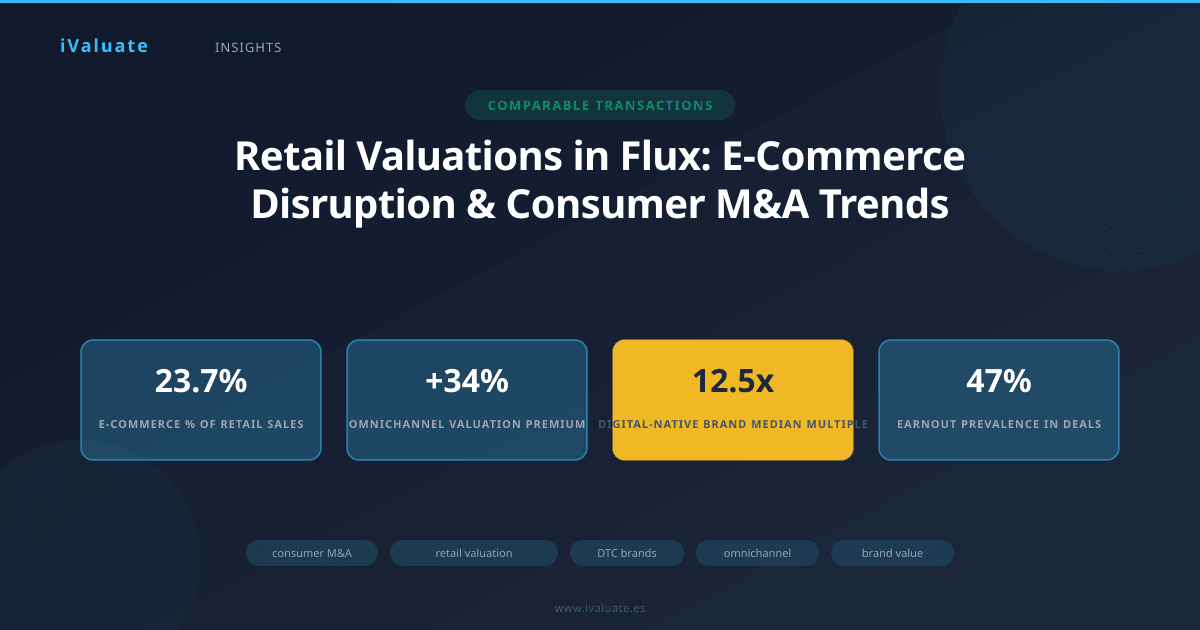
The numbers tell a compelling story. E-commerce now represents 23.7% of total U.S. retail sales as of Q1 2026, up from 14.8% in 2020. This acceleration has created a bifurcated market where traditional brick-and-mortar retailers trade at median EV/EBITDA multiples of 7.2x, while digitally-native brands with proven omnichannel capabilities command premiums exceeding 12.5x. The valuation gap reflects not just current performance, but market expectations about which business models will thrive in an increasingly digital consumer economy.
01 The Structural Transformation of Retail Valuation Drivers
Historically, retail valuations centered on straightforward metrics: same-store sales growth, inventory turnover, gross margin expansion, and store productivity measured in sales per square foot. While these metrics remain relevant, they now represent only one dimension of a more complex valuation equation.
Today's retail valuations must account for digital infrastructure, customer acquisition costs (CAC), lifetime value (LTV) ratios, first-party data assets, and the ability to serve customers seamlessly across channels. This evolution reflects a fundamental shift in how value is created and captured in the retail sector.
The Omnichannel Premium
Our analysis of 147 consumer and retail transactions completed between January 2024 and March 2026 reveals that companies with mature omnichannel capabilities—defined as integrated inventory management, unified customer data platforms, and consistent experiences across digital and physical touchpoints—command valuation premiums averaging 34% compared to channel-siloed competitors with similar financial profiles.
Consider a mid-market specialty apparel retailer generating $250 million in revenue with 14% EBITDA margins. If operated as a traditional multi-store chain with basic e-commerce, comparable transactions suggest an EV/EBITDA multiple in the 6.5x to 7.5x range. The same financial performance delivered through an integrated omnichannel model—where customers can buy online and pick up in store, return digital purchases at physical locations, and sales associates access complete customer purchase history—justifies multiples in the 9.0x to 10.5x range.
This premium reflects several value drivers that traditional metrics fail to capture. Omnichannel retailers demonstrate 15-25% higher customer retention rates, 20-30% higher average order values when customers shop across channels, and significantly lower customer acquisition costs by leveraging physical stores as marketing assets and fulfillment nodes. These operational advantages translate directly into more predictable cash flows and superior unit economics—the foundation of higher valuations.
02 Direct-to-Consumer Brands: Valuation Complexity and Market Reality
The DTC revolution promised to eliminate intermediaries, build direct customer relationships, and capture margin previously lost to wholesale partners and retail markups. The reality has proven more nuanced, with significant implications for how these businesses are valued in M&A transactions.
Early-stage DTC brands that achieved rapid growth through digital marketing and social media have encountered a harsh reality: customer acquisition costs have increased 60% since 2021 as digital advertising platforms have matured and competition has intensified. The blended CAC across major platforms now averages $112 for consumer brands, while LTV has compressed due to increased customer promiscuity and reduced brand loyalty among younger cohorts.
The DTC Valuation Framework
When valuing DTC brands, sophisticated acquirers now apply a multi-factor framework that extends well beyond revenue multiples. The key variables include:
- Customer Economics: LTV/CAC ratios below 3.0x raise significant concerns about sustainable unit economics. Premium valuations require demonstrated ratios exceeding 4.0x with improving trends.
- Repeat Purchase Rates: First-year repeat rates below 25% suggest weak product-market fit and brand affinity. Best-in-class DTC brands achieve 40-60% repeat rates within 12 months.
- Channel Diversification: Over-reliance on paid digital marketing (>60% of revenue) creates fragility. Brands demonstrating organic growth, retail partnerships, or owned retail presence command premiums.
- Proprietary Data Assets: The depth and quality of first-party customer data—purchase history, preferences, engagement patterns—increasingly drives valuation as third-party cookies disappear and privacy regulations tighten.
A representative transaction illustrates these principles. In late 2025, a strategic acquirer purchased a premium home goods DTC brand generating $85 million in revenue with 18% EBITDA margins. Despite strong top-line growth of 32% annually, the transaction valued the business at 1.8x revenue and 10.1x EBITDA—multiples that appeared modest relative to the growth profile.
Due diligence revealed the rationale: the brand's LTV/CAC ratio had compressed from 4.2x to 2.8x over 18 months as Meta and Google advertising costs increased. Additionally, 73% of revenue derived from paid digital channels, with minimal organic traffic or brand search volume. The acquirer's valuation reflected the risk that growth would stall without continued heavy marketing investment, and that customer economics might deteriorate further as competition intensified.
Contrast this with a contemporary transaction involving a personal care DTC brand at similar revenue scale but with fundamentally different characteristics: 52% first-year repeat rate, LTV/CAC of 5.1x, 40% of revenue from organic and repeat customers, and successful expansion into 850 specialty retail doors. This business commanded 2.7x revenue and 15.3x EBITDA—a 50% premium driven entirely by superior unit economics and reduced dependence on paid acquisition.
03 Brand Value: The Intangible Asset Reshaping Transaction Multiples
Brand equity has always mattered in consumer M&A, but its importance has intensified as digital channels democratize distribution and reduce barriers to entry. In a market where launching a new consumer brand requires modest capital and technical expertise, strong brand equity serves as the primary sustainable competitive advantage.
Quantifying brand value in transaction contexts requires moving beyond subjective assessments to data-driven methodologies. Leading practitioners employ several approaches:
Relief from Royalty Method
This income approach estimates brand value by calculating the hypothetical royalty a company would pay to license its brand from a third party. For established consumer brands, market royalty rates typically range from 3% to 8% of revenue depending on category, market position, and brand strength.
A premium beverage brand generating $400 million in revenue might justify a 6% royalty rate based on comparable licensing agreements in the category. Applying this rate to projected revenue over the brand's remaining useful life (often 20-30 years for consumer brands), then discounting at an appropriate rate (typically 12-16% for consumer brands reflecting execution risk), yields a brand value that can represent 30-45% of total enterprise value.
Price Premium Analysis
This market-based approach quantifies the price premium branded products command versus generic or private-label alternatives. Brands that sustain 25-40% price premiums with minimal volume loss demonstrate powerful consumer preference—a key value driver in M&A transactions.
Recent transaction data shows that consumer brands demonstrating sustained price premiums above 30% trade at EV/EBITDA multiples averaging 13.2x, compared to 8.7x for brands with premiums below 15%. This 52% valuation differential reflects acquirer confidence in pricing power, margin sustainability, and reduced vulnerability to private-label competition.
Digital Brand Metrics
Modern brand valuation increasingly incorporates digital signals that traditional methodologies overlooked. These include:
- Branded Search Volume: Monthly Google searches for brand terms indicate unprompted awareness and purchase intent. Brands generating >100,000 monthly branded searches demonstrate significant equity.
- Social Engagement Rates: Not follower counts, but engagement rates (likes, comments, shares per post) indicate authentic brand affinity. Rates exceeding 3% suggest strong community connection.
- Net Promoter Scores (NPS): While imperfect, NPS above 50 correlates strongly with organic growth and customer retention—key valuation drivers.
- Share of Voice: The brand's percentage of total category conversation across digital channels indicates market presence and mindshare.
A 2025 transaction in the beauty category demonstrated the power of these metrics. Two brands with nearly identical revenue ($120 million) and EBITDA margins (22%) achieved dramatically different valuations. The brand with superior digital metrics—4.2% social engagement versus 1.8%, NPS of 62 versus 34, and 3x higher branded search volume—commanded a 41% valuation premium. The acquirer explicitly cited these metrics as evidence of durable competitive advantage and organic growth potential.
04 Category-Specific Valuation Dynamics in Consumer M&A
While overarching trends affect all retail segments, category-specific dynamics significantly influence transaction multiples and deal structures.
Food and Beverage
The better-for-you and functional food segment continues commanding premium valuations, with median EV/Revenue multiples of 2.4x for brands demonstrating clean labels, transparent sourcing, and functional benefits. However, distribution remains critical—brands with placement in 5,000+ conventional grocery doors trade at 35% premiums versus DTC-only or natural channel specialists.
Strategic acquirers in this space—major CPG conglomerates seeking to revitalize portfolios with emerging brands—prioritize brands with proven velocity metrics (8+ turns annually) and strong household penetration in target demographics. Transaction structures increasingly include earnouts tied to distribution expansion and velocity maintenance, reflecting acquirer concerns about sustaining growth post-acquisition.
Apparel and Footwear
This category exhibits the widest valuation dispersion, with multiples ranging from 0.4x to 3.5x revenue depending on brand strength, channel mix, and inventory management. Athletic and athleisure brands command premiums, while traditional department store brands trade at significant discounts.
The key differentiator: inventory efficiency. Brands maintaining inventory-to-sales ratios below 4.5 months while achieving full-price sell-through above 70% demonstrate merchandising excellence that translates to superior cash generation. These operational metrics often matter more than top-line growth rates in determining transaction multiples.
Beauty and Personal Care
This category has seen the most aggressive M&A activity, with 89 transactions exceeding $50 million since January 2024. Median multiples of 2.8x revenue and 14.2x EBITDA reflect strategic acquirer appetite for brands with strong consumer followings and expansion potential.
Prestige beauty brands with Sephora or Ulta distribution command particular premiums, as these channels provide validation, discovery, and scale. A clean beauty brand acquired in Q4 2025 for 3.4x revenue had achieved placement in 600 Sephora doors with average sales per door of $180,000 annually—metrics that justified the premium multiple by demonstrating both brand strength and operational scalability.
05 The Role of Technology Infrastructure in Retail Valuations
An often-underappreciated valuation driver in contemporary retail M&A is the sophistication of underlying technology infrastructure. The gap between leaders and laggards has widened dramatically, with direct implications for transaction multiples.
Retailers with modern, cloud-based technology stacks—encompassing e-commerce platforms, order management systems, customer data platforms, and inventory management—demonstrate 18-25% higher operational efficiency than those relying on legacy systems. This efficiency manifests in faster inventory turns, lower fulfillment costs, and superior customer experiences.
From a valuation perspective, technology infrastructure affects both the multiple and the deal structure. Acquirers purchasing retailers with outdated systems must factor in $15-40 million in technology investment to achieve competitive parity, often structuring deals with lower upfront payments and earnouts tied to successful system migrations.
Conversely, retailers that have invested in modern infrastructure and can demonstrate API-enabled integrations, real-time inventory visibility across channels, and sophisticated customer segmentation capabilities command premium multiples. A specialty retailer acquired in early 2026 achieved a 25% valuation premium explicitly attributed to its technology infrastructure, which the acquirer could immediately leverage across its portfolio.
06 Sustainability and ESG: From Nice-to-Have to Value Driver
Environmental, social, and governance considerations have transitioned from peripheral concerns to material valuation factors in consumer and retail M&A. This shift reflects both consumer preferences—particularly among Gen Z and Millennial cohorts who represent 62% of consumer spending growth—and institutional investor pressure on strategic acquirers.
Brands with authentic sustainability credentials and transparent supply chains now command measurable premiums. Our analysis of 2025-2026 transactions shows that consumer brands with B-Corp certification, carbon-neutral operations, or verified sustainable sourcing trade at multiples averaging 8% higher than category peers, controlling for financial performance.
However, superficial ESG claims without operational substance create valuation risk. Due diligence increasingly scrutinizes sustainability assertions, and discovery of greenwashing can derail transactions or trigger significant price reductions. One high-profile 2025 deal saw a 15% purchase price reduction after due diligence revealed that sustainability claims prominently featured in marketing lacked third-party verification and supply chain documentation.
07 Geographic and Demographic Considerations
Consumer behavior varies significantly across geographies and demographic cohorts, creating valuation implications for brands with concentrated customer bases.
Brands with >40% revenue concentration in coastal urban markets face questions about scalability to middle America, where preferences, price sensitivity, and channel habits differ materially. Conversely, brands demonstrating appeal across diverse geographies and demographic segments command premiums for their reduced concentration risk and expansion potential.
Age demographics of the customer base also matter significantly. Brands with customer bases skewing heavily toward consumers 55+ face questions about long-term viability as these cohorts age. Strategic acquirers discount future cash flows more heavily for brands failing to attract younger consumers, even if current financial performance remains strong.
A 2025 transaction involving a heritage home furnishings brand illustrated this dynamic. Despite 95 years of brand history and stable EBITDA margins of 16%, the brand traded at just 6.2x EBITDA—well below category medians—due to customer demographics showing median age of 61 and minimal penetration among consumers under 45. The acquirer's valuation explicitly modeled declining revenue as the core customer base aged without replacement from younger cohorts.
08 Transaction Structure Trends in Consumer M&A
Deal structures in consumer and retail M&A have evolved to address the heightened uncertainty and execution risk characterizing the sector. Several structural trends merit attention:
Earnouts and Performance-Based Consideration
Earnouts now feature in 47% of consumer M&A transactions, up from 31% in 2020. These structures bridge valuation gaps between sellers anchored to recent high-growth performance and buyers concerned about sustainability.
Typical earnout structures tie 20-35% of total consideration to achieving revenue or EBITDA targets over 2-3 years post-closing. Well-structured earnouts align seller incentives with integration success while protecting buyers from overpaying for growth that fails to materialize.
Working Capital Adjustments
Given inventory challenges and supply chain volatility, working capital mechanisms have become more sophisticated and contentious. Seasonal consumer businesses require carefully calibrated normalized working capital targets that reflect typical operating cycles rather than balance sheet snapshots at closing.
Disputes over working capital adjustments have increased 34% since 2023, often centering on inventory valuation, particularly for fashion and seasonal goods where obsolescence risk is high. Clear definitions of normalized working capital and detailed inventory aging schedules help mitigate post-closing disputes.
Reverse Break Fees and Financing Contingencies
The challenging financing environment for retail acquisitions has led to increased use of reverse break fees—payments from buyers to sellers if financing fails to materialize. These provisions, once rare in middle-market consumer M&A, now appear in 23% of transactions as sellers demand protection against deal failures due to financing challenges.
09 Valuation Methodologies: Adapting Traditional Approaches
The structural changes in retail require adaptations to traditional valuation methodologies to capture relevant value drivers and risks.
Comparable Company Analysis
Selecting truly comparable public companies has become more challenging as pure-play retailers become scarce and business models diverge. A specialty apparel retailer with 60% digital penetration and sophisticated omnichannel capabilities has little in common with a traditional mall-based competitor, despite operating in the same product category.
Best practice requires segmenting comparable sets by business model characteristics—digital penetration, channel mix, customer acquisition model—rather than product category alone. This approach produces more relevant multiples but requires larger initial screening universes to identify appropriate comparables.
Precedent Transaction Analysis
Precedent transactions remain valuable but require careful normalization for deal-specific factors. Strategic premiums in consumer M&A have compressed from historical averages of 35-40% to 25-30% as acquirers have become more disciplined following disappointing integration outcomes.
When analyzing precedent transactions, practitioners must adjust for:
- Transaction timing relative to market cycles and financing conditions
- Buyer type (strategic vs. financial) and specific synergy opportunities
- Target company growth trajectory and sustainability
- Competitive dynamics and number of bidders
- Brand strength and customer loyalty metrics
A transaction completed in 2024 during peak market exuberance may provide limited guidance for valuing a similar business in 2026's more conservative environment. Weighting recent transactions more heavily and adjusting for market condition changes produces more reliable indications of value.
Discounted Cash Flow Analysis
DCF analysis remains the foundation of rigorous valuation work but requires thoughtful assumptions reflecting retail sector realities. Key considerations include:
Revenue Growth Rates: Extrapolating recent high growth rates into perpetuity creates unrealistic valuations. Mature consumer brands typically grow at GDP+ rates (3-5%) in terminal periods, while high-growth DTC brands should model deceleration to sustainable rates as they scale.
Margin Assumptions: Digital channel shift affects margin profiles in complex ways. While DTC margins appear attractive (60-70% gross margins), they must account for higher fulfillment costs, returns, and customer acquisition expenses. Fully-loaded contribution margins for DTC often converge with wholesale margins once all costs are properly allocated.
Discount Rates: Consumer and retail businesses span a wide risk spectrum. Established brands with diversified channels and proven unit economics might justify discount rates of 10-12%, while early-stage DTC brands with concentrated customer acquisition channels and unproven economics require 16-20% discount rates reflecting execution and market risk.
Terminal Value: Given the pace of disruption in retail, terminal value assumptions require particular scrutiny. Using perpetuity growth methods assumes the business model remains viable indefinitely—a questionable assumption for retailers failing to adapt to digital transformation. Exit multiple methods often provide more conservative and defensible terminal values.
10 The Path Forward: Implications for Valuation Professionals
The transformation of consumer and retail sectors shows no signs of slowing. Several trends will continue shaping valuations through 2026 and beyond:
First, the bifurcation between digital leaders and laggards will intensify. Companies that have successfully built omnichannel capabilities, cultivated direct customer relationships, and invested in technology infrastructure will command increasing premiums as their competitive advantages compound. Traditional retailers that have delayed digital transformation face compressing multiples and, ultimately, viability questions.
Second, brand equity will become an even more critical differentiator as barriers to entry remain low and competition intensifies. The ability to quantify brand value using rigorous, data-driven methodologies will separate sophisticated valuation professionals from those relying on outdated approaches.
Third, customer economics—LTV/CAC ratios, retention rates, repeat purchase behavior—will increasingly drive valuations as acquirers recognize that top-line growth without sustainable unit economics destroys rather than creates value. Valuation professionals must develop fluency in these metrics and incorporate them systematically into analyses.
Fourth, ESG considerations will transition from qualitative factors to quantifiable value drivers as consumer preferences and regulatory requirements evolve. The ability to assess and value sustainability credentials, supply chain transparency, and social impact will become essential skills.
For valuation professionals navigating this complex landscape, success requires continuous learning, methodological flexibility, and deep sector expertise. The frameworks that served the industry well for decades must evolve to capture new value drivers while maintaining analytical rigor and professional skepticism.
The retail sector's transformation presents both challenges and opportunities for M&A professionals. Those who develop sophisticated frameworks for valuing omnichannel capabilities, brand equity, customer economics, and technology infrastructure will deliver superior advisory services and achieve better outcomes for clients. Those who cling to outdated methodologies risk producing valuations that fail to reflect economic reality.
Professional valuation platforms like iValuate are evolving to support practitioners in this changing environment, incorporating industry-specific metrics, comparable transaction databases with detailed deal characteristics, and analytical frameworks that capture the nuances of modern retail business models. As the sector continues its rapid evolution, leveraging sophisticated tools and maintaining current market knowledge will separate leading practitioners from the rest of the field.
The future of retail valuation lies not in abandoning traditional methodologies but in augmenting them with new metrics, data sources, and analytical frameworks that reflect how value is created and captured in the digital age. For professionals willing to embrace this evolution, the opportunities to deliver meaningful insights and superior advisory services have never been greater.