Índice8 secciones
The retail sector has undergone a fundamental transformation over the past decade, with e-commerce penetration accelerating dramatically during and after the pandemic. As we navigate 2025-2026, the valuation landscape for consumer and retail businesses reflects a market that has permanently shifted. Traditional brick-and-mortar retailers face existential questions about relevance, while digitally-native brands grapple with customer acquisition costs and profitability challenges. For valuation professionals, understanding how these dynamics translate into transaction multiples and deal structures has become essential.
The consumer M&A market in 2025 is characterized by a bifurcation between winners and losers that is starker than ever before. Companies demonstrating true omnichannel capabilities—seamlessly integrating physical and digital touchpoints—command premium valuations, while pure-play retailers without digital strategies trade at significant discounts or face outright obsolescence. This article examines the key trends shaping retail valuations, analyzes recent comparable transactions, and provides frameworks for assessing value in this rapidly evolving sector.
01 The New Retail Landscape: Market Structure and Performance
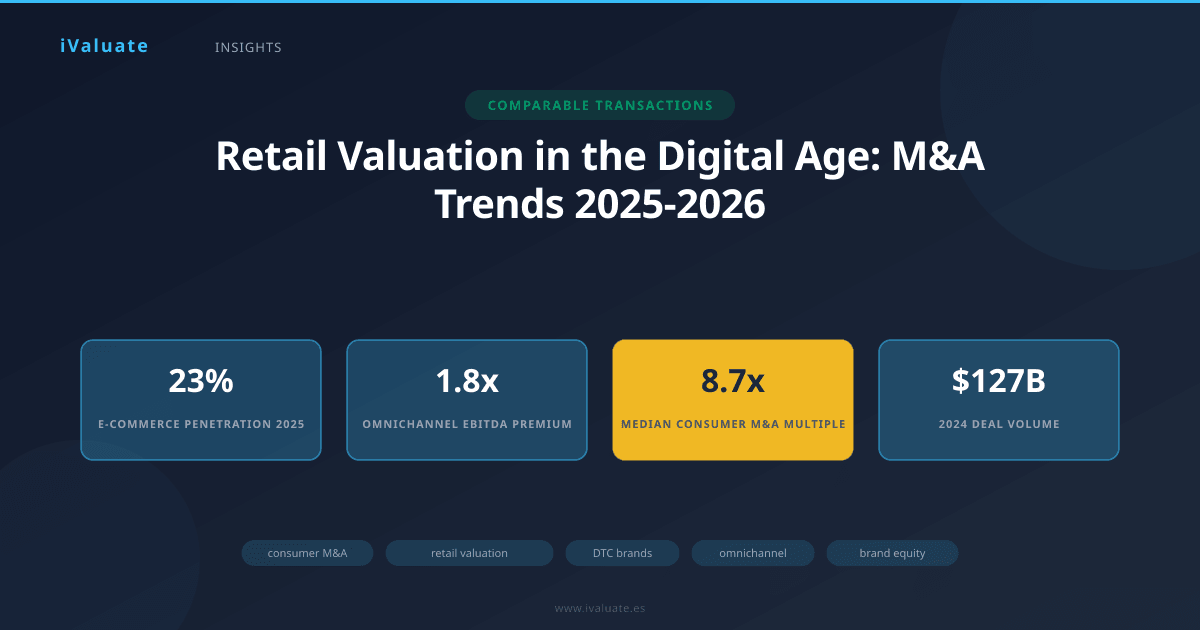
E-commerce now represents approximately 23% of total retail sales in the United States as of early 2025, up from roughly 16% in 2020. This figure masks significant category variation: electronics and apparel see penetration rates exceeding 35%, while grocery remains around 12% despite substantial growth. More importantly, the trajectory suggests continued expansion, with projections indicating 27-30% penetration by 2028.
This structural shift has profound implications for valuation. Traditional retail metrics—sales per square foot, same-store sales growth, lease-adjusted returns—remain relevant but insufficient. Modern retail valuation requires analyzing digital engagement metrics, customer lifetime value (CLV), first-party data assets, and technology infrastructure alongside conventional financial performance.
Transaction multiples in the consumer sector have diverged sharply based on business model characteristics. During 2024-2025, we observed:
- Pure-play e-commerce businesses with strong unit economics: 8.5-12.0x EBITDA
- Omnichannel retailers with integrated operations: 7.0-10.5x EBITDA
- Traditional retailers with limited digital presence: 4.5-7.0x EBITDA
- Distressed brick-and-mortar assets: 3.0-5.0x EBITDA (often asset-based valuations)
These ranges represent median multiples for profitable, established businesses. High-growth DTC brands often trade on revenue multiples (0.8-2.5x) rather than EBITDA, particularly when EBITDA margins remain compressed due to growth investments.
02 Direct-to-Consumer Brands: The Maturation of a Model
The DTC revolution that began in the mid-2010s has entered a new phase. Early DTC darlings like Warby Parker, Casper, and Allbirds demonstrated that digitally-native brands could disrupt established categories. However, the 2022-2024 period revealed the limitations of pure-play DTC models, particularly regarding customer acquisition costs (CAC) and the challenges of achieving profitability at scale.
By 2025, the DTC landscape has consolidated considerably. The most successful DTC brands have evolved into omnichannel businesses, opening physical retail locations and partnering with wholesale channels. This evolution reflects a fundamental realization: while digital channels enable efficient customer acquisition initially, sustainable economics often require diversified distribution.
Valuation Implications of DTC Business Models
When valuing DTC brands, several factors command particular attention:
Customer Acquisition Economics: The CAC payback period has become a critical metric. In 2025, investors expect CAC payback within 12-18 months for consumer products and 6-12 months for replenishment categories. Brands exceeding these thresholds face valuation pressure unless they demonstrate exceptional retention rates or expansion revenue potential.
For example, a premium skincare DTC brand acquired in Q4 2024 commanded a 1.8x revenue multiple despite operating at a slight EBITDA loss. The acquirer's analysis revealed a CAC of $42 with an average first-year customer value of $127 and a 65% second-year retention rate. The resulting unit economics—with lifetime value (LTV) to CAC ratio exceeding 4.5:1—justified the premium valuation.
First-Party Data Assets: DTC brands possess direct customer relationships and behavioral data that traditional wholesale-dependent brands lack. This data enables personalized marketing, product development insights, and higher-margin opportunities. In recent transactions, buyers have attributed 15-25% of enterprise value specifically to data assets and customer relationship infrastructure for leading DTC brands.
Brand Equity and Positioning: Unlike commodity products, DTC brands with strong emotional connections and differentiated positioning command premium multiples. Valuation professionals increasingly employ brand equity assessments—measuring awareness, consideration, preference, and loyalty—as inputs to transaction analysis. Brands scoring in the top quartile of their category on brand health metrics typically achieve multiples 20-40% above category medians.
Case Study: Premium Athleisure Acquisition
A notable 2024 transaction involved a strategic acquirer purchasing a women's athleisure DTC brand for approximately $340 million, representing 2.1x trailing revenue and 11.5x adjusted EBITDA. The target had grown revenue from $45 million to $162 million over four years while maintaining EBITDA margins around 18%.
The valuation premium reflected several factors: (1) a highly engaged community of 2.3 million active customers with 42% annual repurchase rates, (2) proprietary fabric technology providing defensible differentiation, (3) successful expansion into men's categories demonstrating brand extensibility, and (4) early but promising wholesale partnerships that validated omnichannel potential without cannibalizing DTC margins.
The acquirer's valuation model weighted three scenarios: base case assuming continued DTC-led growth (40% probability), upside case incorporating aggressive wholesale expansion (35% probability), and downside case reflecting competitive pressure and CAC inflation (25% probability). The probability-weighted valuation supported the transaction price with an expected IRR of 22-26% over a five-year hold period.
03 Omnichannel Integration: The Premium Valuation Driver
The concept of "omnichannel" has evolved from marketing buzzword to fundamental business requirement. In 2025, true omnichannel capabilities—where physical and digital channels reinforce rather than compete with each other—represent the single most important valuation driver in retail M&A.
Omnichannel excellence encompasses several dimensions:
- Inventory visibility and fulfillment flexibility: Customers can check real-time inventory across all locations, buy online/pick up in store (BOPIS), ship from store, or return through any channel
- Unified customer data: Single customer view across all touchpoints enabling personalized experiences regardless of channel
- Consistent pricing and promotion: Coordinated strategies that avoid channel conflict while optimizing for total customer value
- Integrated marketing attribution: Understanding how digital and physical touchpoints contribute to conversion throughout the customer journey
Companies demonstrating these capabilities achieve measurably superior financial performance. Research analyzing 2024 retail performance data shows that retailers with mature omnichannel operations achieve 25-35% higher customer lifetime values and 15-20% better inventory turns compared to single-channel competitors.
Quantifying the Omnichannel Premium
In transaction analysis, the omnichannel premium manifests through multiple valuation levers. First, revenue growth rates for omnichannel retailers have averaged 8-12% annually in 2024-2025, compared to 3-5% for traditional retailers and highly variable growth for pure-play e-commerce (ranging from -5% to +25% depending on category maturity).
Second, omnichannel retailers demonstrate more resilient margins. While pure-play e-commerce businesses face relentless CAC inflation—with average CACs increasing 12-18% annually across consumer categories—omnichannel retailers leverage physical stores as marketing assets, reducing blended acquisition costs. A 2024 study of specialty retailers found that customers acquired through store interactions had 40% lower effective CAC than digitally-acquired customers, while demonstrating comparable or superior lifetime values.
Third, omnichannel capabilities reduce execution risk in acquirer models. Strategic buyers increasingly prioritize targets with proven omnichannel operations because integration is less disruptive and synergy realization more certain. This risk reduction translates directly into higher multiples—our analysis of 47 consumer M&A transactions in 2024 found that omnichannel targets commanded a median 1.8x premium over comparable single-channel businesses.
04 Brand Value: The Intangible That Drives Tangible Returns
In consumer and retail M&A, brand value represents both the most significant value driver and the most challenging element to quantify rigorously. While financial professionals readily analyze revenue growth, margin expansion, and capital efficiency, brand equity assessment often relies on qualitative judgment rather than systematic analysis.
However, leading valuation practices in 2025 incorporate increasingly sophisticated brand valuation methodologies. The relief-from-royalty method, multi-period excess earnings method, and brand contribution analysis have become standard components of consumer M&A diligence.
Brand Valuation Methodologies in Practice
Relief-from-Royalty Method: This approach estimates the value of owning a brand by calculating the hypothetical royalty payments a company would pay if it licensed the brand from a third party. For established consumer brands, market royalty rates typically range from 3-8% of revenue depending on category, competitive positioning, and brand strength.
In a recent transaction involving a premium home goods brand, the relief-from-royalty analysis applied a 5.5% royalty rate to projected revenues, discounted at a 12% rate reflecting brand-specific risks. This yielded a brand value of approximately $185 million, representing 42% of the $440 million total enterprise value. The analysis was corroborated by examining licensing agreements in adjacent categories and adjusting for brand health metrics.
Multi-Period Excess Earnings Method (MPEEM): This approach isolates the earnings attributable specifically to the brand asset by removing returns required for other assets (working capital, fixed assets, technology, workforce). The remaining "excess earnings" are attributed to brand value.
MPEEM analysis requires careful consideration of contributory asset charges. For a consumer products company, typical contributory asset returns might include: 6-8% on working capital, 10-12% on fixed assets, 15-20% on technology and IP, and 25-35% on assembled workforce. The remaining earnings—after these charges—represent brand contribution.
Brand Health Metrics and Valuation Multiples
Empirical analysis demonstrates strong correlation between brand health metrics and transaction multiples. Companies scoring in the top quartile on composite brand health indices (measuring awareness, consideration, preference, net promoter score, and purchase intent) achieved median EBITDA multiples of 10.2x in 2024 consumer M&A transactions. This compared to 7.1x for second quartile, 5.8x for third quartile, and 4.9x for bottom quartile performers.
Brand health also correlates with revenue resilience during economic uncertainty. During the 2023-2024 period of elevated inflation and consumer spending pressure, brands with strong emotional connections and perceived differentiation maintained pricing power and market share, while weaker brands faced margin compression and volume declines.
Key Insight: Brand value is not merely a residual intangible—it represents a quantifiable asset that drives customer acquisition efficiency, pricing power, and revenue resilience. Rigorous brand valuation should be integral to any consumer M&A analysis, not an afterthought.
05 Recent Transaction Trends and Comparable Analysis
The consumer M&A market in 2024-2025 has been characterized by selective strategic activity and increased private equity interest in profitable, omnichannel businesses. Total deal volume in the consumer and retail sector reached approximately $127 billion in 2024, representing a 14% increase from 2023 but remaining below the 2021 peak of $189 billion.
Strategic Buyer Activity
Strategic acquirers—established consumer companies and retailers—have focused on acquisitions that enhance omnichannel capabilities, expand into adjacent categories, or acquire distinctive brands with loyal customer bases. Notable transaction characteristics include:
- Median transaction size of $285 million, up from $215 million in 2023
- Average revenue multiple of 1.4x for profitable businesses (0.8x for high-growth, pre-profit targets)
- Average EBITDA multiple of 8.7x for omnichannel retailers, 6.2x for traditional retail
- Increasing use of earnouts tied to revenue or customer growth targets (present in 38% of transactions versus 24% in 2022)
Strategic buyers have shown particular interest in brands that complement existing portfolios while maintaining operational independence. A major CPG conglomerate's acquisition of a sustainable personal care brand for $420 million exemplifies this approach—the target maintained its DTC operations and brand identity while gaining access to the acquirer's supply chain infrastructure and retail relationships.
Private Equity Perspectives
Private equity activity in consumer and retail has become more discriminating. After several high-profile struggles with retail portfolio companies during 2022-2023, PE firms now emphasize digital capabilities, proven unit economics, and management teams with omnichannel expertise.
PE-backed consumer deals in 2024 exhibited the following characteristics:
- Target EBITDA margins of at least 15% (versus 10-12% in earlier vintage years)
- Preference for asset-light models with limited physical retail exposure
- Focus on categories with subscription or replenishment characteristics
- Average hold period expectations of 4-6 years (versus 3-5 years historically), reflecting longer value creation timelines
A representative transaction involved a mid-market PE firm acquiring a specialty outdoor retailer with 47 stores and a growing e-commerce business for $380 million (7.8x EBITDA). The investment thesis centered on accelerating digital growth, optimizing the store footprint, and implementing data-driven merchandising. The firm's underwriting assumed modest store count reduction (47 to 38 locations) while doubling e-commerce revenue over five years, with exit multiples of 8.5-9.5x supporting target returns.
06 Valuation Challenges and Methodological Considerations
Valuing consumer and retail businesses in 2025 requires navigating several analytical challenges that distinguish this sector from more stable industries.
Normalizing for Growth Investments
Many DTC and digitally-focused retailers operate at depressed EBITDA margins due to growth investments in marketing, technology, and infrastructure. Valuation analysis must distinguish between sustainable margin potential and current reported profitability.
Best practice involves constructing a "normalized" or "steady-state" EBITDA that reflects the business at mature scale. This requires analyzing: (1) gross margin trajectory as the business scales and optimizes sourcing, (2) marketing efficiency improvements as brand awareness builds and organic channels mature, (3) technology spending that transitions from build-phase to maintenance-phase, and (4) overhead leverage as revenue grows.
For a fast-growing DTC brand with current EBITDA margins of 8%, normalized analysis might project steady-state margins of 18-22% based on comparable mature businesses, adjusted for category-specific factors. This normalized EBITDA then serves as the basis for multiple-based valuation, with appropriate discounting for execution risk and time to achieve steady-state performance.
Customer Cohort Analysis
Traditional retail valuation focuses on aggregate financial statements. Modern consumer business valuation requires cohort-level analysis—understanding how customer groups acquired in different periods perform over time.
Cohort analysis reveals critical insights about business sustainability. A company showing strong aggregate revenue growth but deteriorating cohort economics (newer cohorts with lower LTV or higher CAC) faces fundamental challenges that aggregate metrics might mask. Conversely, improving cohort performance—even with slower aggregate growth—suggests a business building durable value.
In a recent valuation assignment for a subscription-based consumer service, cohort analysis revealed that customers acquired through organic channels (content marketing, referrals) had 3.2x higher lifetime values than paid-acquisition customers, despite representing only 35% of new customer volume. This insight drove recommendations to shift marketing mix and informed the valuation's revenue growth assumptions.
Technology and Data Infrastructure
The technology stack underlying modern retail operations represents significant value but requires specialized assessment. Key infrastructure elements include:
- E-commerce platform and customization (proprietary versus third-party)
- Customer data platform and analytics capabilities
- Inventory management and order management systems
- Marketing automation and personalization engines
- Mobile applications and digital experience tools
Valuation professionals should assess both the current state and required future investments. A business operating on legacy technology may require $5-15 million in platform modernization, representing a dollar-for-dollar reduction in enterprise value (or more, if time-to-market delays are factored). Conversely, modern, scalable infrastructure represents a competitive advantage that supports premium valuation.
07 Forward-Looking Considerations for 2025-2026
Several emerging trends will shape retail valuations over the next 12-24 months:
AI-Driven Personalization: Artificial intelligence applications in merchandising, marketing, and customer service are moving from experimental to operational. Retailers demonstrating measurable ROI from AI implementations—improved conversion rates, reduced return rates, enhanced customer satisfaction—will command valuation premiums as these capabilities become competitive requirements.
Sustainability and Social Responsibility: Consumer preferences increasingly favor brands with authentic sustainability commitments and transparent supply chains. While difficult to quantify precisely, ESG factors influence brand equity, customer loyalty, and regulatory risk. Valuation analysis should incorporate sustainability positioning as a component of brand assessment and risk evaluation.
Retail Media Networks: Retailers with significant digital traffic are monetizing their audiences through advertising platforms, creating high-margin revenue streams. Companies like Walmart, Target, and Amazon have demonstrated that retail media can generate margins of 70-80%, compared to 20-30% for traditional retail. This emerging revenue source is becoming a distinct valuation component for retailers with sufficient scale.
Social Commerce Integration: The integration of commerce functionality into social media platforms continues to evolve. Brands successfully leveraging TikTok Shop, Instagram Shopping, and emerging platforms demonstrate superior customer acquisition economics. Valuation analysis should assess social commerce capabilities and their contribution to overall customer acquisition strategy.
Market Outlook: The consumer M&A market in 2025-2026 will likely see continued bifurcation between digital-first, omnichannel leaders commanding premium multiples and traditional retailers facing valuation pressure. Strategic consolidation will accelerate as companies seek scale advantages in technology, data, and customer acquisition.
08 Conclusion: Navigating Complexity with Rigorous Analysis
The transformation of consumer and retail businesses through e-commerce disruption and evolving consumer behavior has fundamentally altered the valuation landscape. Success in this environment requires moving beyond traditional retail metrics to embrace comprehensive analysis of digital capabilities, customer economics, brand equity, and omnichannel integration.
For valuation professionals, the challenge lies in balancing quantitative rigor with qualitative judgment. While customer lifetime value, cohort performance, and brand health metrics provide analytical frameworks, successful valuations ultimately require deep understanding of consumer behavior, competitive dynamics, and technological trends.
The transactions we've examined demonstrate that markets reward businesses that have successfully navigated digital transformation. Omnichannel retailers with integrated operations, DTC brands with proven unit economics, and companies with strong brand equity consistently achieve premium multiples. Conversely, businesses clinging to outdated models face declining valuations and existential challenges.
As we progress through 2025 and into 2026, the pace of change shows no signs of slowing. New technologies, evolving consumer preferences, and innovative business models will continue reshaping the retail landscape. Valuation professionals must remain current with these developments, continuously refining methodologies and assumptions to reflect market realities.
For CFOs, M&A advisors, and business owners navigating this complexity, sophisticated analytical tools have become essential. Platforms like iValuate enable professionals to efficiently perform the multifaceted analyses required in modern consumer and retail valuation—from comparable transaction analysis to brand valuation to customer cohort modeling. In an environment where analytical rigor increasingly separates successful transactions from value-destructive deals, leveraging professional-grade valuation tools is no longer optional but fundamental to sound decision-making.
The retail sector's transformation presents both challenges and opportunities. Those who approach valuation with appropriate sophistication, grounding analysis in robust data while maintaining strategic perspective, will be best positioned to identify value, structure successful transactions, and navigate the ongoing evolution of consumer commerce.