Índice9 secciones
The intersection of regulatory technology (RegTech) and corporate valuation represents one of the most significant operational transformations in financial services over the past three years. As regulatory scrutiny intensifies globally—with frameworks like the EU's Corporate Sustainability Reporting Directive (CSRD), enhanced SEC disclosure requirements, and stricter audit standards—valuation professionals face mounting pressure to demonstrate compliance while maintaining accuracy and efficiency.
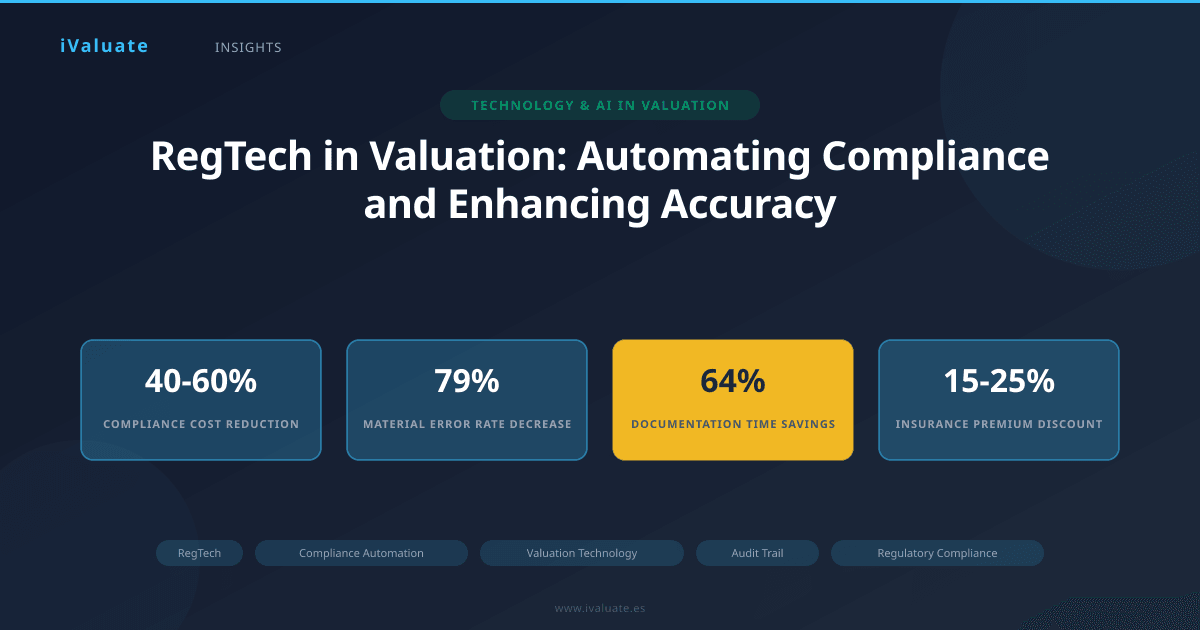
RegTech solutions have emerged as essential infrastructure for modern valuation practices, automating compliance workflows that previously consumed 30-40% of senior practitioners' time. By 2026, firms leveraging comprehensive RegTech platforms report compliance cost reductions of 40-60% while simultaneously improving valuation accuracy and creating defensible audit trails that withstand regulatory examination.
01 The Compliance Burden in Modern Valuation Practice
The regulatory landscape for corporate valuation has grown exponentially more complex since 2023. Valuation professionals must now navigate a labyrinth of overlapping requirements across multiple jurisdictions, each with distinct documentation standards, methodological preferences, and reporting timelines.
Consider the typical compliance requirements for a mid-market M&A fairness opinion in 2026:
- Documentation of all data sources, including verification of third-party market data accuracy and currency
- Detailed methodological justifications with explicit consideration of alternative approaches
- Comprehensive sensitivity analyses demonstrating valuation ranges under various scenarios
- Independence certifications and conflict-of-interest disclosures
- Peer review documentation and quality control checkpoints
- Retention of all working papers and communications for 7-10 years depending on jurisdiction
- ESG factor integration documentation under emerging sustainability reporting frameworks
A 2025 survey by the International Valuation Standards Council (IVSC) found that compliance-related activities now consume an average of 18-22 hours per engagement for complex valuations, representing 25-35% of total project time. For firms without automation, this translates to $15,000-$45,000 in additional costs per engagement, depending on seniority levels involved.
The manual compliance burden has reached an inflection point where it materially impacts both profitability and the ability to accept time-sensitive engagements. Firms that haven't automated these processes are losing competitive positioning.
02 RegTech Architecture for Valuation Compliance
Modern RegTech solutions for valuation integrate several technological layers that work in concert to automate compliance while enhancing analytical capabilities:
Automated Data Validation and Lineage Tracking
The foundation of compliance automation lies in establishing clear data provenance. Advanced RegTech platforms automatically capture the source, timestamp, and transformation history of every data point used in a valuation model. When a comparable company multiple is referenced, the system documents the exact data provider, retrieval timestamp, any adjustments made, and the rationale for those adjustments.
This automated lineage tracking serves multiple purposes. First, it eliminates the manual documentation burden that previously required analysts to maintain separate compliance logs. Second, it creates an immutable audit trail that can be instantly produced for regulatory review. Third, it enables rapid identification of data quality issues—if a data provider issues a correction to historical financials, the system can immediately flag all valuations potentially affected.
Leading platforms now incorporate real-time data validation rules that check incoming information against expected ranges, cross-reference multiple sources, and flag anomalies for human review. A European advisory firm implementing such a system in 2025 reported a 73% reduction in data-related compliance queries during regulatory examinations.
Intelligent Workflow Orchestration
RegTech platforms orchestrate the valuation workflow to ensure compliance checkpoints are embedded at critical junctures rather than bolted on at the end. The system enforces sequential dependencies—for instance, preventing finalization of a discounted cash flow analysis until sensitivity analyses meet minimum threshold requirements or ensuring peer review completion before report generation.
These workflow engines incorporate jurisdiction-specific rule sets that automatically adapt compliance requirements based on engagement characteristics. A purchase price allocation for a German subsidiary triggers different documentation requirements than a US fairness opinion, and the system configures itself accordingly without manual intervention.
Workflow automation also addresses the critical challenge of version control. In traditional practice, valuation models often exist in multiple Excel versions across team members' computers, creating confusion about which represents the final, approved analysis. RegTech platforms maintain a single source of truth with complete version history, automatic conflict resolution, and clear approval chains.
Natural Language Processing for Report Generation
One of the most time-intensive compliance activities involves drafting narrative reports that explain methodologies, assumptions, and conclusions in language that satisfies both technical standards and regulatory expectations. Advanced RegTech solutions now employ natural language processing (NLP) to generate first-draft report sections automatically.
These systems analyze the quantitative model outputs and generate narrative explanations that conform to jurisdiction-specific reporting standards. For example, when a weighted average cost of capital (WACC) calculation produces a 9.2% discount rate, the NLP engine generates explanatory text covering the risk-free rate selection, equity risk premium justification, beta calculation methodology, and size premium rationale—all formatted according to the applicable reporting framework.
The technology has matured significantly since early implementations. By 2026, leading platforms generate narrative content that requires only 15-20% editing by senior practitioners, compared to 60-70% editing requirements in 2023. This represents a fundamental shift from "automation-assisted writing" to "human-refined automation."
03 Compliance Cost Reduction: Quantifying the Impact
The financial impact of RegTech adoption in valuation practices manifests across multiple dimensions, with benefits extending beyond simple labor cost reduction.
Direct Labor Cost Savings
The most immediately measurable benefit comes from reduced time spent on compliance documentation. A mid-sized valuation firm with 15 professionals performing 120 engagements annually can expect to recapture 2,000-2,500 hours previously devoted to compliance activities. At blended rates of $200-$300 per hour, this represents $400,000-$750,000 in annual capacity that can be redirected to revenue-generating activities or used to improve work-life balance.
A North American boutique advisory firm shared detailed metrics from their 2025 RegTech implementation: compliance documentation time per engagement decreased from an average of 21 hours to 7.5 hours—a 64% reduction. Critically, this reduction occurred without any decrease in documentation quality or completeness; regulatory examination pass rates actually improved from 87% to 96%.
Risk Mitigation and Insurance Cost Reduction
Professional liability insurance premiums for valuation practices have increased 35-50% since 2022, driven by higher claim frequencies and regulatory enforcement actions. Insurers now explicitly consider a firm's compliance infrastructure when underwriting policies, with premium discounts of 15-25% available for firms demonstrating robust RegTech implementation.
The risk mitigation value extends beyond insurance premiums. A single regulatory enforcement action or professional negligence claim can cost $500,000-$2,000,000 in legal fees, settlements, and reputational damage. RegTech platforms reduce this exposure by ensuring consistent application of standards, maintaining comprehensive documentation, and providing clear audit trails that demonstrate good-faith compliance efforts.
Opportunity Cost Recovery
Perhaps the most significant but least quantified benefit involves recovering opportunity costs. In traditional practice, the compliance burden often forces firms to decline time-sensitive engagements or rush analyses in ways that increase error risk. With automated compliance, firms can accept more engagements and execute them with greater confidence.
A European mid-market M&A advisor reported that RegTech implementation enabled them to increase annual engagement volume by 23% without adding headcount. The efficiency gains came primarily from eliminating compliance bottlenecks that previously created capacity constraints during peak periods.
04 Enhancing Valuation Accuracy Through Automation
While cost reduction provides the initial ROI justification for RegTech adoption, the accuracy improvements may ultimately prove more valuable. Compliance automation creates several mechanisms that directly enhance valuation quality.
Systematic Error Detection
Manual valuation processes are inherently susceptible to errors—formula mistakes, data entry errors, inconsistent assumptions across model sections, and calculation errors. A 2024 study examining 500 valuation models found that 68% contained at least one material error, defined as a mistake that would change the concluded value by more than 5%.
RegTech platforms incorporate systematic error detection that operates continuously rather than as a final review step. The system validates that:
- All formulas reference appropriate cells and ranges
- Assumptions remain consistent across linked schedules
- Mathematical relationships hold (e.g., balance sheet balances, cash flow reconciliations)
- Results fall within expected ranges based on comparable analyses
- Sensitivity analyses properly reflect the intended variable changes
An investment bank implementing comprehensive error detection reported a 79% reduction in material errors reaching client deliverables, with most issues caught and corrected during the analysis phase rather than discovered during quality review or, worse, by clients.
Methodology Consistency and Standardization
Valuation accuracy suffers when different team members apply methodologies inconsistently or when firms lack clear standards for recurring judgment calls. RegTech platforms encode best practices and firm-specific methodologies, ensuring consistent application across all engagements.
For example, when selecting comparable companies, the system can enforce minimum criteria (revenue size, geographic focus, business model similarity) and automatically flag selections that deviate from established standards. When calculating normalized EBITDA, the platform applies consistent adjustment policies for non-recurring items, ensuring that a "one-time" restructuring charge is treated the same way across all analyses.
This standardization proves particularly valuable for firms with multiple offices or practice groups. A global advisory firm reported that pre-RegTech, the same engagement valued by their New York and London offices would produce conclusions varying by 12-18% on average, primarily due to methodological inconsistencies. Post-implementation, this variation decreased to 3-5%, within the expected range for legitimate judgment differences.
Real-Time Market Data Integration
Valuation accuracy depends critically on using current market data, but manual processes often introduce lag times between data availability and incorporation into analyses. RegTech platforms integrate directly with market data providers, automatically updating comparable company multiples, transaction precedents, and market indicators.
This real-time integration matters particularly in volatile markets. During the market turbulence of early 2025, when technology sector multiples compressed 30-40% over a six-week period, firms with automated data feeds could immediately reflect current conditions in their analyses. Firms relying on manual data updates often worked with information that was 2-4 weeks stale, materially overstating values during a period of rapid multiple contraction.
05 Audit Trail Creation and Regulatory Defense
The ability to produce comprehensive, defensible audit trails represents perhaps the most critical compliance benefit of RegTech implementation. Regulatory examinations and litigation discovery increasingly focus on the valuation process itself—not just the final conclusion, but the entire analytical journey.
Immutable Documentation
RegTech platforms create timestamped, immutable records of every action taken during a valuation engagement. This includes:
- All data queries and retrievals with exact timestamps
- Every model change with before/after values and user identification
- All assumption modifications with rationale documentation
- Communication logs between team members regarding analytical decisions
- Review and approval actions at each workflow stage
This comprehensive documentation serves multiple purposes. During regulatory examinations, firms can instantly produce complete records demonstrating compliance with applicable standards. In litigation contexts, the audit trail provides clear evidence of the analytical process and good-faith efforts to reach appropriate conclusions.
A valuation firm facing regulatory examination in 2025 reported that their RegTech platform enabled them to produce 100% of requested documentation within 48 hours, compared to the 2-3 weeks typically required for manual document assembly. The examiner specifically noted the quality and completeness of the audit trail in their closing letter.
Assumption Transparency and Sensitivity Documentation
Regulatory scrutiny increasingly focuses on the reasonableness of key assumptions and whether practitioners adequately considered alternative scenarios. RegTech platforms automatically document the basis for every significant assumption and generate comprehensive sensitivity analyses showing how value conclusions would change under different scenarios.
This automated sensitivity analysis goes beyond simple one-variable changes. Advanced platforms perform multivariate sensitivity testing, examining how combinations of assumption changes affect conclusions. For example, the system might automatically analyze how value changes when revenue growth, margin assumptions, and discount rates all move together in realistic correlation patterns.
The documentation includes not just the numerical results but narrative explanations of why particular sensitivity scenarios were selected and what they reveal about valuation robustness. This level of documentation, which would require 8-12 hours of manual effort, is generated automatically in minutes.
06 Real-World Implementation: Three Case Studies
Case Study 1: Mid-Market Advisory Firm Transformation
A 25-person advisory firm specializing in middle-market M&A implemented a comprehensive RegTech platform in Q2 2025. Prior to implementation, the firm faced several challenges: regulatory examination findings requiring remediation, professional liability insurance premium increases of 40% over two years, and difficulty scaling to meet growing demand.
The implementation focused on three priorities: automated audit trail creation, workflow standardization, and error detection. Results after 12 months:
- Compliance documentation time reduced from 19 hours to 6.5 hours per engagement
- Material error rate decreased from 14% to 2% of engagements
- Regulatory examination pass rate improved from 83% to 98%
- Professional liability insurance premium reduced by 18% despite market-wide increases
- Engagement capacity increased by 28% without additional hiring
- Client satisfaction scores improved from 7.8 to 8.9 (out of 10)
The firm's managing partner noted: "The RegTech investment paid for itself in seven months through efficiency gains alone. The risk mitigation and quality improvements represent pure upside that's harder to quantify but arguably more valuable."
Case Study 2: Big Four Valuation Practice Standardization
A Big Four accounting firm's valuation practice faced challenges maintaining consistency across 15 offices and 200+ professionals. Different offices had evolved distinct approaches to common valuation scenarios, creating quality control concerns and inefficient knowledge transfer.
The firm implemented an enterprise RegTech platform with centralized methodology libraries, automated quality control, and comprehensive training modules. The implementation took 18 months and required significant change management effort.
Results after full implementation:
- Methodology consistency scores improved from 72% to 94% across offices
- New staff productivity reached full capacity 40% faster due to embedded training
- Peer review cycle time decreased from 5.3 days to 1.8 days average
- Client complaints regarding inconsistent approaches decreased by 67%
- Cross-office collaboration increased as common platform facilitated knowledge sharing
The practice leader emphasized: "The platform transformed us from 15 semi-independent practices into a truly integrated national practice with consistent quality standards."
Case Study 3: Boutique Firm Competitive Positioning
A specialized technology sector valuation boutique with eight professionals competed against larger firms for complex engagements. Despite strong technical expertise, the firm struggled to demonstrate the robust compliance infrastructure that sophisticated clients increasingly demanded.
The firm implemented a RegTech solution specifically designed for smaller practices, emphasizing automated compliance documentation and professional presentation. Results after eight months:
- Win rate on competitive proposals increased from 31% to 47%
- Average engagement size increased by 34% as firm could credibly pursue larger opportunities
- Time from engagement completion to final deliverable decreased from 8 days to 2.5 days
- Client feedback specifically mentioned "institutional-quality documentation" as differentiator
The firm's founder noted: "RegTech leveled the playing field. We now compete on technical expertise rather than losing opportunities due to perceived infrastructure gaps."
07 Implementation Considerations and Best Practices
Successful RegTech implementation requires careful planning and realistic expectations about the change management process involved.
Platform Selection Criteria
Not all RegTech solutions are created equal, and the right choice depends on firm-specific factors:
- Engagement mix: Firms focused on financial reporting valuations need different functionality than M&A advisory practices
- Jurisdiction requirements: Ensure the platform supports all relevant regulatory frameworks
- Integration requirements: Consider compatibility with existing systems (CRM, document management, data providers)
- Scalability: Evaluate whether the solution can grow with the practice
- Vendor stability: Assess the provider's financial health and long-term viability
Change Management Imperatives
Technology implementation fails more often due to people issues than technical problems. Successful firms invest heavily in change management:
- Secure senior leadership commitment and visible sponsorship
- Involve end users in platform selection and configuration decisions
- Provide comprehensive training with ongoing support
- Implement gradually rather than attempting "big bang" rollouts
- Celebrate early wins and share success stories
- Address resistance directly and empathetically
A common mistake involves underestimating the learning curve. Even intuitive platforms require 20-30 hours of use before practitioners achieve full proficiency. Firms should expect a temporary productivity dip during the first 2-3 months of implementation.
08 The Future of RegTech in Valuation
The RegTech landscape continues evolving rapidly, with several emerging trends likely to shape the next generation of compliance automation.
Artificial Intelligence and Machine Learning Integration
Current RegTech platforms primarily automate rule-based processes, but AI integration promises more sophisticated capabilities. Machine learning models can analyze thousands of historical valuations to identify patterns that indicate potential errors or unusual conclusions requiring additional scrutiny.
Natural language processing will advance beyond report generation to include intelligent review of narrative sections, flagging inconsistencies between quantitative analyses and written explanations. Some platforms are already testing AI-powered peer review assistants that provide preliminary quality control before human review.
Blockchain for Audit Trail Integrity
Several RegTech providers are exploring blockchain technology to create absolutely immutable audit trails. While current systems provide strong documentation, blockchain-based solutions could offer cryptographic proof that records haven't been altered after creation—valuable in high-stakes litigation or regulatory proceedings.
Predictive Compliance Analytics
Future platforms will likely incorporate predictive analytics that identify compliance risks before they materialize. By analyzing engagement characteristics, the system could flag situations with elevated regulatory scrutiny risk and automatically implement enhanced documentation protocols.
09 Conclusion: RegTech as Competitive Necessity
The question for valuation practices is no longer whether to adopt RegTech but how quickly and comprehensively to implement it. The compliance burden will only increase as regulatory frameworks continue evolving, and manual processes simply cannot scale to meet these demands while maintaining profitability and quality.
Firms that have embraced compliance automation report not just cost savings but fundamental improvements in their competitive positioning. They can accept more engagements, execute them faster, produce higher-quality work, and defend their conclusions more effectively when challenged. These advantages compound over time, creating widening performance gaps between automated and manual practices.
The implementation journey requires investment—typically $50,000-$200,000 for mid-sized firms, plus ongoing subscription costs—and demands sustained change management effort. However, the ROI typically materializes within 6-12 months through efficiency gains alone, with risk mitigation and quality improvements providing additional value that may prove even more significant over time.
For valuation professionals seeking to navigate this transformation, platforms like iValuate provide comprehensive solutions that integrate compliance automation with analytical capabilities, enabling practitioners to focus on the judgment and expertise that truly differentiate their work while ensuring robust documentation and regulatory defensibility. As the valuation profession continues its digital transformation, RegTech infrastructure has evolved from competitive advantage to operational necessity—the foundation upon which modern, sustainable practices are built.