Índice10 secciones
Professional services firms represent one of the most challenging asset classes in corporate valuation. Unlike manufacturing or technology companies with tangible assets and scalable products, these businesses—law firms, consulting practices, accounting firms, and specialized advisory boutiques—derive their value almost entirely from human capital. As we navigate the 2025-2026 market environment, understanding the nuances of professional services valuation has become increasingly critical as consolidation accelerates and succession planning pressures mount.
The fundamental challenge lies in quantifying what is inherently intangible: expertise, client relationships, reputation, and the collective intellectual capital of partners and senior professionals. When a key partner walks out the door, they often take relationships, revenue streams, and institutional knowledge with them. This reality fundamentally shapes how we approach valuation in this sector.
01 The Structural Economics of Professional Services Firms
Professional services firms operate under a distinctive economic model that differs materially from traditional operating companies. Understanding these structural characteristics is essential before applying any valuation methodology.
The Partnership Model and Capital Structure
Most established professional services firms operate as partnerships or partnership-like structures, even when technically organized as limited liability companies or corporations. This creates unique valuation considerations. Partners typically function as both owners and key employees, blurring the line between return on capital and compensation for services rendered.
In a typical law firm or consulting practice, partners contribute capital upon admission—often ranging from $50,000 to $500,000 depending on firm size and profitability. However, this capital contribution rarely reflects economic ownership in proportion to a true enterprise value. Instead, it serves as a commitment mechanism and working capital source. The real economic interest lies in profit-sharing arrangements, which are usually based on complex formulas incorporating origination credits, billing performance, seniority, and subjective factors.
This structure creates immediate valuation complexity. When valuing a professional services firm, we must distinguish between:
- The enterprise value of the ongoing business entity
- The economic interests of individual partners in current and future profits
- The goodwill attributable to the firm versus personal goodwill of individual partners
- The value of client relationships and how portable they are
Revenue Concentration and Client Dependency
Professional services firms typically exhibit higher revenue concentration than diversified operating companies. A mid-sized consulting firm might derive 30-40% of revenue from its top five clients, while a boutique legal practice might depend on a handful of key relationships for the majority of billings. In 2025, we're observing that firms with revenue concentration above 25% from any single client trade at discounts of 15-25% compared to more diversified peers.
This concentration risk directly impacts valuation multiples. During due diligence for a recent transaction involving a 40-person management consulting firm, we identified that the founding partner personally controlled relationships generating 45% of annual revenue. This discovery reduced the applicable EBITDA multiple from an initial 6.5x to 4.2x, and the transaction ultimately required a three-year earnout tied to client retention.
02 Key Valuation Metrics for Professional Services
Traditional valuation metrics require adaptation when applied to professional services firms. While EBITDA multiples remain relevant, several sector-specific metrics provide additional insight.
Revenue Per Partner and Professional
Revenue per partner (RPP) and revenue per professional serve as fundamental productivity metrics. In 2025-2026, we're seeing the following benchmarks across major professional services categories:
- Large law firms (AmLaw 200): Revenue per equity partner averaging $2.8-4.5 million, with elite firms exceeding $6 million
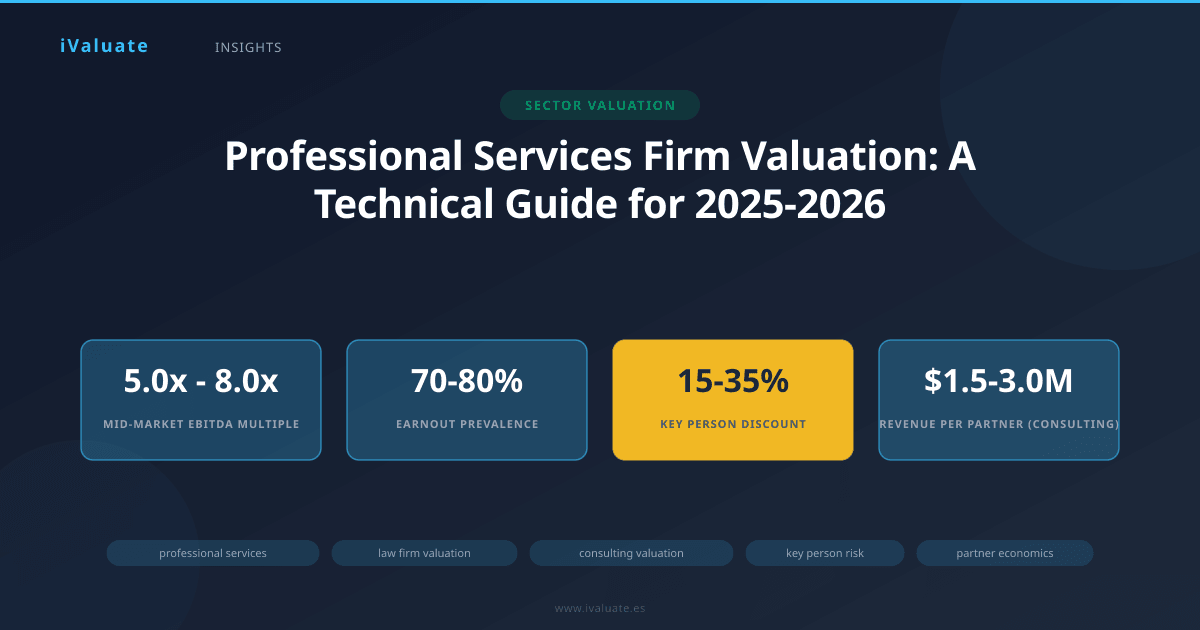
- Management consulting: Revenue per partner ranging from $1.5-3.0 million for established firms
- Accounting firms: Revenue per partner typically $800,000-1.8 million depending on service mix
- Specialized advisory boutiques: Highly variable, from $1.0-5.0 million based on deal flow and sector focus
These metrics matter for valuation because they indicate leverage ratios (how many junior professionals support each partner), pricing power, and operational efficiency. A consulting firm generating $3.5 million per partner with a 4:1 leverage ratio demonstrates stronger economics than one generating $2.0 million per partner at 6:1 leverage, even if absolute revenues are similar.
Profit Margin and Partner Compensation
Professional services firms typically target profit margins (defined as partner profits divided by revenue) of 25-40%. However, this metric requires careful interpretation because partner compensation often includes both a return on capital and compensation for services. A common approach involves normalizing partner compensation by:
- Calculating market-rate compensation for partners based on their roles (e.g., $400,000-600,000 for senior partners performing client work)
- Treating compensation above this level as distributable profit
- Applying valuation multiples to this normalized profit stream
In a 2024 transaction we advised on involving a 25-partner law firm, reported partner distributions averaged $850,000. After normalizing for market compensation of $500,000 per partner, we identified $350,000 per partner in excess economic profit, or $8.75 million firm-wide. This normalized profit figure became the basis for applying an EBITDA multiple rather than the raw distribution amount.
Realization and Collection Rates
For firms operating on billable hours models, realization rates (billed hours divided by worked hours) and collection rates (cash collected divided by billed amounts) provide critical quality-of-earnings insight. Strong firms maintain realization rates above 90% and collection rates above 95%. Deterioration in these metrics often signals pricing pressure, client dissatisfaction, or aggressive revenue recognition.
We recently encountered a consulting firm claiming $12 million in annual revenue but maintaining only an 82% collection rate with aging receivables exceeding 120 days for 30% of billings. This pattern indicated revenue quality issues that reduced valuation by approximately 20% compared to initial expectations.
03 Valuation Methodologies: Application and Adaptation
Professional services firms can be valued using traditional methodologies, but each requires significant adaptation to address sector-specific characteristics.
Income Approach: Discounted Cash Flow
The DCF methodology remains theoretically sound but practically challenging for professional services firms. The primary difficulties include:
Projection uncertainty: Revenue projections depend heavily on partner retention, client stickiness, and key person continuity—all difficult to forecast with precision. We typically apply higher discount rates (14-18% for small to mid-sized firms) compared to traditional operating companies (10-12%) to reflect this uncertainty.
Terminal value assumptions: The going concern assumption underlying terminal value calculations becomes questionable when a firm's value depends on specific individuals. For firms with strong institutional brands and diversified client bases, perpetuity growth assumptions of 2-3% may be reasonable. For smaller, personality-driven practices, terminal values should be heavily discounted or calculated using exit multiples rather than perpetuity formulas.
Working capital dynamics: Professional services firms typically operate with negative working capital due to retainer arrangements and advance billings. This creates cash flow benefits that must be properly reflected in DCF models but will reverse if growth slows.
Market Approach: Comparable Company Analysis
The market approach using comparable transactions or public company multiples provides valuable benchmarking but requires careful selection of comparables. In the current 2025-2026 environment, we're observing the following valuation multiple ranges:
Large, institutionalized firms with strong brands:
- EV/Revenue: 1.5x - 3.0x
- EV/EBITDA: 8.0x - 12.0x
- Examples include publicly traded consulting firms like Accenture (trading at approximately 2.8x revenue and 15.0x EBITDA as of early 2025) and major accounting firm transactions
Mid-sized firms ($10-50 million revenue):
- EV/Revenue: 0.8x - 1.8x
- EV/EBITDA: 5.0x - 8.0x
- Multiples vary significantly based on client concentration, partner age profile, and growth trajectory
Small practices and boutiques (under $10 million revenue):
- EV/Revenue: 0.4x - 1.0x
- EV/EBITDA: 3.0x - 5.5x
- Often structured with significant earnouts (40-60% of total consideration) tied to revenue retention and key person continuity
A critical consideration: these multiples typically assume normalized partner compensation. Deals often fail or require renegotiation when buyers discover that reported EBITDA includes artificially low partner compensation that must be increased post-transaction to retain key professionals.
Asset Approach: Limited Applicability
The asset-based approach provides minimal utility for most professional services valuations. These firms typically maintain minimal tangible assets—office furniture, computer equipment, and modest working capital. The real value lies in intangible assets: client relationships, reputation, methodologies, and human capital. While these intangibles can theoretically be valued individually, the cost and subjectivity involved usually makes this approach impractical except in liquidation scenarios.
04 The Key Person Risk Premium
No factor impacts professional services valuation more significantly than key person dependency. This risk manifests in multiple dimensions and requires sophisticated analysis to quantify properly.
Identifying and Quantifying Key Person Exposure
A rigorous key person analysis examines:
- Revenue attribution: Which professionals control or significantly influence specific client relationships? We typically conduct client-level analysis to map revenue to individual partners or senior professionals.
- Technical expertise: Does the firm possess specialized capabilities that reside primarily with one or two individuals? This is particularly relevant for boutique advisory firms or specialized legal practices.
- Business development: Who generates new client relationships? Firms where 60-70% of new business originates from a single partner face substantial key person risk.
- Operational leadership: Who manages day-to-day operations, quality control, and professional development? Loss of operational leadership can be as damaging as loss of revenue-generating partners.
In a recent valuation of a 35-person technology consulting firm, we identified that the CEO/founder controlled relationships representing 38% of revenue, led all significant business development efforts, and served as the primary technical expert for the firm's most profitable service line. This concentration resulted in a 35% valuation discount compared to initial multiples derived from comparable transactions. The final deal structure included:
- 60% cash at closing based on a 4.5x EBITDA multiple (vs. 7.0x for comparable firms without key person concentration)
- 25% earnout over three years tied to revenue retention
- 15% earnout tied to successful transition of business development responsibilities
- Five-year employment agreement for the founder with non-compete provisions
Mitigation Strategies and Valuation Impact
Professional services firms can reduce key person risk and improve valuations through several strategies:
Client relationship diversification: Implementing formal account team structures where multiple professionals maintain client relationships. Firms demonstrating that no single professional controls more than 15-20% of revenue typically command premium multiples.
Institutionalized methodologies and IP: Developing proprietary frameworks, tools, and methodologies that transcend individual practitioners. Consulting firms with documented, repeatable approaches trade at 20-30% premiums compared to pure staff augmentation models.
Succession planning and partner development: Maintaining a robust pipeline of junior partners and clear advancement criteria. Firms with average partner ages below 50 and demonstrated track records of successful partner transitions face lower key person discounts.
Employment agreements and non-competes: While enforceability varies by jurisdiction, well-structured agreements provide some protection. However, valuators typically assign limited value to these provisions given enforcement challenges and the reality that unhappy partners perform poorly even if legally constrained.
05 Partner Buy-In and Internal Valuation Mechanisms
Professional services firms face unique challenges in establishing internal valuation mechanisms for partner admissions, retirements, and transitions. These internal valuations often differ materially from external market valuations.
Buy-In Formulas and Economic Logic
Partner buy-in amounts typically represent a fraction of true economic value. Common approaches include:
Fixed capital contribution: New partners contribute a predetermined amount (e.g., $100,000-250,000) regardless of firm value. This approach provides simplicity but creates economic disconnects as firm value grows.
Percentage of book value: Partners purchase a percentage interest based on the firm's book value (assets minus liabilities). For professional services firms with minimal tangible assets, this often produces artificially low buy-in amounts.
Multiple of compensation: Buy-in calculated as a multiple (commonly 0.5x to 1.5x) of the new partner's expected annual compensation. This approach ties buy-in to individual economics but ignores firm-wide value.
Formula-based enterprise value: More sophisticated firms calculate enterprise value using formulas (e.g., 1.0x revenue or 5.0x normalized EBITDA) and require new partners to purchase a proportional interest. A new partner acquiring a 2% interest in a firm valued at $20 million would contribute $400,000.
The choice of buy-in mechanism impacts both internal equity and external valuation. Firms with low buy-in requirements relative to economic value face challenges in external transactions because existing partners have minimal capital at risk and may be indifferent to transaction outcomes. Conversely, high buy-in requirements relative to compensation can deter talented professionals from joining.
Retirement and Withdrawal Provisions
Partnership agreements typically specify valuation formulas for retiring partners. These provisions critically impact external valuations because they represent contingent liabilities. Common structures include:
- Book value buyouts: Retiring partners receive book value of their capital accounts, often paid over 3-5 years. This approach minimizes cash drain but may undercompensate long-tenured partners.
- Formula-based payments: Payments calculated using revenue or profit multiples, sometimes with caps or collars. A typical formula might pay retiring partners 1.5x their average annual distributions over the prior three years, paid over five years.
- Goodwill participation: Some agreements provide retiring partners with a share of goodwill value, particularly if they helped build the firm. These provisions can create substantial unfunded liabilities that reduce external valuation.
During a 2024 valuation engagement for a 45-partner law firm, we identified retirement obligations totaling $18 million over the subsequent seven years based on the partnership agreement's formula. This represented nearly 40% of the firm's enterprise value and had to be treated as debt-equivalent in the valuation analysis, significantly reducing equity value available to remaining partners.
06 Sector-Specific Considerations
While professional services firms share common characteristics, important distinctions exist across sectors.
Law Firms: Regulatory and Structural Constraints
Law firms face unique valuation challenges due to regulatory restrictions on ownership by non-lawyers in most jurisdictions. This limits exit options and depresses valuations compared to other professional services sectors. Additionally:
- Billable hour models create revenue predictability but limit scalability
- Partner compensation often consumes 40-50% of revenue, leaving less profit for enterprise value creation
- Client conflicts can prevent firms from pursuing attractive opportunities
- Lateral partner mobility creates constant retention pressure
Law firm valuations in 2025 typically range from 0.6x-1.2x revenue for mid-sized firms, with EBITDA multiples of 4.0x-6.5x. Elite firms with strong brands and national practices command premiums, while small local practices often trade at 0.4x-0.8x revenue.
Management Consulting: Scalability and Methodology Value
Management consulting firms span a wide spectrum from pure staff augmentation (low value, commodity service) to specialized strategy houses (high value, differentiated expertise). Valuation drivers include:
- Proprietary methodologies and intellectual property that enable leverage
- Industry specialization and depth of expertise
- Client diversity and relationship quality
- Technology enablement and tools that enhance delivery efficiency
The consulting sector has seen significant multiple expansion in 2024-2025, with technology-enabled firms and those serving high-growth sectors commanding EV/EBITDA multiples of 8.0x-11.0x. Traditional generalist firms trade at 5.0x-7.0x EBITDA.
Accounting Firms: Recurring Revenue and Regulatory Moats
Accounting firms benefit from recurring audit and tax compliance work, creating more predictable revenue streams than other professional services sectors. However, they face:
- Commoditization pressure in basic compliance services
- Regulatory restrictions on ownership and conflicts
- Seasonal cash flow patterns
- Technology disruption in routine services
Accounting firm valuations typically range from 0.8x-1.4x revenue, with multiples varying based on service mix (advisory commands premiums over compliance), client quality, and geographic market.
07 Transaction Structures and Deal Dynamics
Professional services transactions employ distinctive structures to address key person risk and ensure continuity.
Earnouts and Performance-Based Consideration
Earnouts appear in 70-80% of professional services transactions, compared to 30-40% in other sectors. Typical structures include:
- Revenue-based earnouts: Additional payments tied to achieving revenue targets over 2-4 years, often with retention requirements (e.g., maintaining 90% of baseline revenue)
- EBITDA-based earnouts: Payments tied to profit targets, though these can create conflicts around expense allocation and partner compensation
- Client retention earnouts: Specific payments tied to retaining key clients, particularly relevant when concentration risk exists
A well-structured earnout aligns seller incentives with buyer objectives while providing sellers with upside participation. However, earnouts also create complexity, potential disputes, and integration challenges. In our experience, earnout targets are achieved fully in only 40-50% of professional services transactions, with another 30% achieving partial payouts.
Equity Rollovers and Management Continuity
Many professional services transactions require selling partners to roll over 20-40% of their equity into the acquiring entity. This structure:
- Demonstrates seller confidence in future performance
- Aligns incentives during transition periods
- Provides sellers with potential upside from future growth or subsequent exits
- Reduces cash requirements for buyers
Private equity buyers particularly favor rollover structures, often requiring founding partners to maintain 25-35% ownership through a transaction to ensure commitment and continuity.
08 Current Market Dynamics: 2025-2026 Outlook
The professional services M&A market in 2025-2026 reflects several notable trends:
Continued consolidation: Mid-sized firms are increasingly seeking scale through mergers or sales to larger platforms. This trend is particularly pronounced in accounting and wealth management, where technology investments and regulatory complexity favor larger firms.
Private equity activity: PE firms have deployed significant capital into professional services platforms, particularly in high-margin, specialized sectors like healthcare consulting, regulatory advisory, and technology services. These platforms pursue aggressive buy-and-build strategies, creating exit opportunities for smaller firms.
Valuation multiple compression: After several years of multiple expansion, we're observing modest compression in 2025 as interest rates remain elevated and economic uncertainty persists. Mid-market professional services firms are trading at multiples 10-15% below 2022-2023 peaks.
Technology disruption: AI and automation are reshaping professional services economics, particularly in legal research, basic accounting, and routine consulting work. Firms demonstrating technology adoption and efficiency gains command premium valuations, while those relying on traditional labor-intensive models face multiple pressure.
Succession planning urgency: Baby boomer partners are reaching retirement age in large numbers, creating succession pressure. Firms without clear succession plans or next-generation leadership face significant valuation discounts.
09 Practical Valuation Framework: A Structured Approach
Based on two decades of professional services valuations, we recommend the following structured approach:
Step 1: Normalize financial performance. Adjust historical results for non-recurring items, normalize partner compensation to market rates, and recast financial statements to reflect sustainable economics.
Step 2: Conduct comprehensive key person analysis. Map revenue to individual professionals, assess business development concentration, and identify critical technical expertise dependencies.
Step 3: Assess client concentration and relationship quality. Analyze revenue concentration, client tenure, contract terms, and relationship portability.
Step 4: Evaluate institutional strength. Assess brand value, documented methodologies, technology infrastructure, and organizational depth beyond key individuals.
Step 5: Apply multiple methodologies. Use both income and market approaches, with appropriate adjustments for key person risk, client concentration, and sector-specific factors.
Step 6: Stress test assumptions. Model downside scenarios including key person departure, client loss, and market deterioration to establish valuation ranges.
Step 7: Structure appropriately. Design transaction structures that address identified risks through earnouts, employment agreements, and rollover equity.
10 Conclusion: Mastering the Art and Science of Professional Services Valuation
Valuing professional services firms requires equal parts technical rigor and practical judgment. The quantitative frameworks—discounted cash flow models, comparable multiples, and financial metrics—provide essential structure. However, the qualitative assessment of key person risk, client relationship quality, and institutional strength ultimately determines whether a valuation proves accurate or wildly off-mark.
As we progress through 2025-2026, several imperatives emerge for both buyers and sellers in this sector. Sellers must focus on reducing key person concentration, documenting institutional capabilities, and developing next-generation leadership well before contemplating a transaction. Waiting until retirement looms to address these issues inevitably results in compressed valuations and limited exit options.
Buyers must conduct rigorous due diligence that goes far beyond financial statement analysis. Understanding the true nature of client relationships, assessing cultural fit, and developing detailed integration and retention plans separate successful professional services acquisitions from value-destroying disasters. The statistics are sobering: research suggests that 40-50% of professional services acquisitions fail to achieve projected returns, primarily due to key person departures and client attrition.
For professionals navigating these complex valuations—whether as buyers, sellers, or advisors—sophisticated analytical tools have become essential. Platforms like iValuate enable professionals to efficiently model multiple scenarios, apply appropriate sector benchmarks, and stress test assumptions that drive professional services valuations. As the market continues to evolve and transaction complexity increases, leveraging technology to enhance analytical rigor while maintaining focus on the fundamental human dynamics that drive value creation remains the hallmark of excellence in professional services valuation.
The firms that will command premium valuations in the years ahead are those that successfully balance individual excellence with institutional strength—building organizations that transcend any single person while still attracting and retaining exceptional talent. For valuators, the challenge lies in accurately quantifying this balance and helping clients understand the specific actions that drive value in this uniquely human-capital-intensive sector.