Índice10 secciones
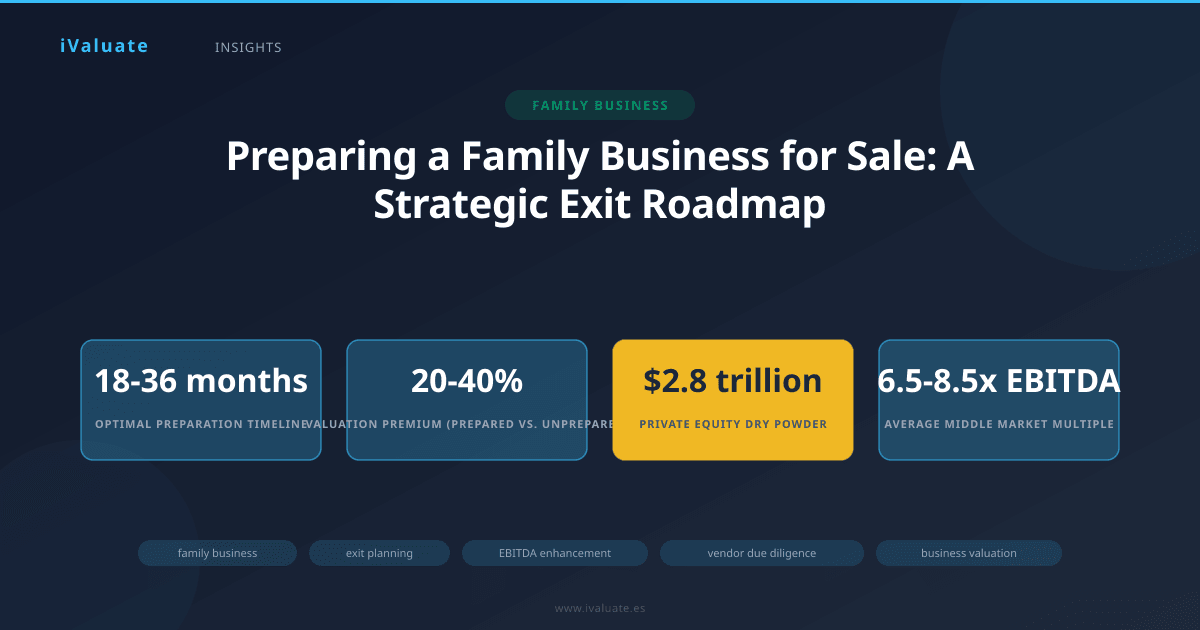
The decision to sell a family business represents one of the most consequential financial events in a family's history. Yet despite controlling an estimated 70-90% of global GDP and representing the majority of private enterprises worldwide, family businesses often approach exit planning with insufficient preparation, leaving substantial value on the table. In the current M&A environment of 2025-2026, where private equity dry powder exceeds $2.8 trillion and strategic buyers face intense pressure to deploy capital, properly prepared family businesses command premium valuations—often 20-40% above poorly prepared competitors.
This article provides a comprehensive framework for preparing a family business for sale, focusing on the critical 18-36 month preparation window that separates premium exits from disappointing outcomes. We'll examine the specific value drivers that matter most to sophisticated buyers, the vendor due diligence process that has become standard practice, and the concrete EBITDA enhancement strategies that can materially impact enterprise value.
01 Understanding Exit Readiness: The Foundation of Value Maximization
Exit readiness extends far beyond having clean financial statements and willing sellers. It encompasses the systematic preparation of every aspect of a business to withstand the intense scrutiny of professional buyers and their advisors. In today's market, where buyers routinely walk away from transactions due to discovered issues during due diligence, exit readiness has evolved from a nice-to-have to an absolute prerequisite for achieving optimal valuations.
The concept of exit readiness encompasses five core dimensions:
- Financial transparency and quality of earnings: Normalized EBITDA calculations, clear separation of personal and business expenses, audited or reviewed financial statements, and robust financial controls
- Operational independence from family members: Professional management team, documented processes, succession planning, and reduced key person risk
- Legal and regulatory compliance: Clear ownership structure, resolved litigation, proper licensing, environmental compliance, and intellectual property protection
- Commercial sustainability: Diversified customer base, contracted recurring revenue, competitive positioning, and documented market opportunity
- Organizational readiness: Aligned family shareholders, clear decision-making authority, resolved family employment issues, and unified exit objectives
A 2024 study by Deloitte found that family businesses that scored highly across all five dimensions achieved valuation multiples averaging 2.3x higher than those with significant gaps. More tellingly, 68% of failed family business transactions in 2023-2024 collapsed due to issues that could have been identified and remediated during a proper exit readiness assessment.
The 18-36 Month Preparation Timeline
While some advisors suggest that business sale preparation can be accomplished in 6-12 months, empirical evidence from successful family business exits demonstrates that 18-36 months represents the optimal preparation window. This timeline allows for meaningful operational improvements to be implemented, measured, and demonstrated to buyers—creating a compelling growth narrative rather than merely presenting historical performance.
The extended timeline breaks down into distinct phases:
Months 1-6: Assessment and Strategy Development
This initial phase involves conducting a comprehensive exit readiness assessment, engaging professional advisors, completing preliminary valuation analysis, and developing a detailed value enhancement roadmap. Family businesses should also address fundamental governance issues during this period, including formalizing shareholder agreements and clarifying decision-making authority for the sale process.
Months 7-18: Value Driver Implementation
The core preparation period focuses on executing specific initiatives to enhance EBITDA, strengthen management team capabilities, diversify customer concentration, improve working capital efficiency, and resolve identified legal or compliance issues. This phase requires disciplined project management and regular progress monitoring against defined KPIs.
Months 19-30: Vendor Due Diligence and Documentation
As the business approaches market-readiness, the focus shifts to completing vendor due diligence, preparing comprehensive information memoranda, assembling data rooms, and engaging sell-side advisors. This proactive approach allows families to control the narrative and address potential concerns before buyers identify them.
Months 31-36: Market Preparation and Process Launch
The final phase involves refining valuation expectations based on current market conditions, developing target buyer lists, preparing management presentations, and formally launching the sale process with maximum momentum.
02 EBITDA Enhancement: The Mathematics of Value Creation
Given that most family business valuations are based on EBITDA multiples, even modest improvements to normalized EBITDA can generate disproportionate increases in enterprise value. Consider a family manufacturing business with $8 million in EBITDA trading at a 7.5x multiple, implying a $60 million enterprise value. If that business can increase EBITDA to $10 million through operational improvements while simultaneously improving its quality profile to command an 8.5x multiple, the enterprise value increases to $85 million—a $25 million or 42% increase in value from a 25% improvement in EBITDA combined with a one-turn multiple expansion.
This mathematical reality explains why sophisticated sellers focus intensely on EBITDA enhancement during the preparation period. The most impactful strategies include:
Revenue Enhancement Initiatives
While buyers discount aggressive top-line growth projections, they highly value demonstrated revenue momentum with clear drivers. Family businesses should focus on:
- Pricing optimization: Many family businesses significantly underprice their products or services due to long-standing customer relationships or outdated pricing models. A systematic pricing review often identifies 3-8% revenue improvement opportunities with minimal customer attrition. A European industrial distributor we analyzed increased EBITDA by €1.2 million annually simply by implementing market-based pricing for their top 50 customers and eliminating legacy discount structures.
- Product/service mix improvement: Shifting revenue mix toward higher-margin offerings can dramatically improve profitability without requiring revenue growth. This might involve discontinuing low-margin product lines, focusing sales efforts on premium services, or implementing minimum order quantities.
- Geographic or channel expansion: Demonstrating successful expansion into new markets or channels provides buyers with a compelling growth narrative. However, timing matters—new initiatives should be launched 12-18 months before sale to demonstrate traction without the execution risk of very recent launches.
Cost Structure Optimization
Family businesses often carry cost structures that reflect historical decisions rather than optimal efficiency. Common opportunities include:
- Organizational structure rationalization: Family businesses frequently maintain redundant positions, overly generous compensation for family members, or organizational structures that evolved organically rather than by design. Rightsizing the organization to market benchmarks while maintaining operational effectiveness typically yields 5-12% EBITDA improvement.
- Procurement and vendor management: Long-standing vendor relationships may no longer represent competitive pricing. Systematic procurement reviews, vendor consolidation, and competitive bidding processes often generate 3-7% cost reductions in materials and services.
- Facility and overhead optimization: Excess capacity, inefficient layouts, or above-market lease rates represent opportunities for improvement. One family-owned logistics company reduced occupancy costs by 18% by consolidating three legacy facilities into two optimized locations, adding $900,000 to annual EBITDA.
Working Capital Efficiency
While working capital improvements don't directly impact EBITDA, they significantly affect enterprise value by reducing the cash required to operate the business. Buyers adjust purchase price for normalized working capital levels, making efficiency improvements directly valuable. Focus areas include:
- Reducing days sales outstanding (DSO) through improved credit policies and collection processes
- Optimizing inventory levels using data-driven forecasting and just-in-time principles
- Extending days payable outstanding (DPO) while maintaining supplier relationships
- Eliminating obsolete inventory and improving inventory turns
A family-owned distribution business reduced working capital requirements by $3.2 million through a systematic program addressing all four areas, effectively adding that amount to transaction proceeds at closing.
Add-Back Identification and Documentation
Family businesses typically include numerous expenses that benefit the family but wouldn't continue under new ownership. Properly identifying, documenting, and normalizing these add-backs is crucial for achieving fair valuation. Common categories include:
- Above-market compensation for family members relative to market rates for their actual roles
- Personal expenses run through the business (vehicles, travel, entertainment, insurance)
- Family member benefits (health insurance, retirement contributions) exceeding market norms
- Related-party transactions not at arm's length pricing
- Discretionary expenses (charitable contributions, sponsorships, club memberships)
- One-time expenses (litigation costs, facility moves, system implementations)
However, buyers have become increasingly skeptical of aggressive add-backs. Best practice involves conservative add-back identification with thorough documentation and third-party validation where possible. Quality of earnings reports from reputable accounting firms provide crucial credibility for material add-backs.
03 Vendor Due Diligence: Controlling the Narrative
Vendor due diligence (VDD)—also called sell-side due diligence—has transitioned from an occasional practice to standard protocol for professionally managed family business sales. VDD involves the seller proactively engaging accounting, legal, and operational advisors to conduct the same analyses that buyers would perform, identifying and addressing issues before they become negotiating points or deal-breakers.
The strategic advantages of VDD are substantial:
Issue identification and remediation: Discovering problems early allows time for resolution rather than explaining them under time pressure during buyer due diligence. A family-owned healthcare services company identified significant gaps in their HIPAA compliance program during VDD, allowing six months for remediation before marketing. Had buyers discovered these issues, the deal would likely have collapsed or required a 15-20% valuation reduction.
Valuation support and credibility: Independent quality of earnings reports and financial due diligence from recognized firms provide crucial third-party validation of normalized EBITDA and add-backs. This credibility often proves decisive in achieving seller-favorable valuations, particularly when multiple buyers are competing.
Process acceleration: Comprehensive VDD materials allow buyers to move quickly through due diligence, reducing execution risk and maintaining deal momentum. In competitive processes, the ability to close quickly often proves as valuable as price.
Negotiating leverage: When sellers can demonstrate that issues have been thoroughly investigated and disclosed, buyers have less basis for post-LOI price reductions. VDD effectively shifts the burden of proof regarding business quality.
Core Components of Comprehensive VDD
A thorough vendor due diligence program for a family business typically includes:
Financial and Quality of Earnings Analysis: Independent accounting firms examine 3-5 years of financial results, validate revenue recognition policies, assess EBITDA quality, evaluate working capital trends, analyze add-backs, and identify any accounting irregularities. For family businesses, particular attention focuses on related-party transactions, personal expenses, and family member compensation normalization. Investment for a middle-market company typically ranges from $75,000 to $200,000.
Tax Due Diligence: Tax advisors review federal, state, and local tax compliance, identify potential exposures, assess tax structure efficiency, and evaluate any tax attributes (NOLs, credits) that transfer with the business. Family businesses often have complex tax situations requiring careful analysis. Cost typically ranges from $40,000 to $100,000.
Legal Due Diligence: Legal counsel reviews corporate structure and governance, material contracts and commitments, litigation and disputes, intellectual property, regulatory compliance, employment matters, and environmental issues. For family businesses, particular attention addresses ownership clarity, shareholder agreements, and any informal arrangements requiring formalization. Investment typically ranges from $50,000 to $150,000.
Commercial Due Diligence: Strategy consultants or industry specialists assess market positioning, competitive dynamics, customer concentration and relationships, growth opportunities, and operational capabilities. This work helps develop the investment thesis and growth narrative that drives buyer interest. Cost varies widely but typically ranges from $75,000 to $250,000 for comprehensive analysis.
The VDD Investment Decision
The total investment in comprehensive VDD for a middle-market family business typically ranges from $250,000 to $750,000—a significant expense that causes some families to hesitate. However, the ROI calculation is compelling. If VDD helps achieve even a 5% higher valuation on a $50 million transaction, the incremental value of $2.5 million dwarfs the cost. More importantly, VDD dramatically reduces execution risk, with studies showing that transactions supported by comprehensive VDD are 3-4x more likely to close at or above initial valuation expectations.
For smaller family businesses (sub-$25 million enterprise value), scaled VDD approaches focusing on financial quality of earnings and critical legal issues can be implemented for $100,000-$200,000, still delivering substantial value relative to cost.
04 Critical Value Drivers Beyond EBITDA
While EBITDA and its associated multiple drive headline valuation, sophisticated buyers evaluate numerous additional factors that influence both the multiple applied and deal certainty. Family businesses must address these value drivers systematically during the preparation period.
Management Team Quality and Depth
The single most common concern buyers express about family businesses is management team capability and continuity post-transaction. When the business is heavily dependent on family members for key functions, buyers perceive significant execution risk and discount valuations accordingly—often by 15-25%.
Addressing this concern requires:
- Recruiting or promoting professional managers into key roles 18-24 months before sale
- Documenting management team capabilities, experience, and track records
- Implementing retention agreements or equity incentives to ensure continuity
- Demonstrating that family members in operational roles are performing at market standards
- Creating succession plans and organizational depth in critical functions
A family-owned software company increased their valuation by approximately $8 million by recruiting an experienced CFO and VP of Sales 20 months before their exit process, demonstrating to buyers that the business could operate independently of the founding family.
Customer Concentration and Relationship Quality
Customer concentration represents one of the most significant risk factors in family business valuations. When a single customer represents more than 15-20% of revenue, or the top three customers exceed 40%, buyers apply meaningful valuation discounts—typically 0.5-1.5 turns of EBITDA depending on severity.
Mitigation strategies include:
- Diversifying the customer base through targeted business development 24-36 months before sale
- Securing long-term contracts or framework agreements with major customers
- Transferring key customer relationships from family members to professional account managers
- Documenting customer satisfaction, retention rates, and relationship strength
- Demonstrating that customer relationships are institutional rather than personal
While meaningful customer diversification takes time, even modest progress combined with strong documentation of relationship quality can materially improve buyer comfort and valuation.
Revenue Quality and Predictability
Buyers pay premium multiples for predictable, recurring revenue streams. Family businesses can enhance revenue quality through:
- Transitioning from project-based to subscription or retainer models
- Implementing multi-year contracts with customers
- Developing proprietary products or services that create switching costs
- Building maintenance, service, or consumables revenue streams
- Creating customer success programs that drive retention and expansion
A family-owned industrial services business increased their EBITDA multiple from 6.5x to 8.2x by transitioning 40% of revenue to annual service contracts over a three-year period, dramatically improving revenue visibility and predictability.
Scalability and Growth Potential
Buyers acquire businesses not just for current cash flows but for growth potential. Demonstrating scalability and clear growth pathways commands premium valuations. Key elements include:
- Documented market opportunity with addressable market sizing
- Proven ability to scale operations (demonstrated through recent growth)
- Identified expansion opportunities (geographic, product, channel) with preliminary validation
- Scalable infrastructure (systems, processes, facilities) that can support 2-3x growth
- Unit economics that improve with scale
The growth narrative should be credible and supported by evidence, not merely aspirational. Buyers heavily discount unsupported growth projections but pay premiums for demonstrated momentum and clear pathways.
05 Addressing Family-Specific Challenges
Family businesses face unique challenges in exit preparation that non-family companies don't encounter. Addressing these issues early in the preparation timeline is crucial for process success.
Family Alignment and Decision-Making
Perhaps the most common reason family business sales fail is lack of alignment among family shareholders. When family members have different objectives (some want to maximize price, others want to ensure employee retention, others prioritize speed), the resulting mixed signals confuse buyers and undermine negotiations.
Best practice involves:
- Conducting formal family meetings to discuss exit objectives and priorities
- Engaging family business consultants or psychologists to facilitate difficult conversations
- Documenting agreed-upon objectives and decision-making processes
- Appointing a single family spokesperson for buyer interactions
- Addressing family employment and transition issues before marketing
- Resolving any family disputes or conflicts that could surface during due diligence
Investment banks and M&A advisors consistently report that family alignment is the single best predictor of transaction success. Families that present unified objectives and clear decision-making authority achieve 20-30% higher valuations on average than those with visible conflicts or uncertainty.
Ownership Structure Clarity
Complex or unclear ownership structures create significant buyer concerns and can delay or derail transactions. Family businesses should ensure:
- Clear, documented ownership percentages for all shareholders
- Resolution of any disputed ownership claims or informal arrangements
- Updated shareholder agreements reflecting current ownership and rights
- Clear authority for the sale transaction (board resolutions, shareholder approvals)
- Resolution of any cross-ownership with related entities
- Clean capitalization table with no outstanding options, warrants, or conversion rights
Legal counsel should review and clean up ownership structure 18-24 months before sale, allowing time to resolve any discovered issues without time pressure.
Related-Party Transactions and Asset Ownership
Family businesses commonly involve related-party transactions and split asset ownership (operating company separate from real estate, for example). While these structures can be legitimate, they require careful documentation and often restructuring before sale.
Key considerations include:
- Documenting that all related-party transactions are at arm's length pricing
- Obtaining third-party valuations or fairness opinions for significant related-party arrangements
- Deciding whether to include real estate in the transaction or establish a market-rate lease
- Unwinding any related-party arrangements that can't be documented as arm's length
- Ensuring all assets necessary for business operations are clearly identified and included
A family-owned manufacturing business nearly lost their buyer when due diligence revealed that critical equipment was owned by a family trust and leased to the operating company at below-market rates. Restructuring this arrangement mid-process delayed closing by three months and created significant buyer concerns about what else might be discovered.
06 The Role of Professional Advisors
While family business owners bring deep operational expertise and industry knowledge, successfully preparing for and executing a sale requires specialized professional guidance. The advisory team typically includes:
M&A Advisor or Investment Bank: Leads the sale process, conducts valuation analysis, prepares marketing materials, identifies and qualifies buyers, manages negotiations, and coordinates the transaction. For middle-market family businesses, boutique investment banks or M&A advisory firms with industry specialization often deliver better outcomes than large bulge-bracket firms. Fees typically range from 2-5% of transaction value with sliding scales.
Transaction Attorney: Handles legal due diligence, purchase agreement negotiation, regulatory approvals, and closing documentation. Experienced M&A attorneys who regularly represent sellers in family business transactions provide crucial guidance on market terms and risk allocation. Fees typically range from $150,000 to $500,000 depending on transaction complexity.
Tax Advisor: Structures the transaction for tax efficiency, advises on entity structure, addresses tax due diligence issues, and plans for post-transaction tax optimization. For family businesses, tax planning can often save 5-15% of after-tax proceeds through proper structuring. Fees typically range from $50,000 to $200,000.
Accounting Firm: Conducts quality of earnings analysis, prepares vendor due diligence reports, and provides transaction support. Many buyers require audited financial statements, making early engagement of a qualified accounting firm essential. Fees vary based on scope but typically range from $75,000 to $250,000.
Wealth Advisor: Helps family members plan for post-transaction wealth management, investment strategy, estate planning, and philanthropic objectives. While not directly involved in the transaction, wealth advisors provide crucial context for decision-making.
The total advisory cost for a well-managed middle-market family business sale typically ranges from 5-8% of transaction value—a significant investment that consistently delivers multiples of its cost in improved outcomes.
07 Market Conditions and Timing Considerations (2025-2026)
The current M&A environment presents a favorable backdrop for well-prepared family business exits. After the valuation corrections and volume decline of 2022-2023, the market has stabilized with several positive trends:
Abundant buyer capital: Private equity firms hold record levels of dry powder exceeding $2.8 trillion globally, creating intense pressure to deploy capital into quality assets. This dynamic particularly benefits family businesses in the lower middle market ($10-100 million enterprise value) where competition for assets remains robust.
Strategic buyer activity: Corporate acquirers have returned to M&A as a growth strategy after the pause of 2022-2023, with strategic deal volume up 24% year-over-year in Q4 2024. Strategic buyers often pay premium valuations for family businesses that offer market access, technology, or talent.
Valuation stabilization: After the multiple compression of 2022-2023, EBITDA multiples have stabilized in most sectors. Lower middle market multiples currently average 6.5-8.5x EBITDA depending on sector and quality, with premium businesses achieving 9-12x or higher. These multiples remain attractive by historical standards.
Financing availability: While more expensive than the 2020-2021 period, debt financing for quality acquisitions remains available with typical leverage of 4-5x EBITDA for strong businesses. This financing availability supports buyer activity and valuations.
However, several factors warrant attention:
- Interest rate uncertainty continues to affect financing costs and buyer return requirements
- Economic growth concerns may impact buyer confidence in certain sectors
- Increased regulatory scrutiny of M&A transactions, particularly in healthcare and technology
- Higher buyer expectations regarding business quality and growth prospects
For family businesses considering exit in the 2025-2026 timeframe, beginning preparation now positions the business to capitalize on favorable market conditions while having flexibility to adjust timing if conditions deteriorate.
08 Measuring Progress: Key Performance Indicators for Exit Readiness
Family businesses should establish clear KPIs to track exit readiness progress throughout the preparation period. Recommended metrics include:
- Financial metrics: EBITDA growth rate, EBITDA margin trend, revenue growth rate, working capital as % of revenue, customer concentration (top 1, 3, 5), revenue retention rate
- Operational metrics: Management team completeness, process documentation completion, system capability assessment, facility utilization, capacity headroom
- Compliance metrics: Outstanding legal/regulatory issues, contract review completion, IP documentation status, insurance coverage adequacy
- Readiness metrics: VDD completion status, data room preparation, management presentation readiness, advisor engagement status
Quarterly reviews against these KPIs help maintain momentum and identify areas requiring additional focus. Many families find that sharing progress metrics with their advisory team creates accountability and drives execution.
09 Common Pitfalls and How to Avoid Them
Even well-intentioned family businesses frequently encounter predictable pitfalls during exit preparation:
Starting too late: The most common mistake is beginning preparation 6-12 months before desired exit, leaving insufficient time for meaningful improvements. The solution is simple: start earlier. Even if the exact exit timing is uncertain, beginning preparation 24-36 months ahead creates optionality and ensures readiness when opportunity arises.
Overestimating value: Family owners often have inflated valuation expectations based on emotional attachment, outdated market data, or misunderstanding of valuation methodologies. Early engagement with M&A advisors and preliminary valuation analysis helps establish realistic expectations and identify the gap between current and desired value.
Neglecting management team development: Many families delay addressing management team gaps, assuming buyers will accept family member dependence. In reality, management team quality often determines whether a transaction closes at all. Recruiting or developing professional management should begin 18-24 months before sale.
Inadequate family alignment: Assuming family members are aligned without explicit discussion and documentation frequently leads to conflicts during the sale process. Formal family meetings and documented agreements should occur early in preparation.
Insufficient investment in preparation: Some families balk at the $500,000-$1,000,000 total investment required for comprehensive exit preparation and advisory services. However, this investment typically returns 5-10x through higher valuations and improved execution certainty.
Poor timing of major initiatives: Launching significant new initiatives (acquisitions, facility expansions, new products) within 12 months of sale creates execution risk that buyers discount heavily. Major initiatives should either be completed 18+ months before sale or deferred until after transaction.
10 Conclusion: The Path to a Premium Exit
Preparing a family business for sale represents a complex, multi-year undertaking that requires systematic attention to financial performance, operational excellence, organizational capability, and family dynamics. While the preparation process demands significant time, investment, and effort, the rewards are substantial—not just in higher valuations but in improved execution certainty, faster processes, and better post-transaction outcomes.
The families that achieve premium exits share common characteristics: they start early, invest appropriately in preparation and advisors, address issues proactively rather than reactively, maintain family alignment throughout the process, and approach the sale with the same strategic discipline that built the business. They recognize that exit preparation isn't merely about making the business presentable to buyers—it's about making the business genuinely more valuable through operational improvements, risk reduction, and growth positioning.
In today's competitive M&A market, where buyers have abundant capital but high standards, the gap between prepared and unprepared sellers has never been wider. Well-prepared family businesses routinely achieve valuations 20-40% above comparable but poorly prepared competitors, while also experiencing smoother processes with higher completion rates.
For family business owners beginning to contemplate exit, the message is clear: start now, invest appropriately, engage experienced advisors, and approach preparation with the same commitment and discipline that built the business. The 18-36 month preparation timeline may seem lengthy, but it's precisely this investment of time and effort that separates premium exits from disappointing outcomes.
Modern valuation platforms like iValuate can help families and their advisors efficiently track progress, model the impact of various improvement initiatives, and maintain focus on the metrics that drive value. By combining systematic preparation, professional guidance, and appropriate analytical tools, family businesses can approach exit with confidence, knowing they've maximized value and positioned themselves for successful transition to the next chapter.