Índice7 secciones
In the current economic environment of 2025-2026, characterized by elevated interest rates, compressed valuations, and heightened scrutiny from lenders, operational restructuring has emerged as the primary value creation lever for distressed companies. Unlike financial restructuring—which addresses balance sheet issues through debt renegotiation or capital infusions—operational restructuring focuses on transforming the core business model, cost structure, and operational processes to restore profitability and enterprise value.
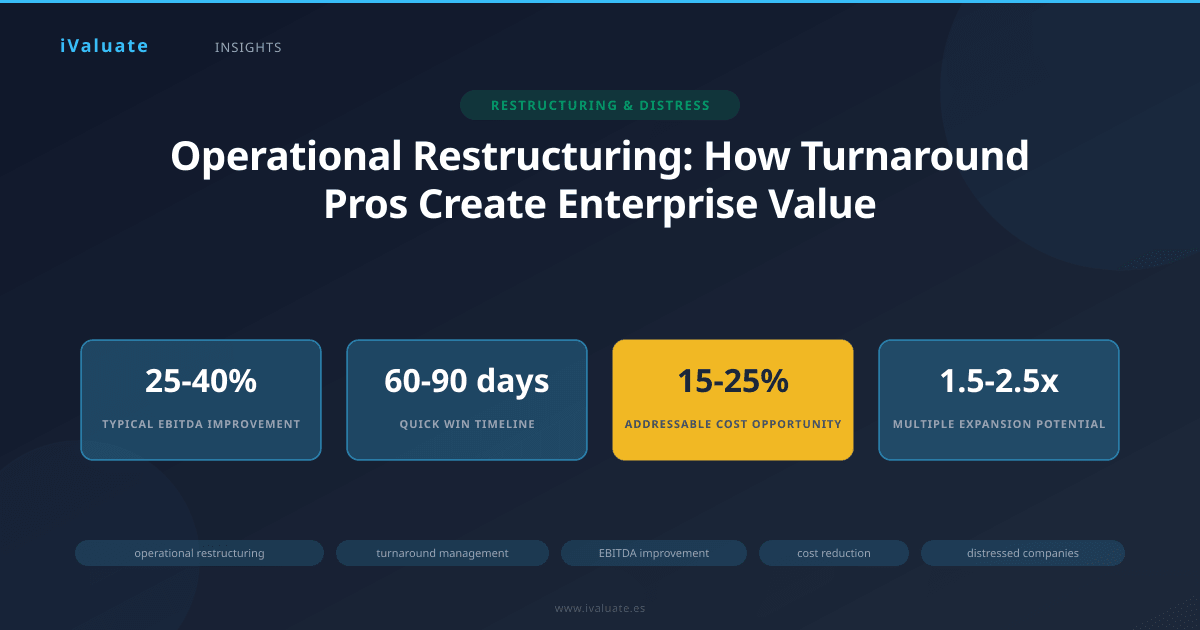
Turnaround professionals with deep operational expertise are commanding premium fees as companies face the reality that financial engineering alone cannot solve fundamental business problems. The stakes are substantial: companies that successfully execute operational restructurings typically achieve 25-40% EBITDA improvements within 12-18 months, while those that fail face liquidation or fire-sale acquisitions at 20-30% discounts to orderly sale values.
01 The Operational Restructuring Framework
Effective operational restructuring follows a disciplined, time-compressed framework that turnaround professionals have refined across hundreds of engagements. The process typically unfolds across four overlapping phases, each with specific objectives and deliverables:
Phase 1: Rapid Diagnostic Assessment (Weeks 1-3)
The initial diagnostic phase establishes the baseline and identifies value creation opportunities. Turnaround professionals conduct a comprehensive assessment across six critical dimensions:
- Financial performance analysis: Detailed EBITDA bridge construction, working capital analysis, and cash flow modeling to understand historical performance drivers and identify variance sources
- Cost structure decomposition: Granular mapping of the cost base into fixed versus variable, value-adding versus non-value-adding, and controllable versus non-controllable categories
- Revenue quality assessment: Customer profitability analysis, product/service line economics, and pricing power evaluation to identify which revenue streams actually create value
- Operational efficiency benchmarking: Comparison of key operational metrics (labor productivity, asset utilization, procurement spend, overhead ratios) against industry standards and best-in-class performers
- Organizational capability review: Assessment of management depth, decision-making processes, and organizational structure effectiveness
- Stakeholder landscape mapping: Understanding lender covenants, supplier terms, customer concentration risks, and regulatory constraints that will shape restructuring options
During this phase, experienced turnaround professionals often uncover 15-25% of total cost base as addressable opportunity, though not all opportunities are immediately actionable given operational, contractual, or strategic constraints.
Phase 2: Stabilization and Quick Wins (Weeks 2-8)
Parallel to the diagnostic work, turnaround teams implement immediate stabilization measures and capture "quick win" opportunities that generate cash and build credibility with stakeholders. Common stabilization actions include:
- Implementing weekly cash management disciplines with 13-week cash flow forecasting
- Renegotiating payment terms with key suppliers to preserve critical supply chains
- Freezing discretionary spending and non-essential capital expenditures
- Reducing inventory levels through aggressive SKU rationalization and improved demand planning
- Accelerating collections from slow-paying customers
Quick wins typically deliver 5-10% EBITDA improvement within 60-90 days and often include: eliminating low-value professional services contracts, renegotiating insurance policies and utility contracts, reducing temporary labor and overtime, and implementing basic procurement controls to eliminate maverick spending.
A mid-market industrial distributor case from early 2025 illustrates the impact: within 45 days of engagement, the turnaround team reduced operating expenses by $2.3 million annually through contract renegotiations ($800K), headcount optimization ($1.1M), and facility consolidation planning ($400K), improving EBITDA margin from 3.2% to 5.8% on a run-rate basis.
Phase 3: Comprehensive Restructuring Plan (Weeks 4-12)
The core restructuring plan synthesizes diagnostic findings into an integrated transformation roadmap with specific initiatives, accountability assignments, and financial targets. Best-practice restructuring plans include:
EBITDA Bridge Construction: The EBITDA bridge serves as the central planning and tracking tool, decomposing the path from current to target EBITDA into discrete, measurable initiatives. A typical bridge includes:
- Revenue initiatives (pricing optimization, customer mix improvement, new product launches)
- Cost of goods sold reduction (procurement savings, yield improvements, waste reduction)
- Operating expense reduction (headcount optimization, facility rationalization, process automation)
- Working capital improvements (inventory reduction, payables extension, receivables acceleration)
Each bridge element requires detailed supporting analysis showing baseline performance, improvement target, implementation timeline, investment required, and risk-adjusted probability of success. Turnaround professionals typically apply 70-85% probability factors to restructuring initiatives to create credible, achievable plans that maintain stakeholder confidence.
Organizational Redesign: Most operational restructurings require significant organizational changes to align structure with strategy and eliminate redundancy. Common approaches include:
- Span of control optimization, typically targeting 1:7-1:10 manager-to-employee ratios versus the 1:4-1:5 ratios common in bloated organizations
- Delayering to reduce management levels and accelerate decision-making
- Shared services implementation for transactional functions (finance, HR, IT)
- Outsourcing of non-core activities where external providers offer 20%+ cost advantages
Organizational restructuring typically delivers 12-18% reductions in SG&A expenses, though implementation requires careful change management to maintain morale and retain critical talent.
Phase 4: Implementation and Performance Management (Months 3-18)
Successful restructuring execution requires rigorous program management disciplines that many distressed companies lack. Turnaround professionals establish:
- Weekly initiative tracking: Detailed monitoring of each restructuring initiative against milestones, with red/yellow/green status reporting and immediate escalation of at-risk items
- Financial impact validation: Monthly reconciliation of actual financial results to restructuring plan targets, with variance analysis and corrective action planning
- Stakeholder communication cadence: Regular updates to lenders, boards, and key stakeholders demonstrating progress and maintaining confidence
- Capability building: Training and development to ensure the organization can sustain improvements after the turnaround team exits
02 Core Value Creation Levers in Operational Restructuring
While every restructuring situation is unique, turnaround professionals consistently focus on several high-impact value creation levers that have proven effective across industries and company sizes.
Strategic Cost Reduction
Cost reduction remains the most reliable and fastest path to EBITDA improvement in distressed situations. However, effective cost reduction requires strategic discipline to avoid the "cut to the bone" approach that damages long-term competitiveness. Leading turnaround professionals employ a zero-based budgeting mindset, challenging every cost element to justify its existence based on value creation rather than historical precedent.
In the 2025-2026 environment, typical cost reduction targets by category include:
- Direct labor: 10-20% reduction through productivity improvements, automation, and workforce optimization. Manufacturing companies are increasingly deploying collaborative robotics and AI-powered quality control systems that reduce labor requirements while improving output quality.
- Indirect labor and overhead: 15-25% reduction through organizational redesign, process automation, and shared services implementation. The maturation of AI-powered tools for financial close, procurement, and customer service has accelerated overhead reduction opportunities.
- Procurement and materials: 8-15% reduction through strategic sourcing, supplier consolidation, and specification optimization. Current supply chain normalization after pandemic-era disruptions has restored buyer negotiating leverage in most categories.
- Facilities and occupancy: 20-35% reduction through real estate rationalization, reflecting the structural shift to hybrid work models and increased acceptance of remote operations.
A professional services firm restructuring in mid-2025 achieved $18 million in annual cost reductions (22% of operating expenses) through: office footprint reduction from 12 locations to 4 regional hubs ($4.2M savings), organizational delayering eliminating 3 management levels ($7.8M), technology platform consolidation ($3.1M), and procurement optimization ($2.9M). The restructuring improved EBITDA margin from -2% to +11% within 14 months.
Revenue Quality Enhancement
While cost reduction generates immediate EBITDA impact, sustainable value creation requires improving revenue quality—the profitability and strategic value of the revenue base. Turnaround professionals conduct granular customer and product profitability analysis, often revealing that 20-30% of revenue actually destroys value when fully-loaded costs are properly allocated.
Revenue quality initiatives typically include:
- Customer portfolio optimization: Repricing or exiting unprofitable customer relationships, particularly those requiring disproportionate service costs or carrying unfavorable payment terms. Many companies discover their largest customers are among their least profitable.
- Product/service line rationalization: Eliminating low-margin, high-complexity offerings that consume disproportionate resources. SKU reduction initiatives commonly eliminate 30-40% of product variants while affecting less than 5% of revenue.
- Pricing discipline restoration: Implementing systematic pricing processes with clear approval authorities, regular price increase cadences, and elimination of discretionary discounting. In the current environment, companies with strong value propositions are achieving 4-8% annual price increases in many sectors.
- Channel optimization: Shifting sales mix toward higher-margin channels and eliminating unprofitable distribution relationships.
These initiatives typically improve gross margins by 300-600 basis points while accepting 5-12% revenue reduction from exited business. The EBITDA impact is strongly positive, as eliminated revenue was often EBITDA-negative when fully costed.
Working Capital Optimization
Working capital improvements generate immediate cash flow benefits that are critical for distressed companies facing liquidity constraints. Best-practice working capital optimization targets each component:
Inventory Reduction: Turnaround professionals typically identify 25-40% inventory reduction opportunities through:
- SKU rationalization eliminating slow-moving and obsolete items
- Improved demand forecasting reducing safety stock requirements
- Supplier lead time reduction enabling lower order quantities
- Consignment arrangements shifting inventory carrying costs to suppliers
A 30% inventory reduction in a company with $50 million inventory and 40% gross margin releases approximately $15 million in cash—often the difference between survival and insolvency.
Receivables Acceleration: Days sales outstanding (DSO) reduction of 8-15 days through enhanced collections processes, early payment discounts, and tighter credit policies. In the current higher interest rate environment, the cash flow benefit of DSO reduction has increased substantially—each day of DSO improvement on $100 million annual revenue generates $275K in cash.
Payables Extension: Days payable outstanding (DPO) extension of 5-10 days through systematic payment term negotiations, though this must be balanced against supplier relationship preservation and early payment discount economics.
Operational Excellence and Process Improvement
Beyond immediate cost reduction, sustainable operational restructuring embeds continuous improvement capabilities that drive long-term competitiveness. Turnaround professionals increasingly deploy lean manufacturing, Six Sigma, and digital transformation methodologies to improve operational performance:
- Manufacturing productivity: Overall equipment effectiveness (OEE) improvements from typical 60-65% levels to 75-85% through predictive maintenance, changeover time reduction, and quality improvement initiatives
- Process automation: Robotic process automation (RPA) and workflow digitization eliminating manual, error-prone processes in finance, HR, and customer service functions. Current RPA implementations typically achieve 40-60% labor reduction in targeted processes with 12-18 month payback periods.
- Supply chain optimization: Network modeling and optimization reducing logistics costs by 10-18% through facility location optimization, route optimization, and mode shifting
- Quality improvement: Defect and rework reduction improving first-pass yield and reducing warranty costs, often delivering 2-4% gross margin improvement
03 The EBITDA Bridge: Tracking Value Creation
The EBITDA bridge serves as both planning tool and performance scorecard throughout the restructuring journey. A well-constructed bridge provides transparency into value creation sources and enables rigorous accountability for results.
Consider a representative EBITDA bridge for a $200 million revenue industrial company improving from $8 million EBITDA (4.0% margin) to $32 million (16.0% margin) over 18 months:
- Starting EBITDA: $8.0 million
- Revenue initiatives: +$2.5 million (price increases +$4.2M, volume decline from customer exits -$1.7M)
- Gross margin improvement: +$8.5 million (procurement savings +$3.8M, product mix improvement +$2.1M, manufacturing productivity +$2.6M)
- Operating expense reduction: +$12.0 million (headcount optimization +$6.8M, facility consolidation +$2.9M, professional services reduction +$1.4M, other +$0.9M)
- One-time restructuring costs: -$2.0 million (severance, facility exit costs, professional fees)
- Other adjustments: +$3.0 million (working capital efficiency, other operational improvements)
- Ending EBITDA: $32.0 million
This bridge demonstrates the multi-faceted approach required for successful operational restructuring, with value creation coming from revenue quality improvement, cost structure optimization, and operational excellence rather than any single initiative.
04 Critical Success Factors and Common Pitfalls
Analysis of hundreds of restructuring engagements reveals consistent patterns separating successful turnarounds from failures.
Success Factors
Decisive leadership and rapid action: Successful restructurings move quickly to establish credibility and momentum. Companies that delay difficult decisions—hoping conditions will improve—typically see their situations deteriorate further. The most successful turnarounds make 60-70% of major restructuring decisions within the first 90 days.
Stakeholder alignment and communication: Maintaining lender, board, employee, and customer confidence requires transparent, frequent communication demonstrating progress against commitments. Weekly lender calls and monthly board updates are standard practice in well-managed restructurings.
Rigorous program management: Successful restructurings employ dedicated program management offices (PMOs) tracking hundreds of individual initiatives, dependencies, and milestones. The PMO ensures nothing falls through the cracks and enables rapid course correction when initiatives underperform.
Balanced short-term and long-term focus: While immediate cash generation is critical, successful restructurings also invest in capabilities and initiatives that position the company for sustainable growth. The best turnaround professionals resist the temptation to cut muscle along with fat.
Common Pitfalls
Across-the-board cost cutting: Undifferentiated percentage cuts across all departments typically damage critical capabilities while failing to address fundamental cost structure issues. Strategic, capability-based cost reduction delivers superior results.
Underestimating implementation complexity: Restructuring plans often underestimate the time, cost, and organizational disruption required for implementation. Realistic planning with appropriate contingencies prevents credibility-damaging plan revisions.
Neglecting change management: Technical restructuring plans fail without effective change management addressing employee concerns, communicating vision, and building organizational commitment. Companies that invest 10-15% of restructuring budgets in change management achieve significantly higher success rates.
Insufficient investment in quick wins: Early visible successes build momentum and stakeholder confidence. Restructurings that defer all benefits to later phases often lose stakeholder support before results materialize.
A retail chain restructuring in late 2024 illustrates the pitfall of delayed action: after six months of analysis and planning with minimal implementation, lender patience expired and the company entered Chapter 11. A subsequent operational restructuring under new management achieved similar EBITDA improvements within four months, but the delay cost equity holders their entire investment through the bankruptcy process.
05 The Role of Technology and Data Analytics
The 2025-2026 restructuring environment is characterized by unprecedented availability of data analytics and AI-powered tools that accelerate diagnostic work and improve decision quality. Leading turnaround professionals leverage:
- Advanced analytics for customer and product profitability: Machine learning algorithms processing millions of transactions to identify profitability patterns invisible to traditional analysis
- Predictive analytics for demand forecasting: AI-powered forecasting reducing inventory requirements and improving service levels simultaneously
- Process mining for operational improvement: Automated analysis of ERP system logs revealing actual process flows, bottlenecks, and automation opportunities
- Benchmarking databases: Access to proprietary databases enabling rapid, granular benchmarking of operational metrics against industry peers and best performers
These tools compress diagnostic timelines from 8-12 weeks to 3-4 weeks while improving analysis quality, enabling faster action and better outcomes.
06 Valuation Impact of Successful Operational Restructuring
The enterprise value impact of successful operational restructuring is substantial and multi-dimensional. Beyond the direct EBITDA improvement, restructured companies benefit from:
Multiple expansion: Companies emerging from successful restructurings typically command 1.5-2.5x higher EBITDA multiples than distressed peers, reflecting reduced risk, improved growth prospects, and enhanced operational capabilities. A company improving from 4% to 16% EBITDA margin might see its valuation multiple expand from 4.5x to 7.5x, creating value through both EBITDA growth and multiple expansion.
Improved strategic positioning: Operational restructuring often clarifies strategic focus, improves competitive positioning, and enhances attractiveness to strategic or financial acquirers. Companies that successfully restructure frequently receive acquisition interest at meaningful premiums to pre-restructuring valuations.
Enhanced financing capacity: Improved EBITDA and cash flow generation enables refinancing at better terms, reducing interest expense and further improving profitability. In the current environment, companies improving from sub-2.0x to above 3.0x debt/EBITDA ratios are seeing interest rate reductions of 200-400 basis points.
The combined impact is dramatic: a company improving EBITDA from $8 million to $32 million while expanding its multiple from 4.5x to 7.5x sees enterprise value increase from $36 million to $240 million—a 6.7x value creation multiple that far exceeds returns available through financial restructuring alone.
07 Looking Ahead: The Future of Operational Restructuring
As we progress through 2025-2026, several trends are reshaping operational restructuring practice:
AI and automation acceleration: Generative AI and advanced automation technologies are creating unprecedented opportunities for cost reduction and productivity improvement. Turnaround professionals who can rapidly deploy these technologies are achieving results that would have been impossible just 24 months ago.
ESG integration: Environmental, social, and governance considerations are increasingly integrated into restructuring plans, as stakeholders recognize that sustainable, responsible operations create more durable value than pure cost optimization.
Hybrid work optimization: The structural shift to hybrid work models continues to create opportunities for real estate rationalization and organizational redesign, though companies are learning to balance cost reduction with culture preservation and collaboration effectiveness.
Supply chain resilience: Post-pandemic supply chain vulnerabilities have elevated the importance of resilience and flexibility alongside cost efficiency, requiring more sophisticated supply chain optimization approaches.
For turnaround professionals, these trends create both opportunities and challenges. Success requires combining traditional restructuring disciplines with emerging capabilities in digital transformation, sustainability, and organizational design.
The companies that will thrive in the coming years are those that view operational restructuring not as a crisis response but as a continuous capability—constantly optimizing operations, eliminating waste, and adapting to changing market conditions. For distressed companies, engaging experienced turnaround professionals early—before liquidity crises eliminate options—dramatically improves outcomes and preserves value for all stakeholders.
Professional platforms like iValuate are increasingly essential tools in this environment, enabling turnaround professionals and their clients to rapidly model restructuring scenarios, track value creation against targets, and communicate progress to stakeholders with transparency and rigor. As operational restructuring grows more complex and data-intensive, the ability to leverage sophisticated analytical tools while maintaining focus on fundamental value drivers will increasingly separate successful turnarounds from expensive failures.