Índice13 secciones
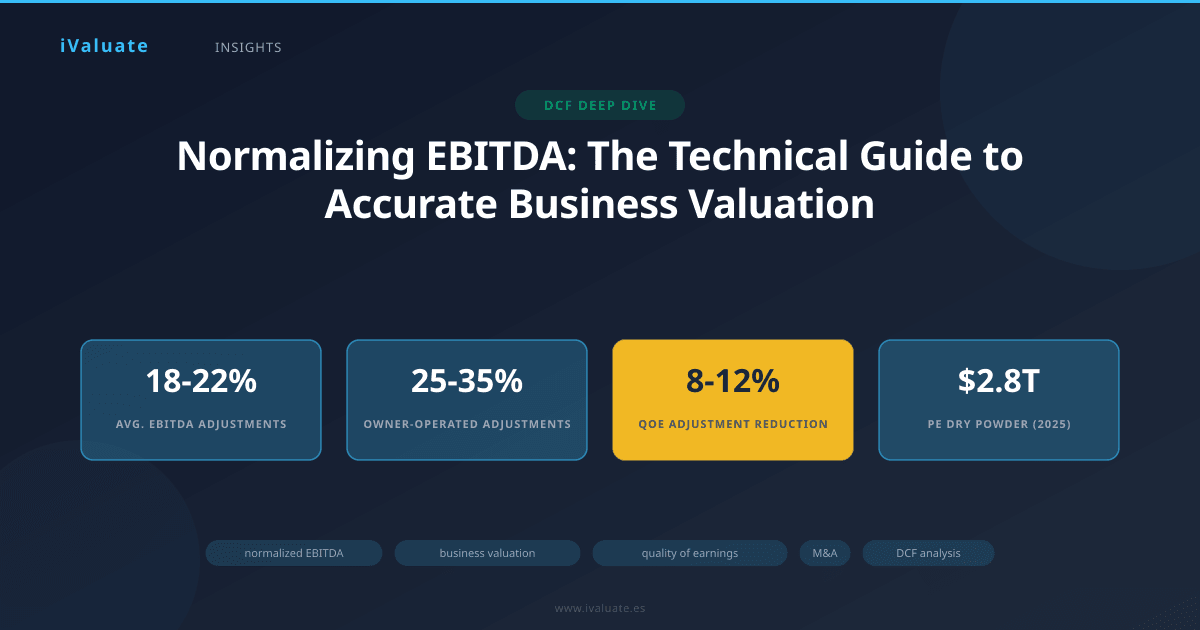
In the current M&A environment of 2025-2026, where private equity dry powder exceeds $2.8 trillion and middle-market valuations hover at 8-12x normalized EBITDA, the accuracy of earnings normalization has never been more critical. A single misclassified expense or overlooked adjustment can swing valuations by 15-25%, potentially costing buyers millions or leaving sellers significantly undercompensated.
Normalized EBITDA—often called adjusted EBITDA or proforma EBITDA—represents the sustainable, recurring earnings power of a business stripped of anomalies, one-time events, and idiosyncratic ownership decisions. This metric forms the foundation of virtually every valuation methodology, from comparable company analysis to discounted cash flow models. Yet despite its ubiquity, EBITDA normalization remains one of the most contentious aspects of business valuation, where art meets science and where deal negotiations often intensify.
01 The Foundation: Understanding Normalized EBITDA
Normalized EBITDA adjusts reported earnings before interest, taxes, depreciation, and amortization to reflect what a hypothetical arms-length buyer could expect to generate from the business under normal operating conditions. The objective is to eliminate distortions caused by:
- Non-recurring or extraordinary items that won't repeat under new ownership
- Owner-specific compensation and benefits exceeding market rates
- Related party transactions not conducted at fair market value
- Discretionary expenses that mask true profitability
- Timing anomalies and accounting policy choices
According to data from Pitchbook's 2025 Middle Market Report, normalized EBITDA adjustments average 18-22% of reported EBITDA for privately-held companies, with owner-operated businesses frequently showing adjustments of 25-35%. These aren't trivial modifications—they fundamentally reshape the valuation narrative.
02 Category One: Non-Recurring and Extraordinary Items
Non-recurring items represent expenses or income that are genuinely one-time in nature and unlikely to repeat in the ordinary course of business. The key test: would a reasonable buyer expect this item to recur with similar frequency and magnitude?
Legitimate Non-Recurring Adjustments
Litigation settlements and legal fees: A manufacturing company that incurred $850,000 in legal expenses defending a patent infringement claim that was settled in 2024 can legitimately add back these costs. However, if the company faces routine IP disputes every 2-3 years, only the excess above the normalized legal budget should be adjusted.
Facility relocations and restructuring: One-time moving costs, lease termination penalties, and employee severance related to a genuine operational restructuring qualify for adjustment. A distribution company that relocated its primary warehouse in 2025, incurring $1.2 million in non-recurring costs, can defensibly add back these expenses.
Natural disasters and force majeure events: Hurricane damage, pandemic-related shutdowns, or supply chain disruptions from geopolitical events (such as the 2024-2025 Red Sea shipping crisis) that caused abnormal expenses or revenue losses warrant adjustment, provided they're truly extraordinary for the specific business.
Asset impairments and write-downs: Non-cash charges for goodwill impairment, inventory obsolescence from discontinued product lines, or write-offs of failed R&D projects should be scrutinized carefully. The impairment itself may be added back, but the underlying business decision that led to the loss may signal operational issues.
Questionable Adjustments Requiring Scrutiny
The challenge emerges when sellers attempt to normalize items that, while perhaps unusual in a single year, represent recurring business risks or management decisions:
- Customer concentration losses: Losing a major customer is painful but represents an inherent business risk, not a non-recurring event. The revenue and margin impact should flow through to normalized EBITDA unless the business model has fundamentally changed.
- Product recall costs: For manufacturers, occasional recalls may be part of the risk profile. Only costs exceeding historical norms should potentially be adjusted.
- Regulatory compliance expenses: New regulatory requirements (such as data privacy laws or environmental standards) represent ongoing costs of doing business, not one-time adjustments.
- Technology system implementations: While ERP implementations create short-term disruption, businesses require periodic technology investments. Only truly extraordinary costs beyond normal capex should be considered.
Best Practice: Apply the "frequency test"—if similar items have occurred more than once in the past five years, they're likely recurring business expenses rather than genuine anomalies. Documentation is critical: maintain a detailed adjustment schedule with supporting invoices, contracts, and narrative explanations.
03 Category Two: Owner Compensation Normalization
Owner compensation normalization represents one of the largest and most defensible adjustment categories, particularly for closely-held businesses where owners have significant discretion over their compensation structure. The principle is straightforward: adjust the owner's total compensation package to reflect what the business would pay a qualified third-party executive to perform the same functions.
Components of Owner Compensation
A comprehensive analysis must capture all forms of owner compensation:
- Base salary and bonuses: The stated W-2 or guaranteed payment amounts
- Payroll taxes and benefits: Employer-paid FICA, health insurance, retirement contributions
- Perquisites: Company vehicles, country club memberships, personal travel on company accounts
- Family member compensation: Payments to spouses, children, or relatives for services rendered (or not rendered)
- Distributions and dividends: While not technically compensation, excessive distributions may indicate understated salary
Determining Market-Rate Compensation
The replacement cost methodology asks: what would this business pay to hire a qualified CEO, COO, or general manager to perform the owner's functions? Several data sources inform this analysis:
Compensation surveys: Resources like the Economic Research Institute (ERI), Salary.com, and industry-specific surveys provide benchmarks. For a $15 million revenue manufacturing company in the Midwest, a qualified CEO typically commands $225,000-$325,000 in total compensation. A $50 million distribution business might require $400,000-$550,000 for equivalent leadership.
Functional analysis: Not all owners perform CEO-level functions. An owner who primarily handles sales might be replaced by a VP of Sales at $180,000-$250,000, while operational owners might require a COO at $200,000-$300,000. Some businesses need multiple executives to replace a multifaceted owner.
Geographic and industry adjustments: Compensation varies significantly by location and sector. A software company CEO in Austin commands 25-30% more than a comparable role in Birmingham. Adjust benchmarks accordingly.
Real-World Example: Owner Compensation Normalization
Consider a $28 million revenue specialty contractor where the founder/owner takes $180,000 in W-2 salary, employs his spouse as "office manager" at $95,000 (market rate: $55,000), and runs $45,000 in personal expenses through the company (luxury vehicle lease, country club, personal travel). The business also pays $38,000 in health insurance and retirement benefits for the owner.
Total owner-related compensation: $358,000. Market rate for a qualified general manager in this industry and geography: $240,000 all-in. The normalization adjustment: $118,000 added back to EBITDA. At a 9.5x EBITDA multiple, this single adjustment increases enterprise value by $1.12 million.
04 Category Three: Related Party Transactions
Related party transactions occur when the business transacts with entities controlled by the owner, family members, or affiliated businesses. These arrangements often deviate from fair market value, either inflating expenses (reducing taxable income) or creating artificial revenue streams.
Common Related Party Adjustments
Real estate leases: Many owners hold commercial real estate in separate entities and lease it to their operating businesses. The critical question: is the rent at market rate? If the business pays $25,000 monthly for a facility that would lease for $18,000 on the open market, the $7,000 monthly excess ($84,000 annually) should be added back to normalized EBITDA. Conversely, below-market leases create a liability—buyers must factor in the future rent increase.
Management fees and royalties: Affiliated entities sometimes charge management fees, licensing fees, or royalties that exceed arm's-length rates. A franchisee paying 8% royalties to a related franchisor when market rates are 5% has a 3% adjustment opportunity. However, if the buyer must continue paying the related party post-transaction, no adjustment is warranted—the expense is ongoing.
Equipment leases and financing: Owner-financed equipment or vehicles leased from related entities may carry above-market rates. Compare lease payments to fair market lease rates or the cost of conventional financing.
Vendor relationships: Purchases from owner-affiliated suppliers must be benchmarked against market pricing. A restaurant buying produce from the owner's farm at 15% above wholesale market prices has a legitimate adjustment, but proving market rates requires comparable vendor quotes.
Intercompany charges: Corporate overhead allocations, shared services, or cost-sharing arrangements between related entities require careful analysis. Are the allocations reasonable and based on actual resource consumption?
Documentation Requirements
Related party adjustments demand robust documentation:
- Independent appraisals for real estate establishing fair market rent
- Comparable lease quotes from unrelated landlords
- Industry benchmark data for royalty rates and management fees
- Vendor quotes demonstrating market pricing for goods and services
- Written agreements documenting the terms of related party arrangements
Buyer Perspective: Sophisticated buyers scrutinize related party transactions intensely. If the seller retains ownership of real estate or affiliated entities post-closing, buyers will demand long-term agreements at clearly established market rates. The inability to continue favorable related party arrangements post-transaction eliminates the adjustment's validity.
05 Category Four: Discretionary and Personal Expenses
Closely-held businesses often run personal or discretionary expenses through the company to minimize taxable income. While understandable from a tax perspective, these expenses mask true profitability and warrant adjustment.
Common Discretionary Adjustments
- Excessive travel and entertainment: Business trips that include substantial personal components, luxury accommodations beyond business necessity, or entertainment expenses disproportionate to revenue generation
- Vehicle expenses: Personal use of company vehicles, luxury vehicles exceeding business requirements, or multiple vehicles for owner and family members
- Professional fees: Personal legal fees, tax preparation for individual returns, or estate planning costs run through the business
- Charitable contributions: While admirable, charitable giving represents an owner's personal decision, not an operating expense a buyer would continue
- Club memberships and subscriptions: Country clubs, social clubs, or subscriptions without clear business development purposes
The threshold question: would a professional management team incur this expense in the normal course of business? If not, it's a candidate for adjustment.
06 Category Five: Accounting Policy and Timing Adjustments
Accounting policy choices and timing differences can distort EBITDA, requiring normalization to reflect economic reality.
Revenue Recognition Adjustments
Businesses using cash-basis accounting may show significant timing distortions compared to accrual-basis reporting. A construction company that received a $500,000 deposit in December 2025 for a project starting in January 2026 would show inflated 2025 revenue under cash accounting. Normalization requires adjusting to the economic substance of the transaction.
Inventory and Cost of Goods Sold
LIFO vs. FIFO inventory accounting, changes in inventory valuation methods, or inventory write-downs may require adjustment. A retailer that wrote down $180,000 in slow-moving inventory in 2025 but historically maintains excess inventory as a business practice shouldn't receive a full adjustment—the write-down reflects a recurring management issue.
Deferred Revenue and Unbilled Receivables
SaaS companies and service businesses with subscription models may have significant deferred revenue (cash received but revenue not yet recognized) or unbilled receivables (services performed but not yet invoiced). Normalized EBITDA should reflect the economic earnings power, not just the accounting timing.
07 Proforma Adjustments: Forward-Looking Modifications
Beyond normalizing historical results, proforma adjustments project the impact of known changes that will affect future performance. These adjustments are more speculative and require careful documentation and buyer agreement.
Legitimate Proforma Adjustments
Signed contracts and commitments: A software company that signed a $2 million annual contract in December 2025, effective January 2026, can proforma the revenue and associated margins into the trailing twelve months, demonstrating the current run rate.
Completed acquisitions: If the target acquired a complementary business mid-year, proforma financials should include a full year of the acquired entity's results (adjusted for synergies and integration costs).
Price increases: Implemented price increases with contractual or demonstrated customer acceptance can be proformed. A distributor that raised prices 6% in October 2025 can proforma a full year at the new pricing, assuming customer retention.
Cost reduction initiatives: Completed restructurings, facility consolidations, or vendor renegotiations with documented savings can be proformed. However, anticipated or planned initiatives without concrete implementation are speculative.
Synergies: The Buyer's Domain
A critical distinction: normalization adjustments belong to the seller and reflect the business's standalone earning power. Synergies—cost savings or revenue enhancements a specific buyer could achieve—belong to the buyer and should not inflate the seller's normalized EBITDA.
For example, a strategic buyer might eliminate redundant corporate overhead, consolidate facilities, or cross-sell products to their existing customer base. These synergies justify a higher purchase price but don't increase the seller's normalized EBITDA. In competitive auctions, buyers may pay for synergies through higher multiples rather than inflated EBITDA.
08 The Quality of Earnings Perspective
Sophisticated transactions involve quality of earnings (QoE) analysis by the buyer's accounting firm. QoE reports scrutinize normalization adjustments with forensic intensity, often challenging 30-40% of seller-proposed adjustments. Common QoE findings include:
- Adjustments lacking adequate documentation or support
- "Non-recurring" items that actually recur with regularity
- Aggressive revenue recognition or timing manipulations
- Related party transactions where market rates aren't substantiated
- Proforma adjustments based on speculative assumptions
In a 2025 survey of middle-market transactions, QoE reports reduced seller-proposed normalized EBITDA by an average of 8-12%, directly impacting purchase price. The lesson: conservative, well-documented adjustments withstand scrutiny; aggressive adjustments invite skepticism and renegotiation.
09 Industry-Specific Considerations
Manufacturing and Distribution
These sectors frequently show adjustments for equipment maintenance timing (major overhauls vs. routine maintenance), inventory obsolescence, and customer concentration issues. Warranty reserves and product liability costs require careful analysis—are they truly non-recurring or part of the business model?
Professional Services
Owner compensation normalization dominates professional services valuations. A law firm where the founding partner bills 1,800 hours annually at $450/hour but takes only $300,000 in compensation has significant normalization potential. However, the analysis must consider whether a replacement attorney could generate similar billing rates and client relationships.
Technology and SaaS
Technology companies often show significant R&D expenses, customer acquisition costs, and stock-based compensation. While stock-based comp is non-cash, it represents real economic cost. Normalization should consider whether the business can attract talent without equity compensation post-transaction. Capitalized software development costs vs. expensed R&D also requires adjustment to reflect economic reality.
Healthcare Services
Healthcare businesses face unique challenges with insurance reimbursement timing, regulatory compliance costs, and provider compensation. Adjustments for one-time EMR implementations, HIPAA compliance projects, or payer contract renegotiations are common, but ongoing regulatory burden is part of the business model.
10 Best Practices and Documentation Standards
Professional-grade EBITDA normalization requires rigorous documentation and methodology:
Maintain a detailed adjustment schedule: Create a line-by-line schedule showing each adjustment, the amount, the category (non-recurring, owner comp, related party, etc.), and a clear explanation. Include supporting documentation—invoices, contracts, market data—for each material adjustment.
Apply consistency: Use the same methodology across all historical periods. If you adjust owner compensation in 2025, apply the same adjustment to 2024 and 2023 for comparability.
Conservative approach: When in doubt, take the conservative position. Aggressive adjustments that don't survive buyer scrutiny damage credibility and create negotiation friction.
Third-party validation: For material adjustments, obtain third-party support—compensation surveys, real estate appraisals, industry benchmarks. Independent validation strengthens your position.
Narrative explanation: Numbers alone don't tell the story. Provide clear, concise explanations for each adjustment category, explaining why the adjustment is appropriate and how it reflects the business's true earning power.
11 Valuation Impact: Quantifying the Stakes
The financial impact of proper EBITDA normalization is substantial. Consider a middle-market company with $3.2 million in reported EBITDA and a 9.5x valuation multiple. Appropriate normalization adjustments totaling $650,000 increase normalized EBITDA to $3.85 million, raising enterprise value from $30.4 million to $36.6 million—a $6.2 million difference.
Conversely, aggressive adjustments that don't survive due diligence create significant problems. A seller who claims $4.5 million in normalized EBITDA based on questionable adjustments, only to have the buyer's QoE report support just $3.7 million, faces a difficult choice: accept a $7.6 million valuation reduction (at 9.5x) or risk the deal collapsing entirely.
Recent market data from GF Data's 2025 Private Capital Markets Report shows that deals with normalized EBITDA adjustments exceeding 30% of reported EBITDA face 40% higher likelihood of price renegotiation during due diligence and 25% longer time-to-close. Clean, conservative normalization accelerates transactions and preserves deal certainty.
12 Looking Forward: The Evolution of EBITDA Normalization
As we progress through 2025-2026, several trends are shaping EBITDA normalization practices:
Increased scrutiny of ESG expenses: Environmental, social, and governance initiatives create new expense categories. Are sustainability investments one-time costs or ongoing commitments? Buyers increasingly view ESG as integral to operations, limiting adjustment opportunities.
Technology and AI implementation costs: Businesses investing heavily in AI, automation, and digital transformation face questions about whether these are one-time implementations or continuous investments. The rapid pace of technological change suggests ongoing rather than one-time expenses.
Remote work implications: The shift to hybrid and remote work models has changed expense patterns—reduced facility costs but increased technology and cybersecurity expenses. Normalization must reflect the new operational reality.
Supply chain resilience investments: Post-pandemic supply chain diversification and resilience investments represent a new category of potentially recurring expenses that sellers may attempt to characterize as non-recurring.
The sophistication of buyers, particularly financial sponsors with extensive portfolio experience, continues to increase. Private equity firms now maintain detailed databases of normalization adjustments across their portfolios, enabling them to quickly identify outliers and questionable adjustments. This institutional knowledge raises the bar for sellers and their advisors.
13 Conclusion: Precision Matters
EBITDA normalization sits at the intersection of accounting precision, business judgment, and negotiation strategy. Done correctly, it reveals the true earning power of a business and establishes a fair foundation for valuation. Done poorly, it creates friction, delays transactions, and destroys value.
The key principles remain constant: adjustments must be well-documented, defensible, and conservative. They should reflect what a reasonable buyer would expect as the sustainable earning power of the business under normal operating conditions. Non-recurring items must be genuinely non-recurring, owner compensation must be benchmarked to market rates with supporting data, and related party transactions must be adjusted to fair market value with independent validation.
For business owners preparing for a transaction, begin the normalization process 12-18 months before going to market. Clean up related party arrangements, benchmark owner compensation, and document any legitimate non-recurring items as they occur. For buyers, invest in thorough quality of earnings analysis and don't accept seller adjustments at face value—verify, document, and negotiate.
In an environment where middle-market valuations are at near-record levels and competition for quality assets remains intense, precision in EBITDA normalization can mean the difference between a successful transaction and a failed deal. Professional valuation platforms like iValuate help both buyers and sellers navigate these complexities, providing structured frameworks for adjustment analysis and documentation that withstand the scrutiny of sophisticated counterparties and their advisors. The businesses that approach normalization with rigor, transparency, and professional support position themselves for optimal outcomes in today's dynamic M&A market.