Índice10 secciones
The mid-market M&A landscape in Southern Europe—specifically Spain, Italy, and Portugal—has demonstrated remarkable resilience through 2025 and into early 2026, even as broader European markets face persistent macroeconomic uncertainty. Companies valued between €10 million and €100 million represent the backbone of these economies, and their transaction activity reveals compelling trends that professional advisors, private equity investors, and strategic acquirers must understand to capitalize on emerging opportunities.
This segment has historically been characterized by family-owned businesses, fragmented industries, and regional champions that have built sustainable competitive advantages in niche markets. The current cycle presents a unique confluence of factors: aging business owners facing succession challenges, strategic buyers seeking bolt-on acquisitions to achieve scale, and private equity funds with substantial dry powder targeting resilient, cash-generative businesses.
01 Market Overview: Deal Volume and Valuation Trends
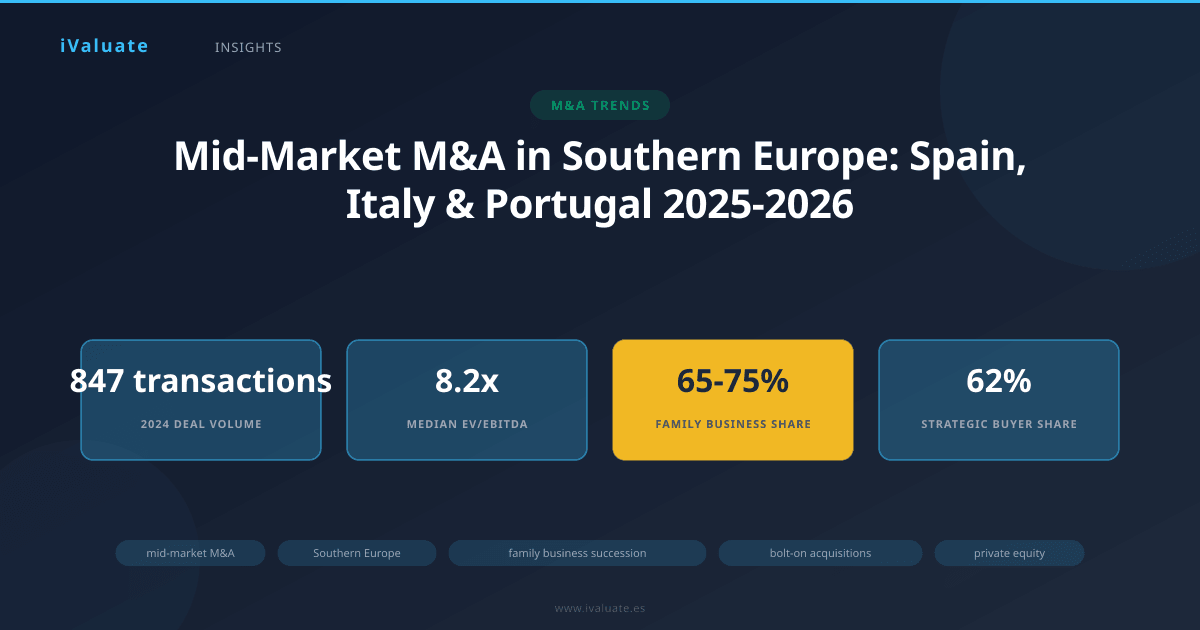
Mid-market M&A activity across Spain, Italy, and Portugal reached approximately 847 transactions in the €10-100M enterprise value range during 2024, representing a 12% increase over 2023 levels. This growth trajectory has continued into 2025, with first-half activity suggesting full-year volumes could approach 920-950 deals—a notable acceleration despite elevated interest rates and geopolitical tensions affecting broader European sentiment.
Valuation multiples in this segment have shown sector-specific divergence. The median EV/EBITDA multiple for completed transactions in 2024-2025 settled at approximately 8.2x across all sectors, though this aggregate figure masks significant variation. Technology-enabled services and healthcare-related businesses commanded premiums of 10.5-13.2x, while traditional manufacturing and construction-related assets traded at 6.1-7.4x multiples.
Spain has led transaction volume with approximately 385 deals in the target range during 2024, followed by Italy with 342 transactions and Portugal with 120 deals. However, when normalized for GDP, Portugal shows the highest deal intensity, reflecting its increasingly dynamic entrepreneurial ecosystem and growing appeal to international buyers seeking European market entry points with attractive cost structures.
Sector Composition and Hot Industries
The sectoral distribution of mid-market deals reveals clear patterns aligned with Southern Europe's economic strengths and transformation priorities:
- Business Services and Technology: Representing 23% of deal volume, this category includes software, IT services, digital marketing, and business process outsourcing. Spanish and Portuguese tech-enabled service providers have attracted particular interest from Nordic and UK-based strategic buyers seeking nearshore capabilities and access to Latin American markets.
- Healthcare and Life Sciences: Accounting for 18% of transactions, this sector encompasses specialized clinics, diagnostic services, medical devices, and pharmaceutical distribution. Italy's fragmented healthcare services market has been especially active, with private equity funds consolidating regional players.
- Industrial and Manufacturing: Despite representing a declining share at 16% of deals, this traditional strength area remains significant. Transactions focus on specialized manufacturers with proprietary technology, sustainable production capabilities, or critical supply chain positions.
- Consumer and Retail: At 14% of volume, this category has bifurcated between struggling traditional retail (minimal activity) and thriving e-commerce, specialty food, and experiential concepts that have attracted both strategic and financial buyers.
- Food and Beverage: Representing 12% of deals, Southern Europe's culinary heritage drives continued interest in premium food producers, wine estates, and specialty ingredient suppliers, particularly those with export capabilities and authentic origin stories.
02 The Family Business Succession Imperative
Family-owned businesses constitute an estimated 65-75% of mid-market companies in Southern Europe, and succession challenges have emerged as the single most significant driver of deal flow in this segment. Demographic data reveals that approximately 42% of family business owners in Spain, Italy, and Portugal are aged 60 or older, with many lacking clear succession plans or willing next-generation leaders.
This succession crisis creates both opportunities and complexities. Unlike Anglo-Saxon markets where professional management transitions are routine, Southern European family businesses often have deeply embedded family leadership, concentrated ownership structures, and informal governance practices that complicate sale processes.
Succession Transaction Characteristics
Transactions driven by succession considerations typically exhibit distinct characteristics that advisors must navigate:
Extended timelines: Family business sales average 14-18 months from initial engagement to closing, compared to 9-12 months for corporate carve-outs or management buyouts. Emotional considerations, family consensus-building, and legacy preservation concerns extend negotiation periods.
Valuation gaps: Founders often harbor inflated value expectations based on emotional attachment rather than market comparables. Successful transactions require patient education about valuation methodologies, market multiples, and the impact of business dependencies on founder expertise or relationships.
Earnouts and rollover equity: Approximately 58% of family business succession transactions in the €10-100M range include earnout provisions averaging 15-25% of total consideration, allowing sellers to participate in future value creation while bridging valuation gaps. Additionally, 34% of deals involve some seller equity rollover, particularly when private equity buyers seek to retain founder expertise during transition periods.
A representative example involves a third-generation Italian precision components manufacturer with €45 million in revenue and €8.2 million in EBITDA. The 67-year-old owner's children pursued professional careers outside the business, creating a succession void. After an 18-month process, the company sold to a German strategic buyer at 9.1x EBITDA (€74.6 million enterprise value) with a three-year earnout capped at €8 million based on customer retention and margin maintenance. The founder remained as a senior advisor for 24 months, ensuring relationship continuity with key automotive OEM customers.
03 Strategic Buyers and Bolt-On Acquisition Strategies
Strategic acquirers—both Southern European champions and international corporations—have accounted for approximately 62% of mid-market transactions in the region during 2024-2025, with bolt-on acquisitions representing the dominant strategic rationale.
Bolt-on acquisitions, where buyers integrate smaller targets into existing platforms to achieve operational synergies, geographic expansion, or capability enhancement, offer compelling value creation opportunities in fragmented Southern European markets. These transactions typically command lower valuation multiples than platform investments (7.2x versus 9.8x median EV/EBITDA) while delivering faster integration timelines and more predictable synergy realization.
Geographic Expansion Bolt-Ons
Cross-border bolt-on activity within Southern Europe has intensified, with Spanish companies acquiring Portuguese targets to gain Atlantic port access and Brazilian market connections, Italian buyers seeking Spanish assets to access Latin American distribution networks, and Portuguese firms acquiring Spanish businesses to achieve EU market scale.
International strategic buyers have also accelerated bolt-on programs targeting Southern European mid-market companies. French industrial groups have been particularly active in Spain and Portugal, completing 87 acquisitions in the €10-100M range during 2024. German Mittelstand companies acquired 64 Italian and Spanish targets in the same period, primarily in industrial automation, automotive components, and specialized machinery.
Capability and Technology Bolt-Ons
Traditional Southern European companies increasingly pursue bolt-on acquisitions of technology-enabled businesses to accelerate digital transformation. A Spanish industrial distributor with €180 million in revenue might acquire a €25 million e-commerce platform to rapidly build digital sales capabilities rather than developing them organically—a pattern repeated across sectors.
These capability acquisitions often involve significant valuation premiums (11-14x EBITDA) but deliver strategic value beyond financial returns. Integration challenges are substantial, as acquirers must bridge cultural gaps between traditional hierarchical organizations and agile technology-oriented targets.
Strategic bolt-on acquisitions in Southern Europe's mid-market deliver average synergy realization of 18-24% of target EBITDA within 24 months, primarily through revenue synergies, shared services consolidation, and procurement optimization.
04 Private Equity Activity and Platform Building
Private equity funds accounted for 38% of mid-market transactions in Southern Europe during 2024-2025, with both local funds and international firms actively deploying capital. The region's private equity market has matured significantly, with approximately €42 billion in dry powder specifically targeting Southern European opportunities as of Q1 2025.
Mid-market private equity strategies in the region cluster around several proven approaches:
Buy-and-Build Platforms
Funds acquire market-leading platforms in fragmented industries, then execute programmatic bolt-on acquisition strategies to consolidate markets and build scale. Healthcare services, business services, and specialized distribution have been particularly active sectors for this approach.
A representative transaction involved a Madrid-based private equity fund acquiring a Portuguese diagnostic imaging platform with 12 centers and €32 million in revenue for 8.8x EBITDA (€48 million enterprise value). Over the subsequent 30 months, the fund completed six bolt-on acquisitions of smaller regional players at an average 6.9x multiple, building a national network of 34 centers with €89 million in revenue. The consolidated platform was subsequently sold to a pan-European healthcare services group at 11.2x EBITDA, delivering a 2.8x gross multiple on invested capital.
Professionalization and Internationalization
Many mid-market family businesses possess strong products and customer relationships but lack professional management systems, financial controls, and international expansion capabilities. Private equity buyers implement governance improvements, recruit professional management, and fund international growth initiatives.
This strategy works particularly well with Italian and Spanish manufacturers serving niche B2B markets. A typical profile might be a €55 million revenue specialty chemicals producer with 85% domestic sales, family management, and limited financial reporting. Post-acquisition, the PE fund recruits a professional CFO and international sales director, implements ERP systems, and funds sales office openings in Germany and France. Within 36 months, international revenue grows from 15% to 38% of total sales, EBITDA margins expand from 14.2% to 18.7%, and enterprise value increases from €68 million to €124 million.
ESG and Sustainability-Driven Investments
An emerging theme in Southern European mid-market PE involves acquiring traditional businesses with significant ESG improvement opportunities. Funds recognize that implementing sustainability practices, improving energy efficiency, and achieving environmental certifications can unlock value through cost reduction, premium pricing, and enhanced exit multiples.
Industrial businesses with high energy consumption or waste generation present particularly attractive opportunities. A Spanish private equity fund acquired a €72 million revenue ceramics manufacturer at 7.1x EBITDA, then invested €8.5 million in solar power generation, waste heat recovery, and circular economy initiatives. These improvements reduced energy costs by 31%, qualified the company for green financing at favorable rates, and positioned it as a preferred supplier to sustainability-focused customers. The exit multiple of 10.4x EBITDA reflected both improved financial performance and ESG premium valuation.
05 Valuation Considerations and Deal Structuring
Valuing mid-market companies in Southern Europe requires nuanced understanding of regional business practices, accounting standards, and market dynamics that differ from Northern European or Anglo-Saxon norms.
EBITDA Normalization Challenges
Family-owned businesses frequently commingle personal and business expenses, maintain family members in non-essential roles, or structure transactions to minimize reported profits for tax purposes. Advisors must carefully normalize EBITDA by adding back:
- Excess compensation to family members relative to market rates for comparable roles
- Personal expenses run through the business (vehicles, travel, real estate)
- Non-recurring professional fees, restructuring costs, or litigation expenses
- Below-market rent when the business occupies family-owned real estate
- Related-party transactions not conducted at arm's length pricing
Normalized EBITDA typically exceeds reported figures by 12-28% in family business transactions, significantly impacting valuation outcomes. A business reporting €6.8 million in EBITDA might normalize to €8.4 million after adjustments, increasing enterprise value from €54.4 million to €67.2 million at an 8x multiple—a €12.8 million difference that fundamentally changes deal economics.
Working Capital and Net Debt Adjustments
Southern European businesses often operate with higher working capital requirements than Northern European peers due to extended payment terms (90-120 days common in Spain and Italy versus 30-60 days in Germany or UK), seasonal inventory build, and customer concentration requiring receivables financing.
Purchase agreements must carefully define normalized working capital levels and adjustment mechanisms. Disputes over working capital adjustments account for approximately 23% of post-closing purchase price disagreements in Southern European mid-market transactions, according to arbitration data.
Net debt calculations require particular attention to off-balance-sheet financing arrangements, director loans, related-party debt, and pension obligations that may not appear in standard financial statements but represent genuine liabilities that adjust enterprise value.
Earnouts and Contingent Consideration
Earnout provisions appear in 47% of Southern European mid-market transactions, serving multiple purposes: bridging valuation gaps, aligning seller and buyer interests during transition periods, and managing risk when historical performance may not predict future results.
Well-structured earnouts include:
- Objective, auditable metrics (revenue, EBITDA, customer retention) rather than subjective measures
- Caps and floors that bound potential outcomes (typically 15-30% of base consideration)
- Time horizons of 12-36 months that balance motivation and uncertainty
- Seller involvement provisions that ensure continued engagement without operational control
- Dispute resolution mechanisms including expert determination or arbitration
Poorly structured earnouts create post-closing conflicts and litigation. Approximately 31% of earnouts in Southern European mid-market deals result in disputes requiring third-party resolution, often because metrics were ambiguous, buyer actions undermined achievement, or economic conditions changed dramatically.
06 Financing Dynamics and Capital Structure
The financing environment for mid-market M&A in Southern Europe has evolved considerably as interest rates normalized from historic lows. Senior debt multiples have compressed from peak levels of 4.5-5.0x EBITDA in 2021-2022 to more conservative 3.0-3.5x EBITDA in 2025, requiring buyers to contribute more equity or seek alternative financing sources.
Bank Financing
Traditional bank financing remains the primary debt source for strategic acquisitions and larger private equity transactions. Spanish, Italian, and Portuguese banks typically offer senior secured facilities at 3.0-3.5x EBITDA with interest rates of Euribor + 250-350 basis points, depending on business quality, sector risk, and borrower covenant strength.
Regional and international banks have different appetites and structuring approaches. Spanish banks show strong preference for domestic transactions and established customer relationships. Italian banks remain more conservative on leverage but offer competitive pricing for high-quality credits. International banks (French, German, UK-based) provide larger facilities and more flexible structures but require stronger financial performance and governance standards.
Alternative Debt and Unitranche Financing
Alternative lenders and unitranche providers have gained market share in Southern European mid-market financing, particularly for private equity-backed transactions. These lenders offer simplified capital structures combining senior and subordinated debt in a single facility, typically at 4.0-4.5x EBITDA leverage with all-in pricing of 7-9%.
Unitranche financing accelerates transaction execution (4-6 week commitment versus 8-12 weeks for traditional bank syndication), provides more flexible covenant packages, and delivers certainty of funding that competitive auction processes demand. Approximately 34% of private equity mid-market acquisitions in Southern Europe during 2024-2025 utilized unitranche or alternative debt structures.
Vendor Financing and Seller Notes
Seller financing appears in approximately 28% of Southern European mid-market transactions, typically representing 10-20% of total consideration. Vendor loans serve multiple purposes: demonstrating seller confidence in business prospects, bridging financing gaps when debt markets are constrained, and providing sellers with ongoing yield on transaction proceeds.
Seller notes typically carry 4-6% interest rates, 3-5 year terms, and subordination to senior bank debt. They may include equity kickers (warrants providing upside participation) or conversion rights if the business achieves specified performance targets.
07 Cross-Border Dynamics and International Buyer Interest
International buyers have accounted for 41% of mid-market acquisitions in Southern Europe during 2024-2025, reflecting the region's growing integration into pan-European and global value chains. Buyer nationality patterns reveal strategic priorities:
French acquirers (18% of international deals) target Spanish and Portuguese assets for Iberian market access, industrial capabilities, and cultural proximity. Sectors include renewable energy, infrastructure services, and consumer goods.
German buyers (14% of international deals) focus on Italian and Spanish manufacturing, automotive suppliers, and industrial technology companies that complement existing operations or provide Southern European production footprints.
UK and US buyers (combined 12% of international deals) pursue technology-enabled services, healthcare, and consumer brands with international growth potential, often viewing Southern European targets as undervalued relative to Northern European or North American comparables.
Nordic acquirers (7% of international deals) seek nearshore business services capabilities, technology talent, and lifestyle/consumer businesses aligned with sustainability values.
Cross-border transactions command valuation premiums averaging 8-12% over domestic deals, reflecting international buyers' willingness to pay for strategic access, their typically larger scale enabling synergy realization, and competitive tension in auction processes.
08 Regulatory and Tax Considerations
The regulatory environment for mid-market M&A in Southern Europe has evolved to balance investment promotion with economic sovereignty concerns and tax base protection.
Foreign Investment Screening
Spain, Italy, and Portugal have implemented or strengthened foreign investment screening mechanisms aligned with EU frameworks. These regimes require notification and approval for acquisitions by non-EU buyers in sensitive sectors including critical infrastructure, defense, healthcare, and strategic technologies.
For mid-market transactions, screening primarily affects deals involving non-EU buyers (particularly Chinese, US, and Middle Eastern investors) and targets with defense contracts, critical infrastructure exposure, or sensitive technology. Approval timelines typically add 4-8 weeks to transaction schedules, though most mid-market deals receive clearance without conditions.
Tax Structuring and Efficiency
Tax-efficient deal structuring significantly impacts net proceeds and after-tax returns. Southern European jurisdictions offer various participation exemption regimes, holding company structures, and capital gains reliefs that sophisticated advisors leverage:
Spain's participation exemption allows corporate sellers to realize capital gains tax-free on qualifying shareholdings (minimum 5% ownership, 12-month holding period), making share deals attractive versus asset deals that trigger higher tax rates.
Italy's substitute tax regime permits individuals selling qualifying business participations to elect a 26% substitute tax rather than progressive income tax rates reaching 43%, though recent reforms have tightened eligibility requirements.
Portugal's participation exemption and holding company regime (particularly Madeira structures, though subject to increased scrutiny) provide tax-efficient exit routes for qualifying investments.
Buyers must also consider VAT treatment, transfer taxes, and notarial fees that vary by jurisdiction and transaction structure. Asset deals in Italy, for example, may trigger significant VAT and registration taxes that share deals avoid, influencing structure decisions.
09 Outlook and Emerging Trends
The mid-market M&A landscape in Southern Europe appears poised for continued growth through 2026 and beyond, driven by structural factors that transcend cyclical economic conditions.
Demographic Succession Wave
The aging of family business founders will continue driving deal flow, with an estimated 15,000-18,000 businesses in the €10-100M valuation range potentially changing hands over the next 5-7 years due to succession needs. This represents an unprecedented transfer of business ownership and wealth, creating opportunities for well-positioned buyers and advisors.
Digital Transformation Acceleration
Traditional Southern European businesses recognize that digital capabilities are no longer optional. M&A will increasingly serve as the primary vehicle for acquiring technology, talent, and digital business models that organic development cannot deliver quickly enough. Expect continued premiums for technology-enabled targets and growing activity in software, data analytics, and digital marketing services.
ESG Integration
Environmental, social, and governance considerations will increasingly influence valuations, with buyers willing to pay premiums for businesses demonstrating strong ESG performance and discounting those with significant ESG risks or remediation needs. The EU's sustainability reporting requirements will enhance transparency and accelerate this trend.
Private Equity Maturation
Southern Europe's private equity market will continue maturing, with more local fund formation, larger fund sizes, and increasing sophistication in deal sourcing, value creation, and exit execution. Secondary and tertiary buyouts will become more common as the market develops depth and track records.
Consolidation Opportunities
Many Southern European industries remain fragmented compared to Northern European peers, presenting ongoing consolidation opportunities. Healthcare services, business services, food production, and specialized distribution all offer attractive buy-and-build potential for patient, well-capitalized buyers.
The confluence of demographic succession needs, digital transformation imperatives, and private equity capital deployment suggests Southern European mid-market M&A will sustain 8-12% annual growth through 2028, outpacing broader European deal volumes.
10 Conclusion: Navigating Complexity, Capturing Value
Mid-market M&A in Southern Europe's €10-100M segment presents compelling opportunities for strategic buyers, private equity investors, and professional advisors who understand the region's distinctive characteristics. Family business succession dynamics, bolt-on acquisition strategies, and cross-border interest create a robust deal environment despite macroeconomic uncertainties.
Success in this market requires cultural sensitivity to family business decision-making, technical sophistication in valuation and deal structuring, and patience to navigate extended transaction timelines. The rewards for those who master these complexities are substantial: attractive valuations relative to Northern European comparables, access to high-quality businesses with sustainable competitive advantages, and participation in the generational wealth transfer reshaping Southern European capitalism.
For corporate development teams, private equity professionals, and M&A advisors focused on this segment, rigorous analytical frameworks and efficient execution capabilities are essential. Tools like iValuate enable professionals to perform comprehensive company valuations, benchmark multiples against comparable transactions, and model various deal structures efficiently—critical capabilities when evaluating the 900+ mid-market opportunities that Southern European markets generate annually.
As we progress through 2025 and into 2026, the fundamentals supporting Southern European mid-market M&A remain robust. Demographics, digital transformation, and capital availability will continue driving transaction activity, while valuation discipline and operational value creation will separate successful acquirers from those who overpay or underdeliver on integration. The professionals who combine regional expertise, technical rigor, and execution excellence will find this market both intellectually rewarding and financially attractive for years to come.