Índice10 secciones
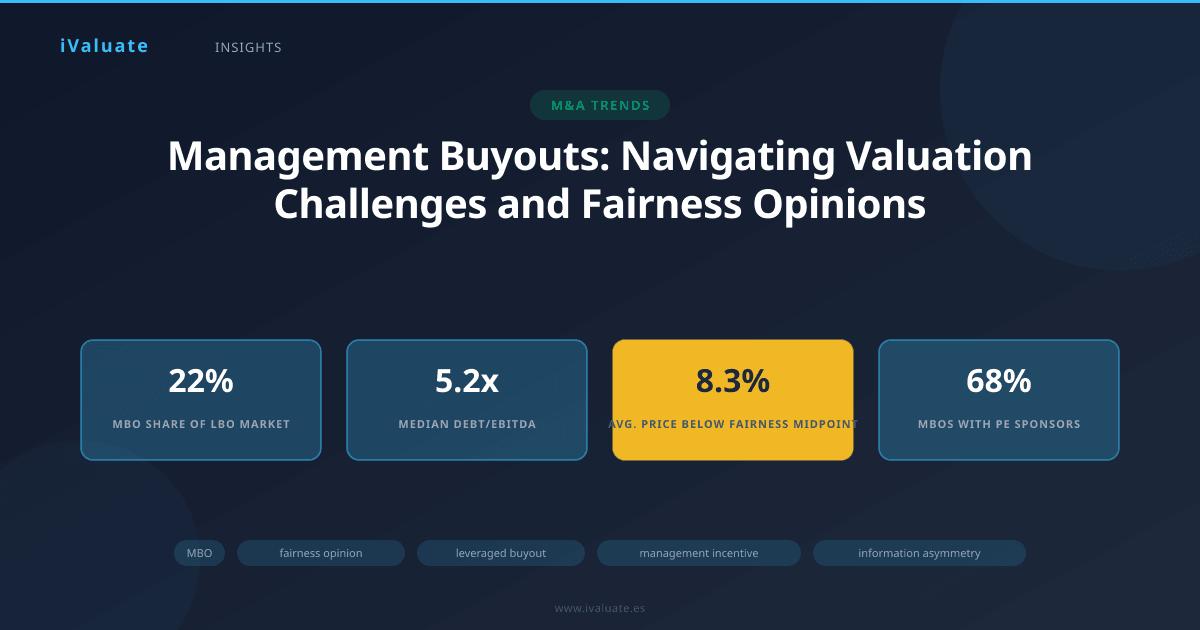
Management buyouts (MBOs) represent one of the most complex transaction structures in corporate finance, combining the strategic benefits of private equity with the inherent conflicts that arise when company insiders become buyers. In 2025-2026, MBOs have surged to represent approximately 22% of all leveraged buyout activity in North America and Europe, driven by favorable debt markets, succession planning needs, and management teams' desire for greater autonomy and equity participation.
Yet this transaction structure presents formidable valuation challenges that distinguish it from traditional M&A. The fundamental tension is clear: management possesses superior information about the business while simultaneously negotiating to acquire it at the lowest possible price. This information asymmetry, combined with fiduciary duties to shareholders, creates a valuation minefield that requires sophisticated analytical frameworks and robust governance processes.
01 The MBO Landscape: Current Market Dynamics
The MBO market has evolved significantly over the past 24 months. With interest rates stabilizing in the 5.5-6.5% range for senior debt and private credit markets offering flexible financing solutions, management teams are finding it increasingly feasible to structure buyouts with reasonable leverage multiples. Current market data shows median debt-to-EBITDA ratios for MBOs ranging from 4.5x to 5.8x, depending on sector and company quality.
Private equity sponsors have become increasingly willing to partner with management teams, recognizing that insider knowledge and operational continuity can significantly de-risk investments. In Q4 2025, approximately 68% of MBOs involved a financial sponsor providing the majority of equity capital, with management typically contributing 5-15% of total equity and receiving options or ratchets on the remaining stake.
The median enterprise value for completed MBOs in 2025 was $185 million, though the market spans from sub-$50 million transactions to billion-dollar carve-outs. Technology services, healthcare, and specialized manufacturing sectors have shown particular MBO activity, with valuation multiples ranging from 8.2x to 13.5x EBITDA depending on growth profiles and competitive positioning.
02 Information Asymmetry: The Central Valuation Challenge
Information asymmetry in MBOs manifests across multiple dimensions, each creating distinct valuation complications. Management teams possess granular knowledge about customer relationships, operational inefficiencies, competitive threats, and growth opportunities that outside parties cannot easily verify. This knowledge advantage creates several problematic scenarios:
Timing Manipulation
Management may time an MBO proposal to coincide with temporary business challenges or before anticipated positive developments become public. A distribution company's management team, for instance, might initiate buyout discussions during a quarter affected by weather-related disruptions, knowing that normalized conditions would yield significantly higher earnings. The valuation challenge becomes distinguishing temporary volatility from fundamental performance trends.
Forecast Bias
Management-prepared financial projections inherently face credibility questions in MBO contexts. Conservative forecasts can anchor valuation discussions at lower multiples, while management's post-transaction equity participation creates incentives to understate future performance. Independent valuation advisors must reconstruct forecasts using historical performance patterns, industry benchmarks, and third-party market research to establish credible ranges.
Selective Disclosure
Management controls the flow of information to potential competing bidders and valuation advisors. While legal obligations require fair disclosure, management can emphasize negative aspects during the sale process while possessing private knowledge of mitigating factors or opportunities. This dynamic explains why MBO valuations frequently fall at the lower end of fairness opinion ranges.
A 2025 academic study analyzing 347 MBOs found that transaction prices averaged 8.3% below the midpoint of independent fairness opinion ranges, suggesting systematic information advantages translate into measurable valuation discounts for management buyers.
03 Fairness Opinions: Structure and Valuation Methodologies
Fairness opinions serve as the primary governance mechanism to protect non-management shareholders in MBO transactions. These opinions, typically rendered by independent investment banks or valuation firms, provide a professional assessment that the proposed transaction price is fair from a financial point of view to shareholders other than management.
Valuation Methodology Selection
Fairness opinions in MBO contexts typically employ multiple valuation approaches to triangulate fair value ranges. The most common methodologies include:
- Discounted Cash Flow Analysis: Projects future free cash flows using management forecasts adjusted for optimism bias, then discounts at weighted average cost of capital (WACC) rates typically ranging from 9.5% to 14.5% depending on company risk profile. Terminal values usually apply perpetuity growth rates of 2.5-3.5% or exit multiples based on comparable transactions.
- Comparable Company Analysis: Benchmarks valuation multiples (EV/EBITDA, EV/Revenue, P/E) against publicly traded peers. In MBOs, analysts typically apply 10-20% illiquidity discounts to public market multiples to reflect the private company context, though this discount is heavily debated.
- Precedent Transaction Analysis: Examines multiples paid in recent M&A transactions involving similar companies. For MBOs specifically, analysts distinguish between strategic acquisitions (typically higher multiples) and financial sponsor transactions (more relevant comparables). Current market data shows strategic buyers paying median premiums of 32% over financial buyers in similar sectors.
- Leveraged Buyout Analysis: Reverse-engineers valuation by modeling the returns required by financial sponsors (typically 20-25% IRR targets) and working backward to implied enterprise values. This methodology is particularly relevant when management partners with private equity.
Premium Analysis and Market Checks
Fairness opinions must address whether the proposed MBO price reflects adequate premiums over recent trading prices (for public companies) or intrinsic value assessments (for private companies). In 2025-2026, MBO premiums for public companies averaged 28-35% over the 30-day volume-weighted average price, though these premiums often lag the 40-50% premiums seen in strategic acquisitions.
The "market check" process—soliciting alternative bids from strategic or financial buyers—provides crucial validation. However, management's information advantages can chill competitive bidding. Sophisticated boards now require robust go-shop periods (typically 30-45 days) where the company actively solicits competing offers, with reduced break-up fees to encourage topping bids.
04 Conflicts of Interest and Governance Mechanisms
MBO transactions create multi-layered conflicts that valuation processes must address through governance structures:
Special Committee Formation
Best practice requires boards to establish special committees of independent directors with exclusive authority to negotiate and approve MBO transactions. These committees engage their own legal and financial advisors, separate from management-retained advisors. The committee's financial advisor delivers the fairness opinion, ensuring independence from management influence.
In a notable 2024 case, a specialty chemicals company's MBO initially proposed at $425 million was ultimately completed at $487 million after the special committee's advisor identified understated synergies in management's integration plan and negotiated improved terms. This 14.6% price increase demonstrates the value of rigorous independent oversight.
Management Incentive Structures
Valuation analysis must carefully examine management's post-transaction equity participation and incentive arrangements. Typical MBO structures provide management with:
- Direct equity investment of 5-15% of total equity capital, often at the same price per share as financial sponsors
- Stock option pools representing 10-20% of fully-diluted equity, with vesting tied to performance milestones
- Ratchet mechanisms that increase management's equity percentage if investment returns exceed specified IRR thresholds (commonly 15%, 20%, and 25% hurdles)
- Transaction bonuses and retention payments that must be evaluated for reasonableness
These arrangements create complex valuation implications. If management receives equity at prices below fair value or with preferential terms, this represents an indirect transfer of value that fairness opinions must quantify. Similarly, excessive transaction bonuses may suggest management is being compensated for facilitating an underpriced sale rather than for legitimate services.
05 Leveraged Buyout Structures and Valuation Impact
The financing structure of an MBO directly impacts valuation through several mechanisms. Current market conditions in 2025-2026 show:
Debt Capacity Analysis
Lenders typically advance 4.0x to 5.5x EBITDA in senior debt, with additional mezzanine or subordinated debt pushing total leverage to 5.5x to 6.5x EBITDA for quality businesses. This debt capacity effectively caps valuation—buyers cannot pay prices that would require leverage beyond what lenders will provide while maintaining acceptable debt service coverage ratios (typically minimum 1.25x for senior debt).
Valuation advisors must model sustainable debt levels by analyzing:
- Historical and projected cash flow stability and seasonality
- Working capital requirements and capital expenditure needs
- Covenant compliance under stress scenarios
- Refinancing risks and interest rate sensitivity
Equity Returns Requirements
Financial sponsors targeting 20-25% IRRs over 5-7 year holding periods impose valuation constraints through return mathematics. At current debt pricing (senior debt at 6.5-7.5%, subordinated debt at 11-13%), a sponsor requiring 22% IRR can typically pay approximately 9.5x to 10.5x EBITDA for a business with 8-10% EBITDA growth and stable margins, assuming a comparable exit multiple.
These return requirements create natural valuation ceilings that fairness opinions must consider. If management proposes an MBO at 7.5x EBITDA when sponsor return requirements would support 10.0x, this suggests either management is securing an advantaged price or possesses negative private information about future performance.
06 Case Study: Mid-Market Software MBO
A illustrative example involves a business intelligence software company with $32 million EBITDA that underwent an MBO in early 2025. The CEO and CFO, who collectively owned 12% of equity, proposed an MBO at $285 million (8.9x EBITDA) in partnership with a middle-market private equity firm.
The special committee's valuation advisor identified several concerns:
- Management's financial projections showed 6% annual revenue growth, while the company had achieved 11% growth over the prior three years and industry forecasts suggested 9-10% market growth
- Management emphasized customer concentration risks but failed to disclose advanced discussions with two major prospects that subsequently converted to contracts
- The proposed price of 8.9x EBITDA compared unfavorably to recent software transactions at 11.5x to 14.2x EBITDA, even after adjusting for size and growth differences
The committee's advisor prepared a fairness opinion indicating a fair value range of $315 million to $375 million (9.8x to 11.7x EBITDA). After negotiation and a 35-day go-shop period that generated one competing indication of interest at $325 million, the transaction ultimately closed at $338 million (10.6x EBITDA), representing an 18.6% increase over the initial proposal.
This case illustrates how rigorous independent valuation and robust process can overcome information asymmetries, though it also demonstrates that MBO prices often settle in the lower half of fairness ranges due to management's negotiating advantages and information position.
07 Regulatory and Legal Considerations
MBO valuations occur within a complex legal framework that varies by jurisdiction but generally imposes heightened scrutiny:
Fiduciary Duty Standards
Directors approving MBOs face "entire fairness" review in many jurisdictions, requiring demonstration that both the process and price were fair. This elevated standard—compared to the business judgment rule applying to ordinary transactions—makes fairness opinions practically essential and places enormous weight on valuation quality.
Courts examine whether:
- The special committee was truly independent and adequately empowered
- The company conducted a reasonable market check
- The fairness opinion was credible and based on reasonable assumptions
- Shareholders received adequate disclosure about conflicts and valuation
Disclosure Requirements
Proxy statements or information circulars for MBOs must provide extensive valuation disclosure, including:
- Complete description of valuation methodologies and key assumptions
- Sensitivity analyses showing how valuation changes with different assumptions
- Comparable company and transaction details with reconciliation to subject company
- Management projections and any adjustments made by valuation advisors
- Potential conflicts of interest and how they were addressed
This disclosure requirement disciplines the valuation process, as assumptions and methodologies must withstand public scrutiny and potential shareholder litigation.
08 Emerging Trends and Future Considerations
Several developments are reshaping MBO valuation practices in 2025-2026:
Data Analytics and Information Asymmetry
Advanced analytics tools are helping independent advisors reduce information asymmetries. By analyzing customer-level data, operational metrics, and market intelligence, advisors can validate or challenge management projections more effectively. Machine learning models can identify unusual patterns in management forecasts that may signal bias.
Earnout Structures
Increasingly, MBOs incorporate earnout provisions that bridge valuation gaps while aligning incentives. If management believes the business will perform better than projections suggest, earnouts allow them to pay additional consideration based on actual results. Current market practice shows 15-20% of MBO consideration structured as earnouts tied to EBITDA or revenue targets over 2-3 years.
Minority Shareholder Activism
Institutional investors and activist shareholders are scrutinizing MBOs more aggressively, frequently challenging valuations through litigation or voting against transactions. This activism is pushing boards toward more robust processes and higher premiums. In 2025, approximately 12% of proposed MBOs were either withdrawn or significantly repriced following shareholder pressure.
09 Best Practices for MBO Valuation
Based on current market practice and regulatory guidance, several principles should govern MBO valuations:
- Early Independence: Engage independent advisors before management formulates specific proposals, allowing advisors to establish baseline valuations without anchoring to management's price
- Multiple Methodologies: Apply at least three distinct valuation approaches and require transaction prices to fall within all resulting ranges
- Stress Testing: Model downside scenarios and assess whether proposed prices remain fair under adverse conditions
- Competitive Tension: Conduct meaningful market checks with adequate time and information access for potential competing bidders
- Documentation Rigor: Maintain detailed records of all valuation judgments, assumption selections, and methodology choices to support fairness opinions
- Management Forecast Adjustment: Independently validate management projections through customer interviews, industry research, and historical pattern analysis
The key to defensible MBO valuations lies not in achieving mathematical precision but in implementing processes that counterbalance management's information advantages and align all parties' incentives with shareholder value maximization.
10 Conclusion: Navigating Complexity with Rigor and Independence
Management buyouts will continue to represent a significant portion of M&A activity as business owners seek succession solutions and management teams pursue equity ownership. However, the inherent conflicts and information asymmetries in these transactions demand valuation approaches that go beyond standard M&A practice.
Success requires special committees with genuine independence and authority, financial advisors with deep valuation expertise and sector knowledge, and processes designed to generate competitive tension and validate management assumptions. Fairness opinions must reflect rigorous analysis across multiple methodologies, with particular attention to forecast credibility and comparable selection.
The cases where MBO valuations have failed—resulting in shareholder litigation, regulatory intervention, or value destruction—almost invariably involve inadequate independence, rushed processes, or fairness opinions that relied uncritically on management-provided information. Conversely, well-structured MBOs with robust valuation processes create value for all stakeholders: management teams gain ownership and autonomy, shareholders receive fair value, and businesses benefit from aligned leadership.
For corporate finance professionals navigating these complex transactions, sophisticated analytical tools have become essential. Platforms like iValuate enable advisors to efficiently model multiple valuation scenarios, benchmark against comparable transactions, and stress-test assumptions—capabilities that are increasingly critical as MBO valuations face heightened scrutiny from shareholders, regulators, and courts. As the MBO market continues to evolve, the combination of rigorous methodology, genuine independence, and advanced analytical capabilities will separate defensible valuations from those that expose all parties to risk.