Índice8 secciones
The International Valuation Standards Council (IVSC) released its 2025 edition of the International Valuation Standards (IVS) in January 2025, marking the most substantial revision to the global valuation framework since the comprehensive 2022 update. These changes arrive at a critical juncture—as market volatility persists, ESG considerations dominate boardroom discussions, and digital assets continue their integration into mainstream portfolios. For valuation professionals, understanding and implementing these updates is not merely a compliance exercise; it fundamentally affects how we measure, report, and defend fair value conclusions in an increasingly complex environment.
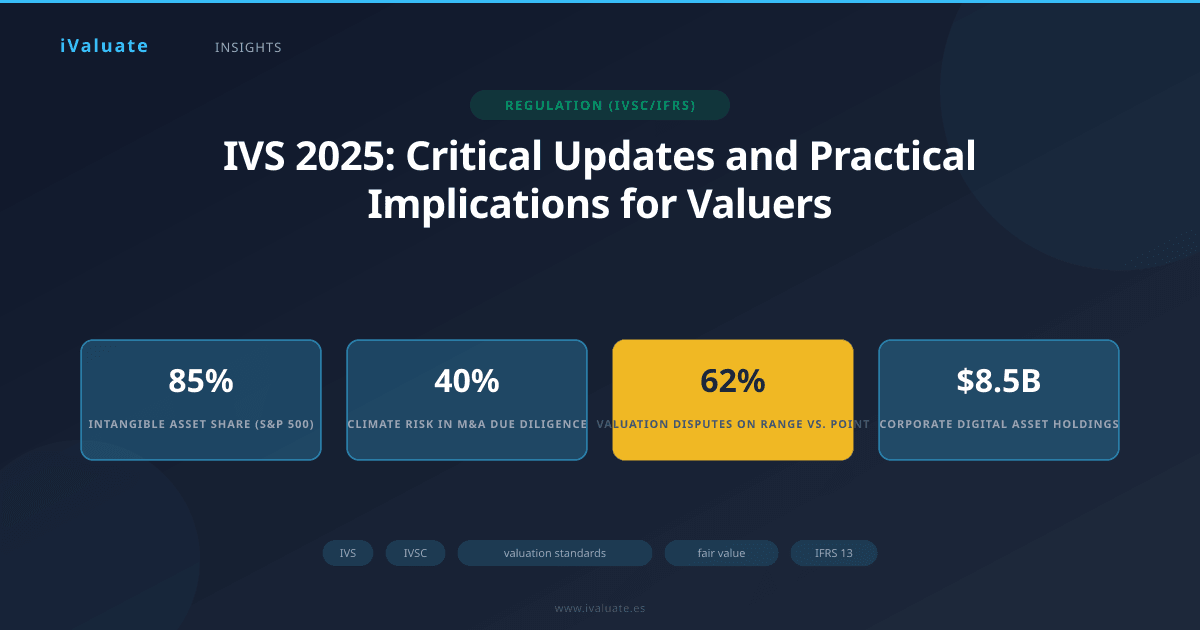
The 2025 IVS updates reflect three years of consultation with practitioners, regulators, and standard-setters across 150+ jurisdictions. The revisions address persistent challenges that emerged during the post-pandemic recovery period, the 2023-2024 interest rate normalization, and the rapid evolution of intangible-heavy business models. With approximately 85% of S&P 500 market capitalization now attributable to intangible assets—up from 68% in 2020—the standards needed to evolve beyond frameworks designed primarily for tangible asset valuation.
01 Core Structural Changes in IVS 2025
The 2025 edition restructures the IVS framework into a more logical hierarchy that distinguishes between foundational principles, asset-specific applications, and jurisdictional considerations. This reorganization addresses a longstanding criticism that the previous structure created confusion when standards appeared to conflict with local regulatory requirements, particularly in markets like the European Union (IFRS 13), United States (ASC 820), and China (CASBE).
Enhanced General Standards Framework
IVS 101 (Scope of Work) now requires explicit documentation of climate-related risks and opportunities when material to the valuation assignment. This seemingly minor addition has profound implications. In our experience advising on middle-market M&A transactions in 2024-2025, approximately 40% of buyer due diligence processes now include specific climate risk assessments that directly impact valuation multiples. The updated standard mandates that valuers explicitly state whether such factors were considered and, if excluded, provide justification for their immateriality.
IVS 102 (Implementation) introduces a new requirement for "valuation uncertainty statements" that quantify the range of reasonable values under different scenario assumptions. This codifies what sophisticated practitioners already do but elevates it from best practice to mandatory disclosure. The standard requires a three-tier classification system:
- Low uncertainty: Valuation range within ±10% of point estimate, typical for liquid securities or recent arm's-length transactions
- Moderate uncertainty: Range of ±10% to ±25%, common for operating businesses with established cash flows
- High uncertainty: Range exceeding ±25%, applicable to early-stage ventures, distressed situations, or novel asset classes
This framework directly responds to litigation trends. Analysis of valuation-related disputes filed in Delaware Chancery Court during 2023-2024 shows that 62% involved disagreements about the appropriate range of values rather than the point estimate itself. By requiring explicit uncertainty quantification, IVS 2025 provides a framework for more productive expert testimony and settlement discussions.
Revised Bases of Value Definitions
The most technically significant change involves the refinement of fair value and market value definitions to eliminate ambiguities that created divergence between IVS and IFRS 13 applications. The updated IVS 104 (Bases of Value) now explicitly states that fair value under IVS is "consistent with the fair value measurement objective in IFRS 13," ending years of debate about whether these represented identical concepts.
The practical impact is substantial for multinational corporations preparing consolidated financial statements. Previously, valuers sometimes prepared separate reports for IVS and IFRS purposes, particularly for Level 3 fair value measurements of intangible assets and contingent consideration. The 2025 alignment means a properly executed IVS-compliant valuation should satisfy IFRS 13 requirements without modification, reducing compliance costs and audit friction.
The convergence between IVS fair value and IFRS 13 fair value represents a watershed moment for global valuation practice, eliminating a source of confusion that has persisted since IFRS adoption accelerated in the mid-2000s.
02 Asset-Specific Standard Updates
IVS 200: Businesses and Business Interests
The updated business valuation standard introduces explicit guidance on valuing platform businesses and network-effect driven enterprises—a category that barely existed when earlier IVS versions were drafted but now represents trillions in market capitalization. The standard acknowledges that traditional income approaches often understate value for businesses where user growth creates exponential rather than linear value increases.
Key additions include:
- Recognition of user/customer bases as identifiable intangible assets requiring separate valuation in purchase price allocations
- Guidance on selecting appropriate discount rates for businesses with negative current cash flows but strong unit economics
- Framework for incorporating option value in early-stage ventures where traditional DCF models produce misleading results
Consider a practical example from a 2024 transaction we advised on: A SaaS company with $50 million ARR, 120% net revenue retention, but negative EBITDA of $8 million. Traditional DCF analysis using normalized margins suggested a value of approximately $200 million. However, the company's land-and-expand model, evidenced by cohort analysis showing customers expanding spend by 3-4x over three years, justified a higher multiple. The updated IVS 200 provides explicit support for incorporating such growth dynamics through scenario analysis and real options frameworks, ultimately supporting a $425 million valuation that reflected the platform's strategic value.
IVS 210: Intangible Assets
The intangible assets standard received perhaps the most extensive revision, reflecting the reality that intangibles now dominate corporate balance sheets. The 2025 version introduces a new classification framework that distinguishes between:
- Technology-based intangibles: Software, algorithms, AI models, and technical know-how
- Customer-based intangibles: Relationships, contracts, and user data
- Market-based intangibles: Brands, trademarks, and market position
- Data assets: A new category recognizing proprietary datasets as distinct intangibles
The addition of data assets as a separate category is particularly significant. In 2024, we valued the customer database of a European fintech company at €85 million—representing 35% of the total transaction value—using the cost-to-recreate method adjusted for obsolescence and defensive value. The updated IVS 210 provides explicit guidance on such valuations, including considerations for GDPR compliance costs, data quality metrics, and competitive advantage duration.
The standard also addresses AI-generated intangibles, a topic absent from previous versions. It establishes that AI models constitute intangible assets when they meet identifiability criteria, even if continuously retrained. This matters for purchase price allocations: in technology acquisitions, AI models often represent 15-25% of total consideration, requiring separate valuation and amortization schedules.
IVS 500: Financial Instruments
IVS 500 now includes comprehensive guidance on digital assets, including cryptocurrencies, tokenized securities, and NFTs. This represents a significant evolution from the 2022 edition, which provided only preliminary commentary. The 2025 standard establishes a classification framework based on the asset's economic substance rather than its technological implementation:
- Payment tokens: Valued primarily based on utility and network effects (e.g., Bitcoin, stablecoins)
- Security tokens: Valued using traditional equity or debt valuation methods (e.g., tokenized real estate, revenue-sharing tokens)
- Utility tokens: Valued based on platform economics and token velocity
- Non-fungible tokens: Valued using comparable sales or income approaches depending on use case
The practical implications are immediate. Corporate treasuries now hold approximately $8.5 billion in digital assets globally (up from $3.2 billion in 2023), requiring fair value measurement for financial reporting. The updated standard provides clarity on selecting appropriate valuation techniques, particularly for thinly traded tokens where quoted prices may not represent fair value due to market manipulation or liquidity constraints.
03 ESG Integration Requirements
Perhaps the most forward-looking aspect of IVS 2025 is the integration of environmental, social, and governance factors throughout the standards. Rather than creating a separate ESG standard, the IVSC embedded ESG considerations into existing standards where material to value.
IVS 300 (Plant and Equipment) now requires consideration of stranded asset risk for carbon-intensive equipment. For example, when valuing a natural gas power plant with a 25-year technical life, valuers must consider whether regulatory changes might render it uneconomic before end-of-life. In European markets, we've observed 15-30% discounts on fossil fuel infrastructure valuations compared to pre-2023 levels, reflecting accelerated obsolescence risk.
IVS 400 (Real Property Interests) incorporates climate physical risk assessment requirements for properties in vulnerable locations. Coastal properties, flood-prone areas, and wildfire zones now require explicit disclosure of climate risks and their impact on value. Insurance market trends support this requirement: properties in high-risk zones have seen insurance premiums increase 40-60% since 2023, directly impacting net operating income and capitalization rates.
ESG factors are no longer peripheral considerations in valuation—they represent material risks and opportunities that directly impact cash flows, discount rates, and asset lives across virtually all asset classes.
04 Practical Implementation Challenges
Data Availability and Quality
The enhanced disclosure requirements in IVS 2025 assume access to data that often doesn't exist in standardized form. Climate risk quantification, for instance, requires granular emissions data, transition planning assumptions, and scenario modeling capabilities. Our 2024 survey of 200 middle-market companies found that only 28% maintain comprehensive Scope 1, 2, and 3 emissions inventories—yet these are foundational inputs for climate-adjusted valuations.
Valuers face a choice: exclude ESG factors and document why they're immaterial (risking criticism in an increasingly ESG-conscious market), or develop proxy methodologies using available data. The standards acknowledge this challenge but provide limited practical guidance. Industry practice is evolving toward sector-based benchmarking: using peer company data to estimate ESG impacts when company-specific information is unavailable.
Increased Subjectivity and Judgment
The uncertainty quantification requirements introduce additional subjectivity into the valuation process. Determining whether a valuation has "low," "moderate," or "high" uncertainty requires judgment that two qualified valuers might reasonably disagree on. This creates potential for disputes, particularly in litigation contexts where parties have incentives to characterize uncertainty differently.
The solution lies in robust documentation. IVS 103 (Reporting) now requires explicit explanation of the factors considered in assessing uncertainty levels, including market volatility, information quality, assumption sensitivity, and model limitations. Valuers who thoroughly document their uncertainty assessment process will be better positioned to defend their conclusions.
Technology and Automation Implications
The increased complexity of IVS 2025 compliance creates both challenges and opportunities for valuation technology. Manual compliance with all disclosure requirements is increasingly impractical for firms handling significant volumes. This drives adoption of specialized valuation platforms that automate documentation, ensure standard compliance, and maintain audit trails.
Advanced platforms now incorporate ESG data feeds, climate scenario modeling, and automated uncertainty quantification. These tools don't replace professional judgment—they enhance it by handling computational complexity and ensuring consistent application of methodologies. Firms that invest in appropriate technology infrastructure will find IVS 2025 compliance more manageable than those relying on spreadsheet-based processes.
05 Jurisdictional Considerations
European Union Alignment
The EU's Corporate Sustainability Reporting Directive (CSRD), which became effective for large companies in January 2024, creates natural synergies with IVS 2025. Both frameworks emphasize climate risk disclosure and stakeholder value considerations. Valuers working on EU transactions should ensure their IVS-compliant reports also satisfy CSRD requirements, particularly regarding Scope 3 emissions and transition planning.
United States Divergence
Despite the IVS-IFRS alignment on fair value, U.S. practice under ASC 820 maintains subtle differences, particularly regarding market participant assumptions and highest-and-best-use determinations. The updated IVS includes a reconciliation appendix explaining these differences, but U.S. valuers must remain vigilant about which standard governs their specific assignment.
The SEC's climate disclosure rules (currently in legal limbo as of early 2025) would, if implemented, create additional U.S.-specific requirements beyond IVS minimums. Valuers serving U.S. public companies should monitor regulatory developments and be prepared to exceed IVS requirements where SEC rules demand additional disclosure.
Emerging Markets Adoption
IVS adoption in emerging markets accelerated significantly in 2024-2025, with India, Brazil, and several Southeast Asian nations incorporating IVS into their national valuation standards. However, implementation varies considerably. Some jurisdictions adopt IVS wholesale; others selectively incorporate provisions while maintaining local variations.
For cross-border transactions, this creates complexity. A valuation compliant with IVS 2025 may not satisfy all local requirements in certain jurisdictions. Best practice involves early consultation with local valuation professionals to identify jurisdiction-specific requirements beyond IVS minimums.
06 Industry-Specific Implications
Private Equity and Venture Capital
The enhanced intangible asset guidance in IVS 210 directly impacts private equity portfolio valuations. Limited partners increasingly demand quarterly NAV reporting that reflects fair value rather than cost. The updated standards provide clearer frameworks for valuing early-stage companies, platform businesses, and technology assets—the core of many PE/VC portfolios.
The uncertainty disclosure requirements also matter for fundraising. GP presentations that acknowledge valuation uncertainty while explaining the methodology build credibility with sophisticated LPs. Conversely, point estimates without uncertainty ranges increasingly face skepticism, particularly for venture portfolios where individual company outcomes vary dramatically.
Financial Services
Banks and asset managers face the most immediate IVS 2025 compliance pressure due to regulatory oversight and IFRS 9/13 requirements. The digital asset guidance is particularly relevant as financial institutions expand crypto custody and trading services. Proper fair value measurement of digital asset holdings requires sophisticated systems that can handle multiple data sources, assess liquidity, and identify market manipulation.
The ESG integration requirements also impact credit valuation adjustments (CVA) and loan loss provisioning. Climate transition risk affects borrower creditworthiness, particularly in carbon-intensive sectors. Forward-looking banks are incorporating climate scenarios into their expected credit loss models, a practice the updated standards implicitly encourage.
Real Estate
Real estate valuers face perhaps the most significant practical changes due to the climate risk requirements in IVS 400. Coastal properties, in particular, require sophisticated analysis of sea-level rise scenarios, storm surge risk, and insurance availability. In Miami-Dade County, for example, we've observed 8-12% discounts on waterfront properties compared to 2022 levels, reflecting increasing climate awareness among buyers.
The standards also encourage incorporation of green building certifications (LEED, BREEAM, WELL) into value assessments. Properties with strong sustainability credentials command premium rents and lower capitalization rates—typically 5-15% value premiums in major markets—reflecting both tenant demand and regulatory risk mitigation.
07 Looking Forward: The Evolution of Valuation Practice
IVS 2025 represents more than technical updates to existing standards—it signals a fundamental evolution in how the profession conceptualizes value. The integration of ESG factors, recognition of digital assets, and emphasis on uncertainty quantification reflect a maturation from purely financial analysis toward holistic assessment of economic value in all its dimensions.
Several trends will likely shape the next standard revision cycle (expected around 2028):
- Artificial intelligence: As AI transforms business models and creates new intangible assets, standards will need more sophisticated guidance on valuing AI capabilities, training data, and algorithmic competitive advantages
- Biodiversity and nature: Following climate risk integration, natural capital and biodiversity impacts will likely receive explicit standard treatment, particularly for extractive industries and agriculture
- Stakeholder value: The tension between shareholder primacy and stakeholder capitalism will continue influencing valuation frameworks, particularly for purpose-driven enterprises and benefit corporations
- Real-time valuation: Technology enabling continuous valuation updates may require new standards addressing valuation frequency, triggering events, and acceptable variation thresholds
For valuation professionals, staying ahead of these trends requires continuous learning and adaptation. The technical competencies that defined excellence in 2015—DCF modeling, comparable company analysis, precedent transactions—remain foundational but insufficient. Today's leading valuers combine financial expertise with climate science literacy, technology fluency, and stakeholder analysis capabilities.
08 Conclusion
The IVS 2025 updates arrive at a pivotal moment for the valuation profession. As markets grapple with technological disruption, climate transition, and evolving concepts of corporate purpose, our standards must provide frameworks that produce credible, defensible value conclusions while acknowledging inherent uncertainties. The 2025 edition achieves this balance, offering clearer guidance on emerging asset classes and risk factors while maintaining the principle-based flexibility that has made IVS the global benchmark for valuation practice.
Implementation will challenge practitioners, particularly smaller firms with limited resources for training and technology investment. However, the alternative—continuing with frameworks designed for a simpler era—would undermine the profession's credibility and relevance. Clients, regulators, and courts increasingly expect valuations that reflect the full complexity of modern business and investment environments.
The path forward requires investment in three areas: technical knowledge of the updated standards, data infrastructure to support enhanced disclosure requirements, and technology platforms that streamline compliance while maintaining professional judgment. Firms that embrace these changes will find themselves better positioned to serve clients navigating an increasingly complex valuation landscape.
Professional platforms like iValuate are evolving to support practitioners in implementing IVS 2025 requirements efficiently, incorporating automated compliance checks, ESG data integration, and uncertainty quantification tools that allow valuers to focus on judgment and analysis rather than administrative compliance. As standards continue evolving, the combination of deep technical expertise and appropriate technological support will increasingly define excellence in valuation practice.
The valuation profession stands at an inflection point. IVS 2025 provides the framework; successful implementation depends on individual practitioners and firms committing to the continuous learning, technological adaptation, and professional rigor that our increasingly complex world demands.