Índice8 secciones
The International Financial Reporting Standard 13 (IFRS 13) has fundamentally transformed how organizations measure and disclose fair value across financial statements. Since its introduction in 2013 and subsequent adoption across more than 140 jurisdictions, IFRS 13 has established a single framework for fair value measurement that applies whenever another IFRS requires or permits fair value measurements or disclosures. As we navigate the complex market conditions of 2025-2026, characterized by elevated interest rates, geopolitical uncertainty, and rapid technological disruption, the practical application of IFRS 13's fair value hierarchy has never been more critical—or more challenging.
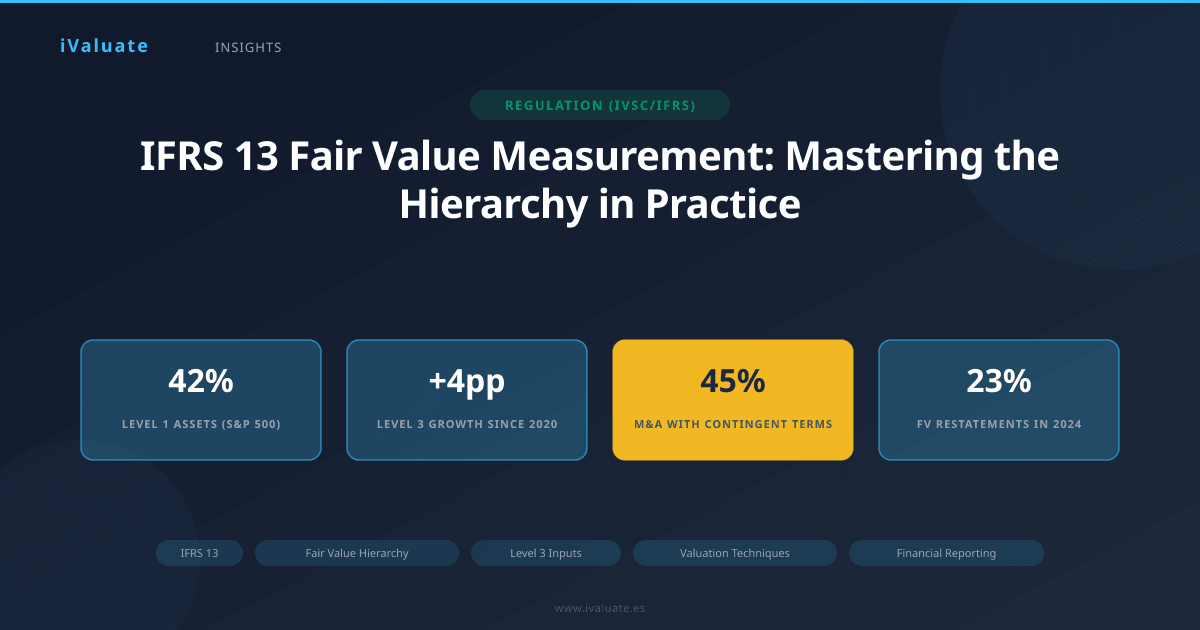
For CFOs, valuation professionals, and M&A advisors, understanding the nuances of IFRS 13 is not merely an academic exercise. The standard directly impacts reported earnings, balance sheet values, regulatory compliance, and stakeholder confidence. Recent enforcement actions by securities regulators have highlighted that approximately 23% of restatements in 2024 involved fair value measurement issues, underscoring the importance of rigorous application of the standard's principles.
01 The Fair Value Definition and Exit Price Concept
IFRS 13 defines fair value as "the price that would be received to sell an asset or paid to transfer a liability in an orderly transaction between market participants at the measurement date." This exit price notion represents a fundamental shift from entity-specific value to a market-based perspective. The standard requires preparers to consider the transaction from the perspective of market participants who are independent, knowledgeable, able, and willing to transact.
The exit price concept has profound implications for valuation practice. Consider a specialized manufacturing facility with limited alternative uses: while the asset may generate substantial value for the current owner through its integration into existing operations, IFRS 13 requires measurement based on what market participants would pay for the asset in its highest and best use. This distinction becomes particularly relevant in purchase price allocation exercises, where the difference between entity-specific value and fair value can materially impact goodwill calculations and subsequent impairment testing.
Key Principle: Fair value is a market-based measurement, not an entity-specific measurement. The focus is on the asset or liability being measured, not the reporting entity's intended use or ability to access markets.
02 Understanding the Fair Value Hierarchy
The cornerstone of IFRS 13 is its three-level fair value hierarchy, which prioritizes inputs to valuation techniques based on their observability and reliability. This hierarchy serves two critical functions: it provides a framework for selecting appropriate valuation approaches, and it drives extensive disclosure requirements that enable financial statement users to assess measurement uncertainty.
Level 1: Quoted Prices in Active Markets
Level 1 inputs represent quoted prices (unadjusted) in active markets for identical assets or liabilities that the entity can access at the measurement date. These inputs provide the most reliable evidence of fair value and should be used whenever available. In practice, Level 1 measurements are most common for exchange-traded securities, commodities with transparent pricing, and certain derivative instruments.
The definition of an "active market" requires careful consideration. IFRS 13 describes an active market as one where transactions occur with sufficient frequency and volume to provide pricing information on an ongoing basis. During the market disruptions of 2023-2024, many corporate bond markets experienced periods of significantly reduced liquidity, raising questions about whether quoted prices remained Level 1 inputs or should be reclassified to Level 2. Market participants generally consider daily trading volume, bid-ask spreads (typically less than 1-2% for active markets), and the recency of transactions when making this determination.
In 2025, approximately 42% of financial assets measured at fair value by S&P 500 companies utilize Level 1 inputs, down from 48% in 2021, reflecting both market structure changes and increased holdings of less liquid instruments. This trend toward less observable inputs increases the importance of robust valuation processes and controls.
Level 2: Observable Inputs Other Than Quoted Prices
Level 2 inputs include quoted prices for similar assets or liabilities in active markets, quoted prices for identical or similar assets in markets that are not active, inputs other than quoted prices that are observable (such as interest rates and yield curves), and market-corroborated inputs. The key distinction is that Level 2 inputs are observable, either directly or indirectly, but require some degree of adjustment or modeling to arrive at fair value.
Common examples of Level 2 measurements include:
- Interest rate swaps valued using observable yield curves and credit spreads
- Corporate bonds without active markets, valued using matrix pricing based on comparable securities
- Foreign currency forward contracts valued using spot rates and forward points
- Real estate valued using recent comparable transactions with adjustments for location, size, and condition
- Private equity investments valued shortly after a transaction using the transaction price with observable market adjustments
The application of Level 2 techniques requires professional judgment, particularly in determining whether adjustments to observable inputs are significant enough to render the measurement Level 3. As a general principle, if the adjustments to observable inputs are significant to the overall fair value measurement, the measurement should be classified as Level 3. In practice, many organizations establish quantitative thresholds (such as adjustments exceeding 10-15% of fair value) combined with qualitative factors to make this determination.
Level 3: Unobservable Inputs
Level 3 inputs are unobservable inputs for the asset or liability, used when relevant observable inputs are not available. This category encompasses the most complex and judgmental valuations, requiring entities to develop assumptions that market participants would use when pricing the asset or liability, including assumptions about risk.
Level 3 measurements have grown significantly in recent years, now representing approximately 18% of fair value measurements for S&P 500 companies in 2025, up from 14% in 2020. This increase reflects several factors: the growth of private market investments, increased use of contingent consideration in M&A transactions, and the proliferation of complex financial instruments including cryptocurrency derivatives and carbon credit contracts.
Typical Level 3 measurements include:
- Contingent consideration in business combinations, particularly earn-outs tied to future performance metrics
- Investments in early-stage private companies without recent funding rounds
- Complex derivatives with long-dated maturities or exotic features
- Intangible assets such as customer relationships, developed technology, and trade names
- Asset retirement obligations with significant estimation uncertainty
Critical Consideration: Level 3 measurements require extensive disclosure under IFRS 13, including quantitative information about significant unobservable inputs, sensitivity analysis, and reconciliation of opening and closing balances. These disclosures are subject to intense scrutiny by auditors and regulators.
03 Selecting Appropriate Valuation Techniques
IFRS 13 does not mandate specific valuation techniques but requires entities to use approaches that are appropriate in the circumstances and for which sufficient data are available. The standard identifies three broad valuation approaches: the market approach, the income approach, and the cost approach. In many cases, multiple techniques may be appropriate, and the standard encourages the use of multiple valuation techniques when possible to triangulate a fair value measurement.
The Market Approach
The market approach uses prices and other relevant information generated by market transactions involving identical or comparable assets, liabilities, or groups of assets and liabilities. This approach is most applicable when observable market transactions exist and adjustments for differences can be reliably quantified.
In practice, the market approach manifests in several forms:
Guideline public company method: This technique uses valuation multiples derived from public companies operating in the same or similar industries. For a private software-as-a-service company, practitioners might analyze public SaaS companies trading at a median EV/Revenue multiple of 6.2x in early 2025 (down from 12.8x in 2021), applying appropriate discounts for size, liquidity, and company-specific factors. The challenge lies in selecting truly comparable companies and determining appropriate adjustments, which can range from 20-40% for illiquidity alone.
Precedent transaction method: This approach analyzes prices paid in actual M&A transactions involving comparable businesses. In the current environment, transaction multiples often exceed trading multiples by 15-30%, reflecting control premiums and synergies. However, practitioners must carefully consider whether transaction prices reflect fair value or strategic value, as IFRS 13 requires the former.
Matrix pricing: Commonly used for debt securities, this technique establishes a pricing matrix based on observable quotes for similar securities, adjusting for differences in credit quality, maturity, and other features. With corporate bond spreads widening to an average of 145 basis points over government securities in 2025 (compared to 95 basis points in 2021), accurate spread adjustments have become increasingly important.
The Income Approach
The income approach converts future amounts (such as cash flows or earnings) to a single present value amount, reflecting current market expectations about those future amounts. This approach is particularly relevant for assets that generate cash flows and for which market comparables are limited.
The discounted cash flow (DCF) method represents the most common application of the income approach. Under IFRS 13, DCF models must reflect assumptions that market participants would use, not entity-specific assumptions. This distinction is critical: a strategic acquirer's synergies should not be included unless market participants generally would realize similar benefits.
Key considerations in applying DCF under IFRS 13 include:
- Cash flow projections: Should reflect market participant assumptions about growth rates, margins, and capital requirements. In 2025, market participants are generally using more conservative growth assumptions than in prior years, with median long-term growth rates of 2.5-3.5% for mature businesses, down from 3.5-4.5% in 2021.
- Discount rates: Must reflect the risk profile of the cash flows from a market participant perspective. With risk-free rates stabilizing around 4.2% in major markets and equity risk premiums averaging 5.8%, weighted average costs of capital for mid-market companies typically range from 10-14% in the current environment.
- Terminal values: Often represent 60-75% of total value in DCF models, making assumptions about perpetual growth rates and terminal multiples critical. The standard requires that terminal value assumptions be consistent with long-term market expectations.
A practical example illustrates these principles: In valuing an acquired customer relationship intangible asset, a telecommunications company would project the cash flows attributable to the existing customer base, applying market-level churn rates (not the acquirer's superior retention rates), market-level operating margins, and a discount rate reflecting the risk of customer attrition. If market participants typically experience 15% annual customer churn while the acquirer expects only 10% due to superior service capabilities, the 15% rate should be used for fair value measurement purposes.
The Cost Approach
The cost approach reflects the amount that would be required currently to replace the service capacity of an asset, often referred to as current replacement cost. This approach is most applicable to tangible assets and certain intangible assets where reproduction or replacement cost provides meaningful information about fair value.
The cost approach requires consideration of physical deterioration, functional obsolescence, and economic obsolescence. For specialized assets such as manufacturing equipment or technology infrastructure, determining appropriate obsolescence adjustments requires significant judgment. In the rapidly evolving technology landscape of 2025, economic obsolescence can be substantial—for example, data center equipment may suffer 30-40% economic obsolescence due to advances in energy efficiency and computing power, even when physically functional.
04 Navigating Complex Measurement Scenarios
Contingent Consideration in Business Combinations
Contingent consideration arrangements have become increasingly prevalent, appearing in approximately 45% of middle-market M&A transactions in 2024-2025. These arrangements typically require Level 3 fair value measurements, as they depend on future events such as revenue targets, EBITDA thresholds, or regulatory approvals.
Consider a recent pharmaceutical acquisition where the buyer agreed to pay an additional €50 million if the target's lead drug candidate receives regulatory approval within three years. Fair value measurement requires estimating:
- The probability of regulatory approval (based on historical success rates for similar compounds, typically 40-60% for Phase III candidates)
- The expected timing of approval
- An appropriate discount rate reflecting the risk profile (often 12-18% for development-stage assets)
- The effect of any caps, floors, or other features of the arrangement
Using a probability-weighted approach with a 55% probability of approval, expected timing of 2.5 years, and a 15% discount rate, the fair value at acquisition might be approximately €23 million, significantly less than the maximum payment. This measurement must be reassessed at each reporting date, with changes in fair value recognized in profit or loss under IFRS 3.
Valuing Illiquid Investments
Private equity and venture capital investments present particular challenges under IFRS 13. While a recent transaction price may provide evidence of fair value, the standard requires consideration of whether circumstances have changed since the transaction date. In the current environment, where private market valuations have compressed significantly from 2021 peaks, relying solely on the most recent funding round may not reflect fair value.
Best practices for valuing illiquid investments include:
- Calibrating to the transaction price initially, but reassessing at each reporting date
- Monitoring public market comparables and adjusting for observed multiple compression (public SaaS multiples, for example, declined approximately 50% from 2021 to 2023 before partially recovering)
- Considering subsequent funding rounds, even if the entity did not participate
- Analyzing the portfolio company's actual performance against projections used in the most recent funding round
- Applying appropriate discounts for illiquidity, typically 20-35% depending on expected time to liquidity and market conditions
Cryptocurrency and Digital Assets
The emergence of cryptocurrency and digital assets has created new fair value measurement challenges. While major cryptocurrencies like Bitcoin and Ethereum trade on multiple exchanges with significant volume, determining whether these constitute "active markets" under IFRS 13 requires careful analysis. Factors to consider include price dispersion across exchanges (typically 0.5-2% for major cryptocurrencies), settlement mechanisms, and regulatory oversight.
For entities holding cryptocurrency, most practitioners classify liquid, exchange-traded cryptocurrencies as Level 2 rather than Level 1, reflecting concerns about market structure, custody arrangements, and the lack of a single principal market. More exotic digital assets, including NFTs and tokens from smaller blockchain projects, typically require Level 3 measurement using comparable transaction analysis or income-based approaches.
05 Disclosure Requirements and Regulatory Expectations
IFRS 13 mandates extensive disclosures designed to help financial statement users assess the valuation techniques and inputs used to develop fair value measurements. For Level 3 measurements, entities must disclose:
- A reconciliation of opening and closing balances, showing separately gains and losses recognized in profit or loss and other comprehensive income
- Quantitative information about significant unobservable inputs used
- A description of the valuation processes used
- Sensitivity analysis showing how fair value would change if significant unobservable inputs were changed to reasonably possible alternative assumptions
Regulators have increasingly focused on the quality of these disclosures. In 2024, the European Securities and Markets Authority (ESMA) issued findings indicating that 31% of reviewed financial statements had deficient fair value disclosures, particularly regarding sensitivity analysis and the description of valuation techniques. Common deficiencies included:
- Boilerplate descriptions of valuation techniques without entity-specific detail
- Sensitivity analysis that tested unreasonably narrow ranges of inputs
- Insufficient explanation of significant changes in Level 3 measurements
- Inadequate disclosure of interrelationships between unobservable inputs
Regulatory Focus: Securities regulators are paying particular attention to transfers between levels of the fair value hierarchy, the reasonableness of unobservable inputs compared to market data, and the consistency of valuation approaches across reporting periods.
06 Practical Implementation Challenges
Establishing Robust Valuation Processes
Effective implementation of IFRS 13 requires more than technical valuation expertise—it demands robust processes, governance, and controls. Leading organizations have established valuation committees or pricing committees that meet quarterly to review significant fair value measurements, challenge key assumptions, and ensure consistency across the organization.
Key elements of a strong valuation process include:
- Clear policies and procedures: Documented methodologies for each type of fair value measurement, including criteria for selecting valuation techniques and determining hierarchy levels
- Independent price verification: For Level 2 and Level 3 measurements, independent validation of inputs and outputs, often using third-party pricing services or valuation specialists
- Regular calibration: Comparing fair value estimates to subsequent transactions or realizations to assess the accuracy of valuation models
- Documentation: Contemporaneous documentation of valuation decisions, including the rationale for key assumptions and the consideration of alternative approaches
Technology and Data Management
The complexity of fair value measurement has driven increased adoption of specialized valuation technology. Modern valuation platforms integrate market data feeds, automate calculations, maintain audit trails, and generate required disclosures. In 2025, approximately 67% of large corporations use dedicated valuation software, up from 42% in 2020.
However, technology is only as good as the data and assumptions it processes. Organizations must invest in robust data governance, ensuring that market data sources are reliable, inputs are properly validated, and models are regularly back-tested. The integration of artificial intelligence and machine learning into valuation processes shows promise but also raises questions about explainability and auditability that must be carefully managed.
07 Looking Forward: Emerging Considerations
As we progress through 2025 and into 2026, several emerging issues will shape the application of IFRS 13:
Climate-related adjustments: Market participants are increasingly incorporating climate risk and transition risk into valuations. For long-lived assets, this may require adjustments to cash flow projections, useful lives, or discount rates. The challenge lies in determining when climate considerations reflect market participant assumptions versus entity-specific views.
Artificial intelligence and intangible assets: The rapid development of AI capabilities is creating new categories of intangible assets that require fair value measurement in business combinations. Valuing proprietary AI models, training datasets, and AI-generated intellectual property presents novel challenges, as traditional valuation approaches may not fully capture the unique characteristics of these assets.
Geopolitical risk: Heightened geopolitical tensions affect fair value measurements through multiple channels: discount rates, growth assumptions, probability-weighted scenarios, and market participant identification. Determining whether geopolitical risk factors are already reflected in observable market inputs or require separate adjustment is an area of ongoing debate.
Sustainability-linked instruments: The proliferation of sustainability-linked bonds, loans, and derivatives creates new measurement challenges. These instruments often include features where cash flows or terms adjust based on the issuer's achievement of ESG targets, requiring fair value measurement techniques that incorporate both financial and non-financial performance metrics.
08 Conclusion: Rigor, Judgment, and Professional Skepticism
The practical application of IFRS 13's fair value hierarchy requires a combination of technical expertise, market knowledge, and professional judgment. As financial instruments become more complex, markets more volatile, and stakeholder expectations more demanding, the importance of rigorous fair value measurement continues to grow. The distinction between Level 1, Level 2, and Level 3 inputs is not merely a classification exercise—it reflects fundamental differences in measurement reliability and uncertainty that directly impact how financial statement users assess an entity's financial position and performance.
For valuation professionals, staying current with market developments, regulatory guidance, and evolving best practices is essential. The 23% of restatements involving fair value issues in 2024 demonstrates that even sophisticated organizations struggle with these requirements. Success requires investment in people, processes, technology, and governance—not as compliance exercises, but as fundamental components of financial reporting quality.
As organizations navigate these challenges, platforms like iValuate provide valuable support by streamlining valuation workflows, maintaining current market data, and ensuring consistent application of IFRS 13 principles across diverse measurement scenarios. Whether measuring contingent consideration in a business combination, valuing illiquid investments, or preparing Level 3 disclosures, having robust tools and methodologies is no longer optional—it's a necessity for maintaining stakeholder confidence and regulatory compliance in an increasingly complex financial reporting environment.
The fair value hierarchy will continue to evolve as markets develop, new asset classes emerge, and standard-setters respond to implementation challenges. Organizations that build strong foundations today—combining technical rigor, independent validation, and transparent disclosure—will be best positioned to meet tomorrow's fair value measurement challenges with confidence and credibility.