Índice9 secciones
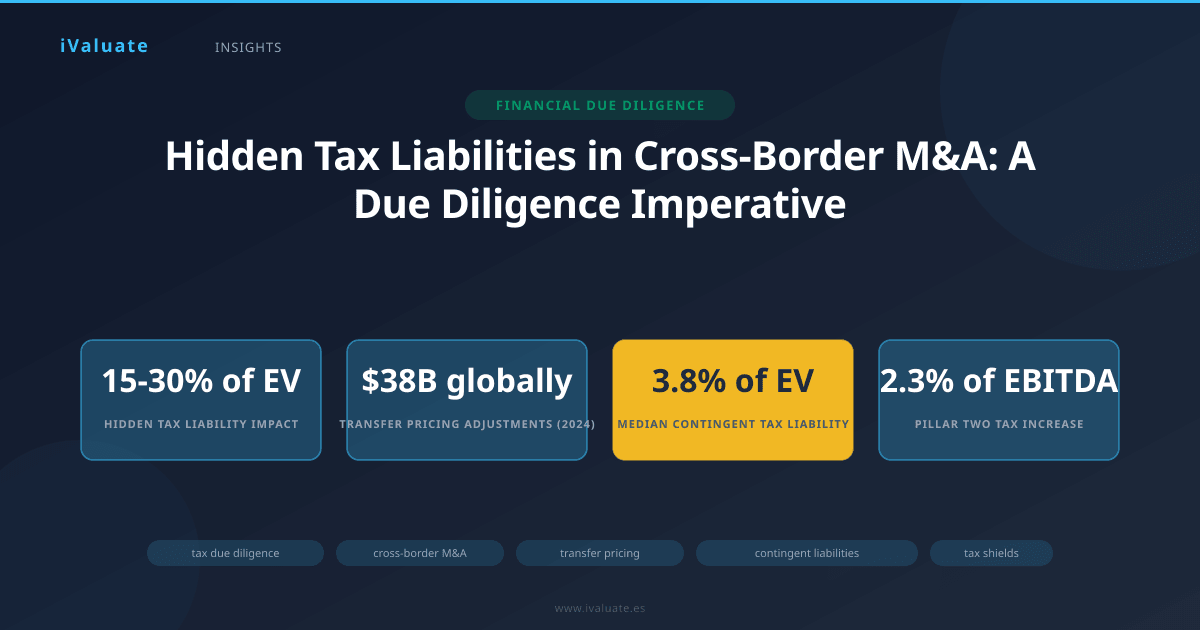
In the current cross-border M&A environment, where global deal flow exceeded $2.1 trillion in 2024 and continues its upward trajectory into 2025, tax due diligence has evolved from a compliance checkbox to a critical value protection mechanism. Recent high-profile cases demonstrate that hidden tax liabilities can erode 15-30% of anticipated deal value, transforming seemingly attractive acquisitions into value-destructive transactions.
The complexity of international tax regimes, coupled with the OECD's Base Erosion and Profit Shifting (BEPS) 2.0 framework implementation and the global minimum tax regime taking effect in 2024, has fundamentally altered the risk landscape. Private equity sponsors and strategic acquirers who fail to conduct rigorous tax due diligence face not only immediate financial exposure but also long-term operational constraints that can undermine post-acquisition value creation strategies.
01 The Expanding Universe of Cross-Border Tax Risk
Cross-border transactions inherently multiply tax complexity. When a U.S. private equity firm acquires a German manufacturing company with operations in Poland, China, and Mexico, the tax due diligence scope must encompass not only each jurisdiction's domestic tax regime but also the intricate web of bilateral tax treaties, transfer pricing regulations, withholding tax obligations, and permanent establishment risks.
The 2025 tax landscape presents several acute pressure points:
- OECD Pillar Two implementation: The 15% global minimum tax now applies to multinational enterprises with revenues exceeding €750 million, fundamentally altering tax planning strategies and creating potential top-up tax liabilities that many sellers have not adequately quantified
- Transfer pricing scrutiny intensification: Tax authorities worldwide collected over $38 billion in transfer pricing adjustments in 2024, representing a 47% increase from 2022 levels
- Digital services tax proliferation: More than 40 jurisdictions now impose unilateral digital services taxes, creating overlapping obligations and potential double taxation
- Beneficial ownership transparency requirements: New reporting regimes in the EU, UK, and U.S. (Corporate Transparency Act) expose previously opaque structures to regulatory scrutiny
02 Transfer Pricing: The $38 Billion Risk Factor
Transfer pricing represents the single largest source of hidden tax liability in cross-border transactions. When related entities in different jurisdictions transact with each other, tax authorities require that pricing reflect arm's-length market terms. The challenge lies in the inherent subjectivity of determining what constitutes "arm's length" and the asymmetric information between taxpayers and revenue authorities.
The Mechanics of Transfer Pricing Exposure
Consider a technology company with intellectual property held in Ireland, manufacturing operations in Vietnam, and sales subsidiaries across Europe and North America. The Irish entity licenses IP to the Vietnamese manufacturer, which produces goods sold to regional sales companies. Each intercompany transaction—IP licensing, manufacturing services, distribution arrangements—must be priced according to transfer pricing principles.
During due diligence, acquirers frequently discover that target companies have:
- Applied transfer pricing methodologies inconsistently across jurisdictions
- Failed to update intercompany agreements to reflect functional changes in the business
- Inadequately documented the economic analysis supporting their transfer prices
- Underestimated the risk of tax authority challenges, particularly in high-tax jurisdictions where profit shifting is suspected
A 2024 analysis of 200 cross-border transactions revealed that 62% of targets had material transfer pricing documentation deficiencies, and 23% faced active or probable transfer pricing audits that were not disclosed in initial management representations. The financial impact can be staggering: a single transfer pricing adjustment can generate tax liabilities plus interest and penalties ranging from 5-15% of enterprise value.
Real-World Impact: The Manufacturing Sector Case
In early 2024, a U.S. industrial conglomerate acquired a European automotive components manufacturer for €840 million. Post-closing, the acquirer discovered that the target's transfer pricing for components sold from its low-tax Eastern European manufacturing hub to its German sales entity had been challenged by German tax authorities. The preliminary assessment indicated an understatement of German taxable income by approximately €180 million over a five-year period.
The resulting tax liability, including interest and penalties, totaled €67 million—representing 8% of the purchase price. More significantly, the required prospective adjustment to transfer pricing reduced the target's effective EBITDA by €22 million annually, materially impacting the acquisition's return profile. The acquirer's IRR projection declined from 18.5% to 13.2%, and the transaction barely cleared the firm's hurdle rate.
03 Contingent Tax Liabilities: Quantifying the Unquantified
Contingent tax liabilities represent potential obligations that may crystallize based on future events, tax authority actions, or legal interpretations. Unlike booked tax liabilities that appear on the balance sheet, contingent liabilities often lurk in footnotes, management discussion, or—most dangerously—remain entirely undisclosed.
Categories of Contingent Tax Exposure
Sophisticated tax due diligence identifies and quantifies several categories of contingent liability:
1. Uncertain Tax Positions: Under accounting standards (ASC 740 in the U.S., IAS 12 internationally), companies must evaluate whether tax positions taken in returns are "more likely than not" to be sustained upon examination. Many private companies, particularly those without Big Four auditors, maintain inadequate reserves for uncertain positions. Due diligence frequently reveals that aggressive tax positions—accelerated depreciation, questionable deductions, classification of capital versus ordinary items—carry 30-50% probability of adjustment but lack corresponding reserves.
2. Indirect Tax Exposures: Value-added tax, goods and services tax, and customs duty obligations often receive insufficient attention during tax due diligence. A 2025 survey of M&A advisors found that 71% of transactions involved material indirect tax issues discovered post-closing. Common problems include improper VAT treatment of cross-border services, misclassification of goods for customs purposes, and failure to register for VAT in jurisdictions where economic nexus has been established.
3. Withholding Tax Deficiencies: Cross-border payments for services, royalties, interest, and dividends typically trigger withholding tax obligations. Target companies frequently fail to withhold appropriate amounts or to obtain proper documentation (such as certificates of tax residence) to support reduced treaty rates. The contingent liability includes not only the unpaid withholding tax but also penalties and potential personal liability for responsible officers.
4. Permanent Establishment Risk: When a company's activities in a foreign jurisdiction cross the threshold from mere solicitation to a taxable presence, a permanent establishment (PE) is created, triggering corporate income tax obligations. The PE concept has expanded significantly under BEPS Action 7, and many companies have created unintended PEs through employee activities, dependent agent relationships, or construction projects. The contingent liability encompasses multiple years of unreported income, plus penalties that can reach 40-75% of the tax due in certain jurisdictions.
Quantification Methodologies
Professional tax due diligence employs probability-weighted analysis to quantify contingent liabilities. For each identified risk, advisors assess:
- The technical merit of the tax position (probability of sustaining the position: 0-100%)
- The potential adjustment amount if the position fails
- The applicable tax rate, interest rate, and penalty regime
- The statute of limitations period and likelihood of examination
The expected value of the contingent liability equals the probability-adjusted exposure. For material items, sensitivity analysis explores best-case, base-case, and worst-case scenarios. This quantification directly informs purchase price adjustments, escrow arrangements, and indemnification provisions in the transaction agreement.
In cross-border transactions closed in 2024-2025, the median contingent tax liability identified during due diligence represented 3.8% of enterprise value, with the 90th percentile reaching 12.4% of EV. These figures underscore why sophisticated buyers insist on comprehensive tax due diligence and robust indemnification protection.
04 Tax Attributes and the Erosion of Tax Shields
Tax attributes—including net operating loss carryforwards, tax credits, basis step-ups, and favorable tax elections—represent valuable assets that can generate significant cash tax savings. However, these attributes are fragile, subject to limitation or complete forfeiture upon change of ownership. The erosion or loss of expected tax shields can reduce post-acquisition cash flows by 8-15%, materially impacting equity value.
Net Operating Losses and Section 382 Limitations
In the United States, Section 382 of the Internal Revenue Code imposes strict limitations on the use of net operating losses (NOLs) following an ownership change. When more than 50% of a company's ownership changes hands within a three-year period, annual NOL utilization is limited to the product of the company's value at the ownership change date and the long-term tax-exempt rate (4.47% as of January 2025).
For a company with $100 million in NOL carryforwards and an equity value of $200 million, the annual limitation would be approximately $8.9 million. If the company generates $40 million in annual taxable income, it can only utilize $8.9 million of NOLs annually, extending the utilization period and reducing the present value of the tax shield by 35-50% compared to pre-transaction expectations.
The situation becomes more complex in cross-border contexts. Many jurisdictions impose similar or more restrictive limitations on loss utilization following ownership changes. Germany's "Mantelkauf" rules can result in complete forfeiture of loss carryforwards if more than 50% of ownership changes hands. France, Italy, and Spain impose varying restrictions based on business continuity tests and ownership change thresholds.
International Tax Attribute Considerations
Cross-border transactions introduce additional layers of complexity regarding tax attributes:
Foreign Tax Credits: U.S. acquirers of foreign targets must evaluate the availability and limitations of foreign tax credits. The 2017 Tax Cuts and Jobs Act's transition to a modified territorial system, combined with the Global Intangible Low-Taxed Income (GILTI) regime, has fundamentally altered foreign tax credit planning. Due diligence must assess whether the target's foreign tax credit position will be preserved post-acquisition and whether the acquirer's existing foreign tax credit limitations will constrain utilization.
Basis Step-Up Opportunities: Asset acquisitions or Section 338 elections can generate significant basis step-ups, creating valuable depreciation and amortization deductions. However, the tax cost of achieving the step-up—through deemed asset sale taxation at the target level—must be carefully evaluated. In cross-border contexts, the analysis becomes more complex due to varying treatment of asset versus stock acquisitions, goodwill amortization rules, and exit taxation regimes.
Hybrid Entity Structures: Many international tax planning structures rely on hybrid entities—entities treated as corporations in one jurisdiction and as pass-through entities in another. The OECD's BEPS Action 2 recommendations have led to widespread adoption of anti-hybrid rules that neutralize the tax benefits of these structures. Due diligence must identify hybrid arrangements and quantify the impact of anti-hybrid rules on the target's effective tax rate and cash tax position.
Case Study: Private Equity Acquisition with NOL Surprise
A prominent private equity firm acquired a U.S.-based software company with significant international operations for $650 million in mid-2024. The target had accumulated $180 million in U.S. NOL carryforwards and $95 million in foreign NOLs across various jurisdictions. The investment thesis assumed these NOLs would shelter taxable income for 4-5 years, contributing $42 million in present value to the equity valuation.
Post-closing tax analysis revealed several problems:
- The U.S. Section 382 limitation restricted annual NOL utilization to $29 million, extending the utilization period and reducing present value by $11 million
- German NOLs of $38 million were completely forfeited due to the ownership change exceeding the 50% threshold
- French NOLs of $22 million were subject to a business continuity test that the target failed when the private equity sponsor implemented operational restructuring
- The target's historical transfer pricing positions, when corrected, shifted income from low-tax to high-tax jurisdictions, reducing the value of remaining NOLs
The aggregate impact reduced the present value of tax attributes from $42 million to $16 million—a $26 million reduction representing 4% of the purchase price. Combined with other tax issues identified post-closing, the transaction's IRR fell from a projected 22% to 16.8%, significantly below the sponsor's target return.
05 Structuring Considerations and Risk Mitigation
Sophisticated acquirers employ multiple strategies to identify and mitigate tax risks in cross-border transactions:
Enhanced Due Diligence Protocols
Best-in-class tax due diligence extends beyond reviewing tax returns and financial statement tax provisions. Comprehensive reviews include:
- Jurisdiction-by-jurisdiction analysis: Detailed examination of tax compliance, filing positions, and audit history in every material jurisdiction
- Transfer pricing documentation review: Assessment of economic analyses, comparability studies, and intercompany agreements for all material related-party transactions
- Tax authority correspondence: Review of all communications with tax authorities, including information document requests, audit reports, and settlement agreements
- Tax provision workpapers: Detailed analysis of uncertain tax position schedules, deferred tax assets and liabilities, and effective tax rate reconciliations
- Indirect tax compliance testing: Sample-based testing of VAT/GST returns, customs declarations, and withholding tax calculations
- Management interviews: Structured discussions with tax directors, controllers, and business unit leaders to identify risks not evident from documentation
Transaction Structure Optimization
Transaction structure significantly impacts tax outcomes. Key considerations include:
Stock versus Asset Acquisition: Asset acquisitions provide basis step-up benefits but trigger seller-level taxation. In cross-border contexts, the analysis must consider exit taxes, capital gains rates, and the availability of participation exemptions or other preferential regimes for share dispositions.
Acquisition Vehicle Jurisdiction: The jurisdiction of the acquisition vehicle affects withholding taxes on post-acquisition dividends, interest, and royalties. Selecting a jurisdiction with favorable treaty networks can reduce withholding taxes by 10-15 percentage points, generating significant annual cash tax savings.
Debt Push-Down Structures: Leveraged acquisitions often involve pushing acquisition debt into the target to generate interest deductions. However, thin capitalization rules, earnings stripping limitations (such as the U.S. Section 163(j) interest limitation), and anti-avoidance rules constrain debt capacity. The OECD's Pillar Two rules add another layer of complexity, as excessive interest deductions can trigger top-up taxes in certain circumstances.
Contractual Protections
Even with thorough due diligence, residual tax risk remains. Transaction agreements should include:
- Specific tax indemnities: Seller indemnification for pre-closing tax liabilities, including contingent liabilities identified during due diligence
- Escrow arrangements: Retention of 10-20% of purchase price in escrow for 18-36 months to secure indemnification obligations
- Tax covenant provisions: Restrictions on seller actions between signing and closing that could trigger tax liabilities or impair tax attributes
- Purchase price adjustment mechanisms: Post-closing adjustments based on final determination of tax attributes, working capital, and contingent liabilities
In cross-border transactions, these protections must account for jurisdictional differences in indemnification enforcement, currency fluctuations affecting escrow values, and the practical challenges of pursuing claims against foreign sellers.
06 The OECD Pillar Two Effect: A New Paradigm
The implementation of the OECD's Pillar Two global minimum tax framework in 2024-2025 represents the most significant change to international tax architecture in decades. For cross-border M&A, Pillar Two introduces new categories of tax risk and fundamentally alters tax due diligence requirements.
Pillar Two Mechanics and M&A Implications
Pillar Two requires multinational enterprises with revenues exceeding €750 million to pay a minimum effective tax rate of 15% in each jurisdiction where they operate. If a jurisdiction's effective tax rate falls below 15%, a "top-up tax" is imposed, collected either by the jurisdiction itself (through a Qualified Domestic Minimum Top-up Tax) or by the parent jurisdiction (through an Income Inclusion Rule).
For M&A transactions, Pillar Two creates several acute issues:
Effective Tax Rate Recalculation: Pillar Two's effective tax rate calculation differs significantly from financial statement effective tax rates. Temporary differences, tax credits, and various adjustments can cause a company with a 12% book effective tax rate to have a 17% Pillar Two effective tax rate, or vice versa. Due diligence must include detailed Pillar Two modeling to identify jurisdictions where top-up taxes will apply.
Substance Requirements: Pillar Two includes a substance-based income exclusion that reduces top-up tax exposure for companies with genuine economic activity (payroll and tangible assets) in low-tax jurisdictions. Targets with IP-centric business models and minimal substance in low-tax jurisdictions face higher Pillar Two exposure. A technology company with IP in the Cayman Islands and minimal local employees could face top-up taxes of $15-30 million annually on previously untaxed IP income.
Acquisition Structure Implications: Pillar Two affects the optimal acquisition structure. Traditional structures using intermediate holding companies in low-tax jurisdictions may trigger top-up taxes, eliminating their historical benefits. Due diligence must model post-acquisition Pillar Two liability under various structural alternatives.
Quantifying Pillar Two Impact
A 2025 analysis of 150 cross-border transactions involving targets with revenues exceeding €750 million found that Pillar Two increased annual tax expense by an average of 2.3% of EBITDA, with the impact ranging from 0% (for targets already paying 15%+ in all jurisdictions) to 8.7% (for targets with significant low-taxed IP income). This incremental tax expense directly reduces equity value, with the present value impact ranging from 3-12% of enterprise value depending on the target's tax profile and growth trajectory.
07 Practical Due Diligence Framework
Based on analysis of hundreds of cross-border transactions, the following framework provides a systematic approach to tax due diligence:
Phase 1: Preliminary Assessment (Week 1-2)
- Review tax sections of confidential information memorandum and management presentation
- Analyze three years of consolidated and subsidiary-level tax returns
- Review financial statement tax provisions and footnotes
- Conduct preliminary management interviews to identify known issues
- Develop risk matrix identifying high, medium, and low priority areas
Phase 2: Deep Dive Analysis (Week 3-5)
- Jurisdiction-by-jurisdiction compliance review
- Transfer pricing documentation and benchmarking analysis
- Detailed review of uncertain tax positions and contingent liabilities
- Tax attribute analysis including NOLs, credits, and basis
- Indirect tax compliance testing
- Review of tax authority audits and correspondence
- Pillar Two modeling and effective tax rate analysis
Phase 3: Quantification and Reporting (Week 6)
- Probability-weighted quantification of identified risks
- Valuation impact analysis for material issues
- Structuring recommendations to mitigate risks
- Preparation of tax due diligence report with executive summary
- Management presentation of findings and Q&A
The timeline assumes a mid-market transaction with operations in 3-5 jurisdictions. Larger, more complex transactions may require 8-12 weeks for comprehensive tax due diligence.
08 The Cost of Inadequate Tax Due Diligence
The financial impact of tax due diligence failures extends beyond immediate cash tax liabilities. Consider the full spectrum of value destruction:
Direct Tax Liabilities: Unpaid taxes, interest, and penalties for pre-closing periods, typically 5-12% of enterprise value for material issues.
Reduced Tax Shields: Loss or limitation of NOLs, credits, and other tax attributes, reducing present value by 3-8% of enterprise value.
Increased Effective Tax Rate: Correction of aggressive tax positions or implementation of Pillar Two requirements, increasing ongoing tax expense by 2-5% of EBITDA.
Operational Constraints: Required changes to transfer pricing, entity structure, or business operations to achieve tax compliance, potentially reducing operational efficiency and EBITDA by 1-3%.
Management Distraction: Tax audits, disputes, and remediation efforts consume hundreds of management hours that could be devoted to value creation initiatives.
Reputational Risk: Aggressive tax positions or compliance failures can damage relationships with customers, suppliers, and regulators, particularly for public companies or those in regulated industries.
Aggregating these impacts, inadequate tax due diligence can reduce equity returns by 15-30% in severe cases, transforming attractive acquisitions into value-destructive transactions.
09 Looking Forward: Tax Due Diligence in 2025-2026
The tax due diligence landscape continues to evolve rapidly. Several trends will shape best practices in 2025-2026:
Technology-Enabled Due Diligence: Advanced analytics and artificial intelligence are transforming tax due diligence from a manual, document-intensive process to a data-driven analysis. Tools that can analyze millions of transactions to identify transfer pricing outliers, detect indirect tax compliance gaps, and model Pillar Two implications are becoming essential for efficient, comprehensive due diligence.
Expanded Scope: Tax due diligence increasingly encompasses environmental, social, and governance (ESG) tax considerations, including carbon taxes, plastic taxes, and tax transparency reporting requirements. The EU's Corporate Sustainability Reporting Directive (CSRD) and similar initiatives globally are elevating tax transparency expectations.
Real-Time Tax Reporting: Many jurisdictions are implementing real-time tax reporting requirements, creating new compliance risks but also generating data that can enhance due diligence. Spain's SII system, Italy's electronic invoicing requirements, and similar initiatives provide transaction-level data for indirect tax analysis.
Increased Cooperation: Tax authorities worldwide are sharing information through automatic exchange frameworks, making it increasingly difficult for companies to maintain inconsistent positions across jurisdictions. Due diligence must assume that tax authorities have access to comprehensive information about the target's global operations.
In this complex, rapidly evolving environment, sophisticated acquirers recognize that tax due diligence is not merely a defensive exercise to identify problems but a strategic tool to optimize transaction structure, negotiate appropriate protections, and maximize post-acquisition value. Professional platforms like iValuate are increasingly integrating tax considerations into comprehensive valuation analyses, enabling dealmakers to quantify the impact of tax risks and opportunities on equity value with precision and efficiency.
The most successful acquirers in today's cross-border M&A market treat tax due diligence as a value creation opportunity, not merely a risk mitigation exercise. By identifying tax planning opportunities, optimizing transaction structure, and negotiating appropriate protections, sophisticated buyers can enhance returns by 3-7% while simultaneously reducing downside risk.
As cross-border deal activity continues its robust growth trajectory through 2025 and 2026, the importance of rigorous, comprehensive tax due diligence will only increase. The convergence of Pillar Two implementation, enhanced tax authority cooperation, and growing stakeholder expectations for tax transparency creates an environment where tax risks are both more significant and more visible than ever before. Acquirers who invest in best-in-class tax due diligence—leveraging experienced advisors, advanced analytical tools, and comprehensive frameworks—will be best positioned to avoid value-destructive surprises and capture the full potential of their cross-border acquisitions.