Índice10 secciones
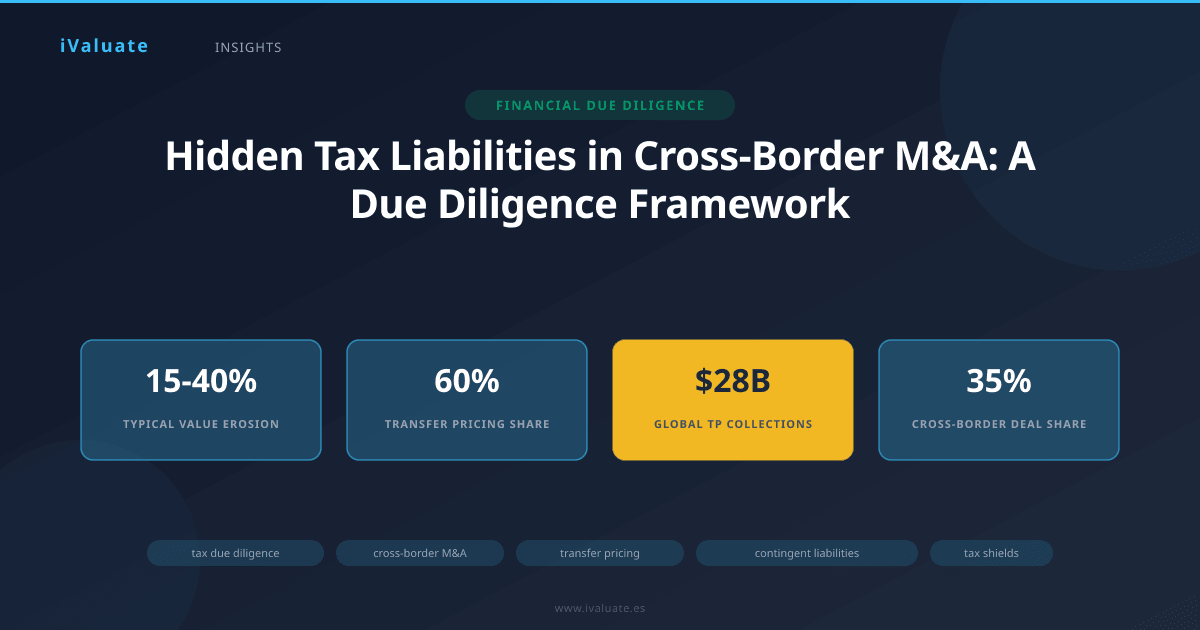
In the current M&A environment of 2025-2026, cross-border transactions continue to represent approximately 35% of global deal volume, with aggregate values exceeding $1.2 trillion annually. Yet beneath the headline multiples and strategic rationales lies a minefield of tax exposures that can fundamentally reshape deal economics. A comprehensive tax due diligence process isn't merely a compliance exercise—it's a critical value discovery mechanism that frequently uncovers contingent liabilities capable of eroding 15-40% of anticipated equity value.
The complexity has intensified dramatically following the OECD's Pillar Two implementation, which established a global minimum corporate tax rate of 15% across 140+ jurisdictions. Combined with heightened transfer pricing scrutiny, beneficial ownership transparency requirements, and the proliferation of digital services taxes, the tax landscape for cross-border acquisitions has never been more treacherous. Private equity sponsors and strategic acquirers who treat tax DD as an afterthought consistently discover—too late—that their carefully modeled returns have evaporated.
01 The Anatomy of Tax Due Diligence in Cross-Border Transactions
Tax due diligence in cross-border contexts extends far beyond reviewing filed returns and assessing current compliance. It requires a forensic examination of historical tax positions, structural arrangements, and forward-looking exposures across multiple jurisdictions with potentially conflicting tax regimes. The process typically encompasses four critical dimensions:
- Historical compliance review: Verification of tax return filings, payment histories, and audit trails across all relevant jurisdictions for the past 5-7 years
- Structural analysis: Evaluation of holding company architectures, intellectual property ownership, financing arrangements, and intercompany flows
- Contingent liability assessment: Identification and quantification of potential tax exposures from aggressive positions, pending disputes, or uncertain tax treatments
- Post-acquisition integration planning: Modeling of tax-efficient structures, preservation of tax attributes, and optimization of the combined entity's effective tax rate
The stakes are substantial. In a recent cross-border acquisition of a European software company by a US-based strategic buyer, initial tax DD uncovered €47 million in unrecognized VAT liabilities related to digital services across 12 EU member states—representing 22% of the proposed purchase price. The transaction proceeded only after a significant price adjustment and establishment of a robust indemnity structure.
02 Transfer Pricing: The Primary Source of Hidden Liabilities
Transfer pricing represents the single largest category of tax risk in cross-border M&A, accounting for approximately 60% of all material tax adjustments discovered during due diligence. The fundamental challenge stems from the inherent tension between tax optimization and arm's-length pricing principles. Target companies frequently structure intercompany transactions to minimize global tax burdens, but these arrangements often fail to withstand scrutiny under increasingly aggressive tax authority challenges.
Common Transfer Pricing Vulnerabilities
The most problematic areas consistently involve:
- Intellectual property arrangements: Cost-sharing agreements, IP licensing structures, and development cost allocations that lack contemporaneous documentation or economic substance
- Management service fees: Intercompany charges for corporate services that cannot be substantiated with detailed activity logs, time tracking, or benefit analyses
- Financing structures: Intercompany loans with interest rates that deviate from arm's-length benchmarks or debt-to-equity ratios that trigger thin capitalization concerns
- Trading arrangements: Buy-sell structures involving limited-risk distributors or contract manufacturers with profit allocations unsupported by functional analysis
In 2024-2025, tax authorities collected over $28 billion globally through transfer pricing adjustments, representing a 34% increase from the prior two-year period. The OECD's enhanced Country-by-Country Reporting requirements have provided tax authorities with unprecedented visibility into multinational profit allocation, triggering audit activity that frequently surfaces during M&A due diligence.
A mid-market pharmaceutical acquisition in 2025 revealed transfer pricing exposure exceeding $120 million related to a Swiss IP holding company structure. The target had allocated 85% of global profits to Switzerland based on legal IP ownership, despite core R&D activities occurring in the US and Germany. The buyer negotiated a 28% purchase price reduction and required the seller to establish a $95 million escrow for potential tax authority challenges.
Documentation Deficiencies and Penalty Exposure
Beyond the substantive transfer pricing positions themselves, documentation gaps create separate penalty exposure that can equal 20-40% of any tax adjustment. Most jurisdictions now require contemporaneous transfer pricing documentation—prepared at the time transactions occur—including master files, local files, and functional analysis supporting intercompany pricing. Target companies, particularly founder-led businesses or portfolio companies of smaller private equity funds, frequently lack this documentation entirely.
The absence of contemporaneous documentation doesn't merely create penalty risk; it fundamentally undermines the target's ability to defend its historical positions. In transfer pricing disputes, the burden of proof typically rests with the taxpayer. Without robust documentation, even reasonable pricing positions become indefensible, forcing settlement at unfavorable terms.
03 Unrecognized Tax Contingencies: The Balance Sheet Time Bombs
Contingent tax liabilities represent obligations that may or may not materialize depending on future events, tax authority actions, or legal interpretations. Under accounting standards (ASC 450 in the US, IAS 37 internationally), companies must recognize provisions for tax contingencies when losses are probable and reasonably estimable. However, the practical application of these standards leaves substantial room for judgment—and aggressive targets routinely understate or entirely omit material contingencies.
Categories of Commonly Unrecognized Contingencies
Due diligence frequently uncovers significant exposures in these areas:
- Permanent establishment risk: Cross-border activities that inadvertently create taxable presence in foreign jurisdictions, particularly relevant for service businesses, digital platforms, and companies with traveling employees
- Withholding tax exposures: Failures to withhold and remit taxes on cross-border payments for services, royalties, or interest, creating both primary liability and penalties
- Indirect tax positions: VAT/GST treatment of complex transactions, particularly digital services, cross-border supplies, and mixed-use activities
- Uncertain tax positions: Aggressive interpretations of tax law, particularly regarding deductibility of expenses, characterization of income, or application of tax incentives
- Historical restructuring transactions: Past reorganizations, spin-offs, or asset transfers that relied on favorable tax treatment without securing advance rulings or meeting all technical requirements
The financial impact can be staggering. A 2025 acquisition of an Asian manufacturing business revealed unrecognized permanent establishment exposure across seven countries where the target's technical staff regularly performed installation and commissioning services. The potential tax liability, including penalties and interest, exceeded $180 million—nearly 40% of the enterprise value. The transaction was restructured as an asset purchase to exclude the historical liabilities, with a corresponding 35% reduction in consideration.
The Pillar Two Dimension
The OECD's Pillar Two framework, now implemented across the EU, UK, and numerous other jurisdictions, has introduced an entirely new category of contingent liability. The Global Anti-Base Erosion (GloBE) rules impose a 15% minimum effective tax rate on a jurisdictional basis for groups with revenue exceeding €750 million. For target companies with operations in low-tax jurisdictions, this creates potential top-up tax obligations that may not be reflected in historical financial statements.
Sophisticated buyers now model Pillar Two impact as part of tax DD, particularly for targets with significant operations in traditional low-tax jurisdictions like Ireland (12.5% statutory rate), Singapore (17% with generous incentives), or various Caribbean jurisdictions. A European industrial conglomerate's 2025 acquisition of a target with substantial Singapore operations required detailed modeling showing an additional $32 million in annual tax expense post-acquisition due to Pillar Two top-up taxes—materially impacting the deal's IRR assumptions.
04 Tax Attributes and the Erosion of Tax Shields
While much of tax DD focuses on identifying liabilities, equally important is the verification and preservation of tax assets—particularly net operating loss carryforwards (NOLs), tax credits, and other attributes that create valuable tax shields. These attributes often feature prominently in acquisition models, with buyers assuming they can utilize accumulated losses to shelter future income and enhance after-tax returns.
The reality proves far more complex. Tax attribute utilization faces numerous restrictions that can substantially impair or entirely eliminate anticipated benefits:
Change of Ownership Limitations
Most jurisdictions impose restrictions on tax attribute utilization following ownership changes. In the US, Section 382 limits annual NOL utilization to the equity value of the company multiplied by the long-term tax-exempt rate (currently approximately 4.5%). For a company with $100 million in NOLs acquired for $200 million, annual utilization would be capped at roughly $9 million—meaning the full NOL would require 11+ years to utilize, substantially diminishing present value.
European jurisdictions employ varied approaches, from complete forfeiture of losses upon ownership change (Germany's strict interpretation) to continuity-of-business tests (UK) to temporal limitations (France's 10-year carryforward). A pan-European acquisition requires jurisdiction-by-jurisdiction analysis of attribute preservation, often revealing that headline NOL balances overstate realizable value by 40-60%.
Cross-Border Attribute Challenges
Cross-border acquisitions introduce additional complexity regarding tax attribute utilization. Key considerations include:
- Jurisdictional restrictions: Most countries prohibit using foreign losses to offset domestic income, limiting strategic consolidation benefits
- Separate entity requirements: Many jurisdictions require maintaining separate legal entities to preserve attributes, constraining post-acquisition integration flexibility
- Business continuity tests: Requirements to continue substantially the same business that generated the losses, potentially conflicting with operational transformation plans
- Temporal limitations: Varying carryforward periods (5-20 years depending on jurisdiction) that may expire before utilization
In a 2025 cross-border merger between a profitable US technology company and a loss-making European competitor, initial models assumed full utilization of €240 million in European NOLs. Detailed tax DD revealed that ownership change rules, business continuity requirements, and integration plans would limit realizable value to approximately €85 million—a 65% impairment requiring complete remodeling of deal economics and a 12% reduction in offer price.
Valuing Tax Shields Appropriately
Sophisticated buyers discount tax attributes to present value using risk-adjusted rates reflecting utilization uncertainty. A typical framework applies:
- Probability adjustment: 60-80% probability for well-documented attributes with clear utilization paths; 30-50% for attributes facing legal or business uncertainty
- Timing analysis: Detailed projection of utilization based on realistic income forecasts and applicable limitations
- Discount rate: Cost of equity (10-15% typically) rather than after-tax cost of capital, reflecting the equity-like risk profile of tax attributes
This methodology frequently reveals that tax attributes trading at face value in purchase price negotiations actually warrant 40-70% discounts when properly risk-adjusted—a gap that sophisticated buyers exploit in negotiations.
05 Structural Red Flags: Identifying High-Risk Tax Architectures
Certain structural arrangements should trigger enhanced scrutiny during tax DD, as they frequently harbor hidden liabilities or unsustainable positions:
IP Holding Company Structures
Arrangements involving IP ownership in low-tax jurisdictions (Ireland, Netherlands, Luxembourg, Singapore, Switzerland) with licensing back to operating entities warrant detailed examination. Key questions include:
- Was the IP transfer properly documented with contemporaneous valuation support?
- Do the licensing arrangements reflect arm's-length economics?
- Does the IP holding company have sufficient substance (employees, decision-making, risk assumption)?
- Have tax authorities in high-tax jurisdictions challenged the arrangement?
Post-BEPS (Base Erosion and Profit Shifting), tax authorities aggressively challenge IP structures lacking economic substance. The EU's Anti-Tax Avoidance Directive and various countries' controlled foreign corporation rules have substantially curtailed the effectiveness of these arrangements.
Hybrid Instruments and Entities
Financial instruments or entities treated differently for tax purposes in different jurisdictions (debt in one country, equity in another) create deduction/no-inclusion outcomes that tax authorities increasingly target. The OECD's hybrid mismatch rules, now implemented broadly, deny tax benefits from these arrangements—potentially triggering significant back-tax exposure if the target has relied on hybrid structures.
Tax Haven Subsidiaries
Subsidiaries in jurisdictions with zero or minimal corporate taxation (Cayman Islands, British Virgin Islands, Bermuda) often serve legitimate purposes (holding structures, treasury functions) but require careful examination. Enhanced beneficial ownership transparency requirements and substance regulations in these jurisdictions have created compliance obligations that many companies have ignored, creating potential exposure.
06 The Due Diligence Process: Best Practices for Buyers
Effective tax DD in cross-border transactions requires a structured, multi-phase approach:
Phase 1: Initial Assessment (Week 1-2)
- Review organizational charts, entity structures, and jurisdictional footprint
- Analyze three years of consolidated and jurisdictional tax returns
- Identify material cross-border transactions and intercompany arrangements
- Review tax provision calculations and uncertain tax position schedules
- Assess transfer pricing documentation completeness
Phase 2: Deep Dive (Week 3-5)
- Conduct detailed transfer pricing analysis with benchmarking studies
- Review correspondence with tax authorities and status of audits/disputes
- Analyze tax attribute schedules with utilization modeling
- Examine historical restructuring transactions and tax opinions
- Assess permanent establishment risk through employee travel analysis
- Model Pillar Two impact for relevant jurisdictions
Phase 3: Quantification and Structuring (Week 6-7)
- Quantify identified exposures with probability-weighted scenarios
- Model post-acquisition tax structure and integration alternatives
- Develop indemnity and escrow recommendations
- Prepare tax-specific representations and warranties
- Calculate purchase price adjustments for material findings
Leading private equity firms and strategic acquirers engage specialized tax DD advisors from Big Four firms or boutique tax consultancies, allocating 8-12% of total DD budgets to tax workstreams for complex cross-border deals. This investment consistently delivers returns through risk identification and structural optimization.
07 Negotiating Protection: Indemnities, Escrows, and Insurance
Once tax exposures are identified, buyers employ multiple mechanisms to allocate risk:
Tax-Specific Indemnities
Comprehensive tax indemnity provisions should cover:
- All taxes relating to pre-closing periods, regardless of when assessed
- Penalties and interest on tax deficiencies
- Costs of defending tax audits and disputes
- Losses from failure to realize anticipated tax attributes
- Specific identified exposures with uncapped or separately capped indemnity
Survival periods for tax indemnities typically extend beyond general representations—6-7 years is common, aligning with statute of limitations periods in major jurisdictions.
Escrow Structures
For material identified exposures, buyers should require escrow holdbacks of 100-150% of estimated exposure (accounting for penalties and interest). Escrow release typically occurs upon expiration of relevant statute of limitations periods or resolution of specific risks.
Representations and Warranties Insurance
R&W insurance has become standard in private equity transactions, with 85%+ of PE-backed deals now including coverage. However, standard policies typically exclude or limit tax coverage, particularly for:
- Known tax issues or matters disclosed in DD
- Taxes not yet assessed or arising from uncertain positions
- Transfer pricing adjustments
- Penalties and interest
Specialized tax liability insurance (TLI) policies can provide coverage for specific identified risks, though at premium costs of 8-15% of coverage limits. These policies prove most valuable for known exposures where probability and magnitude remain uncertain—such as pending tax audits or aggressive historical positions.
08 Post-Acquisition Integration: Optimizing the Tax Structure
Tax DD shouldn't end at closing. The post-acquisition integration period offers opportunities to optimize the combined entity's tax structure, but requires careful planning to avoid triggering additional liabilities:
- Entity rationalization: Eliminating redundant entities while preserving tax attributes and avoiding taxable liquidations
- Financing optimization: Restructuring debt to maximize interest deductibility while respecting thin capitalization rules and BEPS limitations
- Transfer pricing realignment: Implementing arm's-length arrangements that optimize global tax efficiency while maintaining defensibility
- IP consolidation: Centralizing IP ownership in appropriate jurisdictions with proper valuation and documentation
- Supply chain restructuring: Optimizing manufacturing, distribution, and service delivery footprints for tax efficiency
These initiatives require 12-24 months to implement properly and should be planned during the DD phase to ensure day-one readiness. A leading technology acquirer's 2025 post-merger integration program generated $180 million in annual tax savings through strategic restructuring—but only because the tax optimization roadmap was developed during pre-closing DD and executed systematically post-close.
09 Looking Forward: The Evolving Tax Risk Landscape
As we progress through 2025-2026, several trends are reshaping tax DD requirements in cross-border M&A:
Enhanced transparency and data sharing: Automatic exchange of information between tax authorities, combined with Country-by-Country Reporting and beneficial ownership registries, has eliminated the opacity that previously shielded aggressive tax positions. Buyers must assume that historical tax positions will face scrutiny.
Digital services taxation: The proliferation of unilateral digital services taxes (DSTs) pending multilateral resolution creates complex compliance obligations and potential double taxation for technology, e-commerce, and digital media businesses. Due diligence must assess DST exposure across 40+ jurisdictions with varying rules.
ESG and tax transparency: Institutional investors increasingly scrutinize portfolio companies' tax practices through an ESG lens. Aggressive tax planning that was once celebrated now creates reputational risk, particularly for consumer-facing businesses. DD must assess not just legal compliance but alignment with evolving stakeholder expectations.
AI and automation in tax authority enforcement: Tax authorities are deploying advanced analytics and AI to identify non-compliance, making historical aggressive positions increasingly likely to surface. The IRS's $80 billion funding increase and similar investments by European tax authorities signal intensified enforcement that will uncover previously undetected exposures.
10 Conclusion: Tax DD as Value Creation
In the complex landscape of cross-border M&A, comprehensive tax due diligence represents far more than risk mitigation—it's a critical value creation tool. Sophisticated buyers who invest in rigorous tax DD consistently achieve superior returns through accurate risk pricing, effective negotiation of protections, and identification of post-acquisition optimization opportunities.
The stakes continue to escalate as tax authorities become more sophisticated, transparency requirements expand, and the global minimum tax regime takes hold. Buyers who treat tax DD as a compliance checkbox rather than a strategic imperative consistently discover—too late—that hidden tax liabilities have evaporated their anticipated returns. Those who embrace comprehensive, expert-led tax due diligence position themselves to navigate this complexity successfully.
For M&A professionals managing complex cross-border transactions, leveraging specialized platforms and tools has become essential. Solutions like iValuate enable deal teams to efficiently model tax impacts, scenario-test structural alternatives, and quantify exposures—transforming tax DD from a bottleneck into a competitive advantage. As the tax landscape grows more complex, the integration of sophisticated analytical tools with deep tax expertise will increasingly separate successful acquirers from those who stumble into costly surprises.