Índice9 secciones
When private equity firm Carlyle Group acquired a UK-based manufacturing business in early 2025, the initial enterprise valuation suggested an attractive 8.5x EBITDA multiple. However, deeper financial due diligence revealed a £47 million defined benefit pension deficit—representing nearly 35% of the initially calculated equity value. After adjusting for this unfunded liability and the associated cash funding requirements, the effective purchase price multiple jumped to 11.2x, fundamentally altering the investment thesis.
This scenario plays out with increasing frequency across mature markets. As interest rates stabilized in 2025-2026 following years of volatility, many acquirers discovered that pension and employee benefit liabilities represent one of the most significant—yet often inadequately analyzed—value adjustments in transaction structuring. For middle-market companies with legacy defined benefit plans, these obligations can constitute the difference between an attractive acquisition and a value trap.
01 The Pension Deficit Reality: Scale and Prevalence
Defined benefit (DB) pension plans, once the gold standard of employee retirement benefits, have become substantial balance sheet liabilities for companies that maintain them. Unlike defined contribution plans where the employer's obligation ends with the annual contribution, DB plans promise specific retirement benefits based on salary and service years—creating an obligation that extends decades into the future.
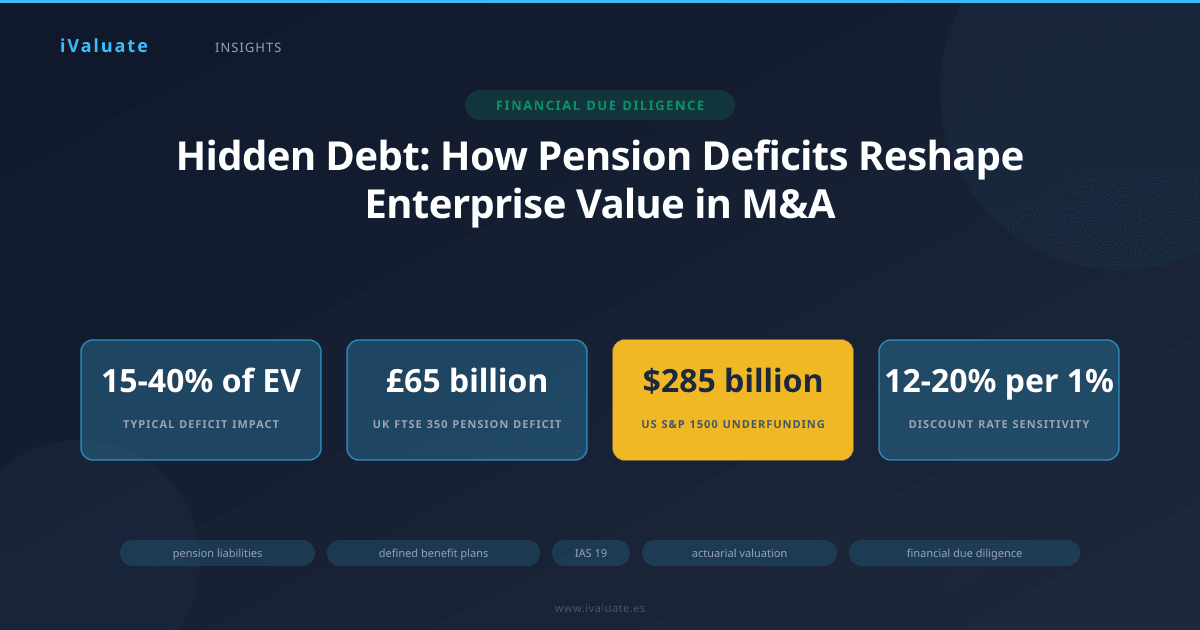
According to 2025 data from Mercer's Global Pension Index, aggregate pension deficits for FTSE 350 companies with DB schemes stood at approximately £65 billion, despite funded ratios improving from historic lows. In the United States, S&P 1500 companies reported combined pension underfunding of $285 billion as of year-end 2024, though this represented improvement from the $415 billion deficit recorded in 2022.
The prevalence varies significantly by sector and geography:
- Manufacturing and Industrial: 68% of companies with revenues between $100M-$500M maintain some form of DB obligation, with median deficits representing 22% of enterprise value
- Retail and Consumer Goods: 45% prevalence, with deficits averaging 18% of EV in affected companies
- Professional Services: 31% prevalence, typically with smaller relative deficits (8-12% of EV)
- Technology and Software: Less than 15% prevalence, primarily in legacy businesses from pre-2000 era
Geography matters enormously. UK companies face particularly stringent funding requirements under the Pensions Regulator's framework, while US companies operate under ERISA guidelines that, while comprehensive, often permit longer funding horizons. Continental European schemes vary widely by country, with Dutch and Swiss plans generally better funded than those in Southern Europe.
02 Understanding IAS 19 and Pension Accounting Mechanics
International Accounting Standard 19 (Employee Benefits) governs how companies recognize and measure pension obligations in their financial statements. For valuation professionals, understanding IAS 19—and its US equivalent, ASC 715—is essential because the accounting treatment directly impacts reported equity and can obscure the true economic burden.
Key Components of Pension Accounting
Under IAS 19, the net defined benefit liability (or asset) appears on the balance sheet as the difference between:
- Present Value of Defined Benefit Obligation (DBO): The actuarial present value of all future pension payments earned by employees to date
- Fair Value of Plan Assets: The market value of investments held by the pension trust to fund these obligations
The income statement impact splits into two components:
- Service Cost: The increase in obligation from one additional year of employee service (included in operating expenses)
- Net Interest Cost: The unwinding of the discount on the net liability, calculated as the discount rate multiplied by the net deficit (typically shown in finance costs)
Critically, actuarial gains and losses—changes in the DBO or plan assets due to assumption changes or experience different from assumptions—flow through Other Comprehensive Income (OCI) rather than the income statement. This treatment means that significant economic changes in pension funding status may not impact reported earnings, creating a disconnect that valuation professionals must bridge.
The Discount Rate Dilemma
The discount rate used to calculate the present value of pension obligations represents perhaps the most sensitive assumption in pension accounting. IAS 19 requires companies to use high-quality corporate bond yields (typically AA-rated) matching the duration of the pension liabilities.
Consider the mathematical impact: A 100 basis point decrease in the discount rate typically increases pension liabilities by 12-20%, depending on the plan's duration. For a company with a £100 million DBO, a rate decline from 5.0% to 4.0% could increase the obligation to £115-120 million—an immediate £15-20 million hit to equity value.
The 2022-2024 interest rate cycle illustrated this volatility dramatically. UK gilt yields rose from 1.5% in late 2021 to over 4.5% by mid-2023, reducing aggregate FTSE pension deficits by over £100 billion. However, as rates stabilized in 2025-2026, this tailwind dissipated, and many companies found their funding positions static or deteriorating due to longevity assumption changes.
03 Actuarial Valuation: Beyond the Balance Sheet Numbers
The pension deficit shown on a company's balance sheet represents an accounting construct, not necessarily the economic reality facing an acquirer. Professional due diligence requires a comprehensive actuarial review that challenges key assumptions and quantifies the true cash funding requirement.
Critical Actuarial Assumptions
Mortality and Longevity: Life expectancy assumptions directly determine how long the plan must pay benefits. The adoption of updated mortality tables (such as the CMI_2023 model in the UK) has consistently extended expected lifespans, increasing liabilities by 2-5%. A 65-year-old male retiree now has a life expectancy of approximately 87 years in developed markets, up from 84 years a decade ago. Each additional year of life expectancy adds roughly 3-4% to pension obligations.
Salary Inflation: For final salary schemes, the assumption about future salary growth directly impacts the ultimate benefit calculation. In the current environment of 2025-2026, with wage inflation running at 3.5-4.5% in most developed markets (elevated from the 2-3% historical norm), this assumption carries increased significance. Conservative assumptions might project 3.0% long-term salary growth, while aggressive assumptions might use 2.0%, creating a 5-8% difference in calculated obligations.
Pension Increases: Many schemes promise inflation-linked increases to pensions in payment. With inflation volatility experienced in 2022-2024, the assumed long-term inflation rate (typically 2.0-2.5% in developed markets) significantly impacts valuations. Plans with full inflation linking carry substantially higher obligations than those with capped increases.
The Funding vs. Accounting Gap
A critical distinction exists between the IAS 19 accounting deficit and the funding deficit calculated under local pension regulations. In the UK, the Pensions Regulator requires triennial valuations using technical provisions that often exceed IAS 19 obligations by 10-25%. This occurs because:
- Funding valuations typically use more conservative discount rates (often gilts plus a modest spread rather than corporate bond yields)
- Regulatory frameworks may require additional prudence margins
- Funding targets often aim for self-sufficiency or buyout basis, both more expensive than ongoing plan assumptions
For acquirers, the funding deficit represents the more relevant metric because it determines actual cash contributions required. A company showing a £30 million IAS 19 deficit might face a £42 million funding deficit, requiring an additional £12 million in cash contributions over the recovery plan period (typically 5-10 years).
04 Valuation Impact: Quantifying the Equity Value Adjustment
Translating pension deficits into equity value adjustments requires a nuanced approach that considers both immediate balance sheet impact and ongoing cash flow implications.
Direct Balance Sheet Adjustment
The most straightforward impact: the net pension deficit directly reduces net asset value. In an asset-based valuation or when calculating tangible book value, the deficit represents a clear liability. For a company valued at £150 million enterprise value with £20 million net debt and a £25 million pension deficit, the equity value calculation becomes:
Equity Value = Enterprise Value - Net Debt - Pension Deficit
Equity Value = £150M - £20M - £25M = £105M
However, this simple subtraction understates the true impact in most scenarios.
Cash Flow Impact and EBITDA Adjustments
The ongoing cash contributions required to fund the deficit create a persistent drag on free cash flow. If a company must contribute £4 million annually over seven years to eliminate a £25 million deficit, this represents cash that cannot be used for growth investment, debt reduction, or distributions to shareholders.
Sophisticated buyers adjust EBITDA to reflect the economic cost of pension obligations. While IAS 19 service costs already flow through operating expenses, the deficit funding contributions represent an additional cash cost. Some practitioners calculate an "adjusted EBITDA" that deducts an annualized deficit contribution, effectively reducing the valuation multiple applied.
Consider a business generating £15 million EBITDA, valued at 10x, suggesting £150 million enterprise value. If the business requires £4 million annual pension contributions beyond the service cost already in EBITDA, some buyers would adjust:
Adjusted EBITDA = £15M - £4M = £11M
Enterprise Value (at 10x) = £110M
This £40 million reduction (27% of the original valuation) reflects the true economic impact more accurately than simply subtracting the £25 million balance sheet deficit.
Risk Premium and Multiple Compression
Beyond direct adjustments, pension deficits introduce uncertainty that can compress valuation multiples. Key risks include:
- Regulatory Risk: Pension regulators may require accelerated funding or additional contributions
- Longevity Risk: People living longer than assumed increases obligations
- Investment Risk: Poor asset performance requires additional contributions
- Inflation Risk: Higher-than-expected inflation increases inflation-linked benefits
In practice, companies with material pension deficits (>20% of enterprise value) often trade at 1.0-2.0x lower EBITDA multiples than comparable businesses without such obligations, all else equal. This multiple compression reflects both the cash flow drag and the risk premium investors demand for assumption uncertainty.
05 Real-World Case Studies: Lessons from Recent Transactions
Case Study 1: UK Engineering Acquisition (2024)
A mid-market private equity firm evaluated a UK-based precision engineering company with £85 million revenue and £12 million EBITDA. Initial valuation suggested 9.0x EBITDA, or £108 million enterprise value. Financial due diligence revealed:
- IAS 19 pension deficit: £18 million (17% of EV)
- Regulatory funding deficit: £26 million (24% of EV)
- Required annual contributions: £3.8 million over 7 years
- Plan had 450 deferred members and 280 pensioners, with average age of pensioners at 71
The actuarial review identified that the company had used a 4.8% discount rate while comparable schemes were using 4.5%, understating the deficit by approximately £3 million. Additionally, the mortality assumptions hadn't been updated to reflect CMI_2023 tables, creating another £2 million understatement.
The buyer's adjusted valuation:
- Revised deficit estimate: £31 million
- Adjusted EBITDA (deducting annual contribution): £8.2 million
- Applied multiple: 8.0x (vs. 9.0x initially, reflecting risk premium)
- Revised enterprise value: £65.6 million
- Equity value: £65.6M - £15M net debt - £31M pension = £19.6M
The original equity value implied was £73 million (£108M EV - £15M debt - £18M pension). The revised analysis suggested £19.6 million—a 73% reduction. Ultimately, the transaction proceeded at £42 million equity value after the seller agreed to make a £20 million one-time contribution to the pension scheme at closing.
Case Study 2: US Manufacturing Carve-Out (2025)
A corporate divestiture involved a manufacturing division with $180 million revenue and $28 million EBITDA. The parent company's consolidated pension plan covered 1,200 employees in the division. Key issues emerged:
- The division's allocated share of the pension deficit: $45 million
- However, the buyer would need to establish a separate plan, requiring a Section 363 transfer
- Buyout pricing from insurers: $67 million (reflecting insurance company margins and conservative assumptions)
- Alternative: establish new plan with $52 million funding to achieve 95% funded status acceptable to regulators
The $45 million accounting deficit understated the true economic cost by $7-22 million depending on the chosen solution. The buyer negotiated a structure where:
- Seller retained pension obligations for all current retirees (reducing buyer's exposure by $28 million)
- Buyer assumed obligations for active and deferred members with $38 million funding at close
- Purchase price reduced by $41 million to reflect this allocation
This creative structuring allowed the deal to proceed while fairly allocating the economic burden.
06 Due Diligence Best Practices: A Systematic Approach
Professional acquirers employ a rigorous framework for assessing pension liabilities during due diligence:
Phase 1: Initial Assessment (Week 1-2)
- Obtain last three years of financial statements and pension disclosures
- Review most recent actuarial valuation reports (both IAS 19 and funding basis)
- Identify all benefit plans (DB pensions, retiree medical, deferred compensation)
- Quantify gross exposure: deficit amounts, number of members, plan demographics
- Assess materiality: if deficit exceeds 10% of enterprise value, proceed to detailed review
Phase 2: Detailed Actuarial Review (Week 3-5)
- Engage independent actuarial consultant to review assumptions
- Benchmark discount rates, mortality tables, inflation assumptions against market
- Perform sensitivity analysis: impact of 0.5% discount rate change, 1-year longevity increase
- Review plan governance: trustee composition, investment strategy, funding agreements
- Analyze plan assets: allocation, performance, liquidity, concentration risks
- Calculate alternative measures: buyout cost, self-sufficiency funding level
Phase 3: Cash Flow Modeling (Week 4-6)
- Project required contributions over 10-year horizon under various scenarios
- Model impact on free cash flow and debt capacity
- Assess covenant implications if acquisition financing is involved
- Evaluate strategic options: accelerated funding, plan freezes, member transfers, insurance buyouts
Phase 4: Deal Structure Optimization (Week 6-8)
- Negotiate allocation of pension obligations between buyer and seller
- Consider seller funding contribution at close vs. purchase price reduction
- Evaluate post-close plan management: freeze to new accruals, close to new members
- Structure representations, warranties, and indemnities related to pension assumptions
- Establish escrow or holdback for potential adverse developments
07 Mitigation Strategies and Post-Acquisition Management
Once an acquisition closes, active management of pension obligations becomes critical to protecting equity value:
Plan Freezes and Closures
Freezing a DB plan—stopping future benefit accruals while preserving benefits already earned—immediately caps the obligation and eliminates service cost. Approximately 62% of UK DB plans and 71% of US corporate DB plans were closed to new accruals as of 2025. The benefits include:
- Elimination of future service costs (typically 15-25% of annual pension expense)
- Reduced sensitivity to salary inflation assumptions
- Simplified administration and governance
- Clearer path to eventual plan termination
However, freezes may trigger employee relations challenges and, in some jurisdictions, require union consultation or regulatory approval.
Liability-Driven Investment Strategies
Shifting plan assets from growth-oriented investments (equities) to liability-matching investments (bonds) reduces funding volatility. As interest rates stabilized in 2025-2026, many plans adopted LDI strategies that hedge interest rate and inflation risks. While this typically reduces expected returns, it also reduces the risk of deficit expansion, providing more predictable cash flow requirements.
Insurance Buyouts and Buy-Ins
The pension risk transfer market has grown substantially, with over £45 billion of UK liabilities transferred to insurers in 2024 alone. Buyout transactions—where an insurer assumes all obligations and the plan terminates—provide complete risk elimination but at a premium cost (typically 105-115% of IAS 19 liabilities for well-funded plans).
Buy-in transactions—where the plan purchases an insurance policy matching its liabilities while remaining in place—offer an intermediate solution, hedging longevity and investment risk while maintaining potential upside if the plan becomes overfunded.
08 Regulatory Developments and Future Outlook
The regulatory landscape continues to evolve, with implications for how pension obligations impact valuations:
UK Regulatory Changes
The Pension Schemes Act 2021 introduced new criminal offenses for actions that materially harm pension scheme funding. The Pensions Regulator's powers expanded significantly, including:
- Contribution notices requiring companies to fund deficits more rapidly
- Clearance requirements for transactions that might weaken employer covenant
- Potential personal liability for directors in cases of willful or reckless behavior
These enhanced powers increase the importance of pension due diligence in UK transactions, as buyers may inherit regulatory scrutiny and funding obligations that exceed balance sheet deficits.
US Regulatory Environment
The SECURE 2.0 Act (2022) and subsequent guidance have modified funding requirements and provided some relief for plan sponsors, but substantial obligations remain. The PBGC (Pension Benefit Guaranty Corporation) continues to monitor underfunded plans, and the agency's variable-rate premiums ($52 per $1,000 of underfunding in 2025) create an additional cost for deficit plans.
Market Outlook for 2025-2026
Several trends will shape pension liability impacts on valuations:
- Interest Rate Stability: With central bank rates stabilizing around 4-5% in major economies, the dramatic deficit reductions of 2022-2023 have ended, but volatility has decreased
- Longevity Improvements: Continued increases in life expectancy will add 1-2% annually to obligations for many plans
- Regulatory Scrutiny: Increased focus on pension security, particularly in distressed situations, will elevate due diligence importance
- Risk Transfer Growth: The buyout market will continue expanding, providing exit options for well-funded plans
Key Takeaway: Pension deficits represent one of the most significant hidden liabilities in middle-market M&A. The difference between the accounting deficit and the true economic cost can exceed 50% of equity value in mature companies with legacy DB plans. Professional due diligence requires independent actuarial review, cash flow modeling, and creative deal structuring to fairly allocate these obligations.
09 Conclusion: Integrating Pension Analysis into Valuation Discipline
The impact of defined benefit pension obligations on enterprise and equity value extends far beyond the balance sheet deficit disclosed in financial statements. As the case studies and analysis presented demonstrate, the true economic cost encompasses immediate funding requirements, ongoing cash flow drains, assumption uncertainty, and regulatory risk—factors that can reduce equity value by 15-40% in companies with material legacy obligations.
For valuation professionals, CFOs, and M&A advisors, several principles should guide pension analysis:
First, never accept balance sheet pension deficits at face value. Independent actuarial review of assumptions, particularly discount rates and mortality tables, frequently reveals understated obligations of 10-25%.
Second, focus on cash flow impact rather than accounting expense. The annual contributions required to fund deficits represent real economic costs that reduce free cash flow and should inform valuation multiples.
Third, quantify the full range of potential outcomes through sensitivity analysis. Understanding how obligations change with different discount rates, longevity assumptions, and inflation scenarios enables better risk assessment and negotiation positioning.
Fourth, consider creative deal structures that fairly allocate pension risk between buyers and sellers. Seller contributions at close, obligation splitting between active and retired members, and post-close insurance buyouts can bridge valuation gaps.
Fifth, recognize that pension obligations represent manageable risks, not deal-killers. With proper analysis, appropriate pricing adjustments, and post-acquisition mitigation strategies, companies with DB plans can represent attractive investments.
As we progress through 2025-2026, the combination of regulatory scrutiny, demographic pressures, and market volatility ensures that pension liabilities will remain a critical valuation consideration. The acquirers who invest in rigorous due diligence and sophisticated modeling will identify both risks to avoid and opportunities that less-prepared competitors overlook.
Modern valuation platforms like iValuate increasingly incorporate pension liability analysis into their comprehensive due diligence frameworks, enabling professionals to model various scenarios, stress-test assumptions, and quantify equity value impacts efficiently. As the complexity of pension accounting and regulation continues to increase, leveraging technology alongside expert actuarial advice becomes essential for accurate valuation and successful transaction execution.
The companies that master pension liability analysis—understanding not just the accounting mechanics but the economic reality, regulatory requirements, and strategic options—will make better investment decisions, negotiate more favorable terms, and ultimately generate superior returns by accurately pricing one of the most significant hidden liabilities in corporate finance.