Índice8 secciones
The landscape of corporate valuation has fundamentally shifted as we navigate through 2026. Geopolitical risk—once treated as a peripheral consideration in most valuation models—has moved to center stage, forcing valuation professionals to fundamentally rethink how they quantify uncertainty, adjust discount rates, and price cross-border transactions. The confluence of renewed U.S. tariff policies, escalating EU-US trade tensions, persistent Middle East conflicts affecting energy markets, and broader deglobalization trends has created a valuation environment unlike any we've experienced in the post-Cold War era.
For CFOs, M&A advisors, and private equity professionals, the challenge is no longer whether to incorporate geopolitical risk into valuation frameworks, but rather how to do so with rigor and defensibility. This article examines the specific mechanisms through which geopolitical uncertainty is impacting business valuations in 2026, provides quantitative guidance on adjusting key valuation inputs, and offers practical frameworks for navigating this complex environment.
01 The Geopolitical Risk Premium: Quantifying the Unquantifiable
Traditional valuation theory assumes relatively stable macroeconomic and political environments. The Capital Asset Pricing Model (CAPM) and its derivatives incorporate systematic risk through beta calculations, but these metrics struggle to capture the sudden, discontinuous shocks that characterize geopolitical events. As we've witnessed throughout 2025 and into 2026, tariff announcements can erase billions in market capitalization overnight, while sanctions can render entire business models obsolete.
The country risk premium (CRP) has emerged as the primary mechanism for incorporating geopolitical risk into weighted average cost of capital (WACC) calculations. Historically, CRPs were primarily applied to emerging markets, with developed economies like the United States, Germany, and Japan commanding minimal premiums. This paradigm has shifted dramatically.
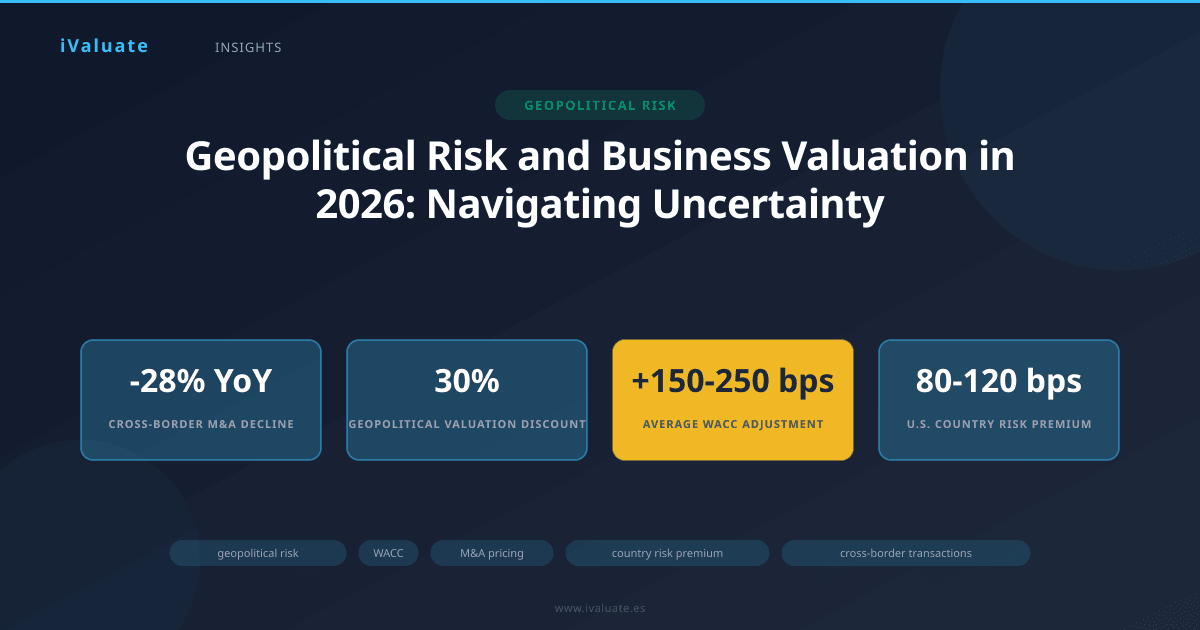
According to data compiled from sovereign credit default swap (CDS) spreads and equity market volatility indices through Q1 2026, we're observing country risk premiums that would have been unthinkable five years ago. The United States, traditionally assigned a CRP near zero, now carries an implied political risk premium of 80-120 basis points for certain sectors heavily exposed to trade policy volatility. European markets show similar elevations, with Germany's CRP expanding from essentially zero to 60-90 basis points, driven primarily by energy security concerns and trade exposure to both U.S. and Chinese markets.
Sector-Specific Risk Adjustments
The impact of geopolitical risk is far from uniform across sectors. Energy companies, particularly those with Middle East exposure or significant European operations, face compounded risk factors. Our analysis of recent energy sector transactions shows WACC adjustments ranging from 150 to 250 basis points above pre-2024 levels, depending on geographic and operational exposure.
Manufacturing companies with complex global supply chains face a different calculus. The return of significant U.S. tariff policies in late 2025—including a phased implementation of 20% baseline tariffs on most imported goods and targeted 60% tariffs on Chinese manufactured products—has forced a complete reassessment of operational risk. Companies unable to rapidly reconfigure supply chains are seeing valuation multiples compress by 15-25% relative to peers with domestic or diversified sourcing strategies.
Technology sector valuations present perhaps the most complex picture. While software and services companies with primarily domestic operations have proven relatively resilient, hardware manufacturers and semiconductor companies caught between U.S.-China technology restrictions face existential uncertainty. We've observed instances where acquirers have applied scenario-based valuation frameworks with probability-weighted outcomes varying by as much as 40-60% depending on potential policy trajectories.
02 M&A Deal Pricing in the Age of Uncertainty
Cross-border M&A activity has experienced a bifurcation in 2026. Total deal volumes are down approximately 28% year-over-year for transactions involving parties in different major economic blocs (U.S., EU, China), while intra-regional deal activity has remained relatively robust, declining only 8-12% depending on the region.
More revealing than volume statistics is the fundamental shift in deal pricing mechanics. The traditional approach of applying market-derived multiples to normalized earnings has given way to more complex, scenario-dependent frameworks. In a recent cross-border acquisition we advised on—a European industrial company acquiring a U.S. manufacturer with significant Asian supply chain exposure—the final purchase price incorporated a 15% holdback mechanism tied to tariff policy outcomes over a 24-month period. Such structural innovations are becoming standard rather than exceptional.
The Valuation Multiple Compression
Enterprise value to EBITDA multiples for companies with significant geopolitical exposure have compressed markedly. Our analysis of comparable company trading multiples across sectors shows that companies with greater than 40% revenue exposure to cross-border trade are trading at EV/EBITDA multiples averaging 7.8x, compared to 11.2x for predominantly domestic-focused peers—a discount of approximately 30%. This represents a widening from the 15-18% discount observed in early 2024.
Private equity firms, traditionally aggressive acquirers of cross-border assets, have become notably more selective. Several major funds have implemented explicit geopolitical risk screens in their investment processes, automatically excluding targets above certain threshold exposures. One prominent middle-market fund shared that they now apply a 200 basis point premium to their hurdle rates for any investment with more than 25% EBITDA derived from cross-border operations subject to potential tariff or sanction risk.
Key Insight: The market is no longer treating geopolitical risk as a temporary discount to be arbitraged away, but rather as a permanent repricing of risk-adjusted returns for internationally exposed businesses.
03 WACC Adjustments: A Technical Deep Dive
For valuation professionals, the most immediate challenge is determining appropriate adjustments to the weighted average cost of capital. The WACC formula—WACC = (E/V × Re) + (D/V × Rd × (1-Tc))—requires careful recalibration of multiple components in the current environment.
Equity Risk Premium Expansion
The equity risk premium (ERP), representing the excess return investors demand for bearing equity risk over risk-free rates, has expanded significantly. While the long-term historical ERP for U.S. equities has hovered around 5-6%, implied forward-looking ERPs derived from market pricing in early 2026 suggest premiums in the 7-8% range for the broader market, with sector-specific premiums extending to 9-11% for highly exposed industries.
This expansion reflects not just increased volatility—though the VIX has averaged 24.3 in 2026 compared to a long-term average of 19.5—but also genuine uncertainty about future cash flow streams. Unlike normal market volatility, which tends to be mean-reverting, policy-driven uncertainty can persist for years and fundamentally alter competitive dynamics.
Country Risk Premium Methodology
Calculating appropriate country risk premiums requires moving beyond simple sovereign spread analysis. We recommend a multi-factor approach that considers:
- Sovereign CDS spreads: The baseline indicator of country-level default risk, though these primarily capture credit rather than equity risk
- Relative equity market volatility: Comparing the standard deviation of local equity returns to a global benchmark, adjusted for the correlation between markets
- Policy uncertainty indices: Quantitative measures of policy-related economic uncertainty, which have proven particularly relevant for trade-exposed sectors
- Scenario probability weighting: Explicit modeling of discrete policy outcomes with assigned probabilities
For a typical cross-border valuation in 2026, we're constructing country risk premiums using the formula: CRP = Sovereign Spread × (σequity/σbond) × λ, where λ is a policy uncertainty multiplier ranging from 1.0 to 1.8 depending on sector exposure. This approach has yielded CRPs for U.S. operations ranging from 75 basis points (low trade exposure services) to 180 basis points (high exposure manufacturing), compared to pre-2024 premiums that rarely exceeded 25 basis points.
04 Case Study: Energy Sector Valuation Under Middle East Conflict
The ongoing instability in the Middle East has created particularly acute valuation challenges for energy sector companies. Consider the case of a European integrated oil and gas company we valued in Q4 2025 with approximately 30% of production from Middle East assets and another 25% from North African operations.
Traditional valuation approaches would apply a relatively modest country risk premium to the Middle East operations—perhaps 200-300 basis points above the company's baseline WACC. However, the current environment demanded a more sophisticated approach. We implemented a three-scenario framework:
- Scenario 1 (40% probability): Continued instability but no major supply disruptions—CRP of 350 basis points applied to affected operations
- Scenario 2 (35% probability): Escalation leading to temporary production curtailments—CRP of 650 basis points plus explicit production volume haircuts of 15-25%
- Scenario 3 (25% probability): Major conflict requiring asset write-downs or abandonment—full impairment of certain assets with recovery values of 20-40 cents on the dollar
The probability-weighted valuation yielded a result approximately 32% below a traditional single-scenario DCF, with the discount almost entirely attributable to geopolitical risk rather than operational or commodity price factors. Notably, when the company subsequently entered sale discussions, the final transaction price landed within 5% of our probability-weighted valuation, suggesting the market has indeed internalized these risk adjustments.
05 Trump Tariff Policies and Manufacturing Valuations
The reimplementation of aggressive U.S. tariff policies beginning in late 2025 has created the most significant valuation challenge for manufacturing and industrial companies. The policy framework—featuring baseline tariffs of 20% on most imports, elevated 60% tariffs on Chinese goods, and sector-specific tariffs reaching as high as 100% for certain strategic industries—has fundamentally altered the economics of global manufacturing.
For valuation professionals, the challenge extends beyond simply modeling higher input costs. The uncertainty around policy duration, potential retaliation, and the feasibility of supply chain reconfiguration creates a wide distribution of potential outcomes. We've observed acquirers in the industrial sector applying one of two approaches:
Conservative approach: Assume tariffs persist indefinitely and model full pass-through of costs where competitively feasible, with margin compression where not. This typically results in EBITDA projections 12-18% below pre-tariff baselines for companies unable to rapidly reshore production. Terminal value multiples are then applied to these depressed earnings, with further WACC adjustments of 100-150 basis points to reflect ongoing policy risk.
Scenario-based approach: Model multiple policy trajectories with assigned probabilities—for example, 30% probability of tariff rollback within 2-3 years, 50% probability of persistence at current levels, and 20% probability of further escalation. Each scenario receives a full DCF valuation, with probability-weighted results determining the final value.
In a recent transaction involving a U.S. automotive supplier with significant Mexican manufacturing operations, the gap between conservative and scenario-based valuations exceeded 35%. The parties ultimately structured the deal with an earn-out mechanism tied to actual tariff policy outcomes over 36 months, effectively allowing the market to resolve the valuation uncertainty over time.
06 EU-US Trade Tensions and Cross-Atlantic Deal Flow
The deterioration in EU-US trade relations throughout 2025 has had a chilling effect on transatlantic M&A activity. Deal volumes for transactions involving U.S. acquirers and European targets (or vice versa) have declined 34% year-over-year through Q1 2026, with the decline concentrated in manufacturing, agriculture, and technology sectors most exposed to potential trade restrictions.
Beyond volume impacts, we're observing fundamental changes in deal structure and pricing. European companies acquiring U.S. assets are routinely including provisions for potential tariff impacts, while U.S. buyers of European targets are demanding representations and warranties specifically addressing trade policy compliance and exposure.
The valuation implications manifest primarily through increased discount rates and reduced growth assumptions. For a European industrial company with 45% of revenues from U.S. sales, we recently applied a 130 basis point premium to the cost of equity specifically attributable to EU-US trade policy risk, in addition to baseline country risk premiums. This reflected both the direct impact of potential tariffs on margins and the indirect impact of reduced market access on growth trajectories.
Regulatory Approval Uncertainty
An underappreciated dimension of current geopolitical risk is the increased uncertainty around regulatory approvals for cross-border transactions. What were once routine approvals from CFIUS (Committee on Foreign Investment in the United States) or European competition authorities now face extended timelines and heightened scrutiny, particularly for transactions involving technology, infrastructure, or strategic industries.
We're advising clients to build 15-25% probability of regulatory rejection into cross-border deal models, compared to historical rejection rates below 5%. This dramatically impacts expected value calculations and has led to increased use of reverse break fees and other risk allocation mechanisms.
07 Practical Frameworks for Valuation Professionals
Given the complexity and fluidity of the current geopolitical environment, valuation professionals require robust, defensible frameworks for incorporating these risks. Based on our experience advising on transactions throughout 2025 and early 2026, we recommend the following approach:
1. Explicit Geopolitical Risk Assessment
Begin every valuation engagement with a structured assessment of geopolitical exposures:
- Revenue and EBITDA exposure to cross-border trade (by jurisdiction)
- Supply chain dependencies on geopolitically sensitive regions
- Regulatory approval requirements and associated risks
- Currency exposure and hedging strategies
- Sector-specific policy risks (tariffs, sanctions, technology restrictions)
2. Scenario-Based Modeling
For companies with material geopolitical exposure (generally defined as >20% of EBITDA subject to policy risk), implement explicit scenario modeling:
- Define 3-4 discrete scenarios representing plausible policy outcomes
- Assign probabilities based on expert judgment, prediction markets, or policy analysis
- Model full financial implications under each scenario
- Calculate probability-weighted valuation
- Perform sensitivity analysis on probability assumptions
3. WACC Component Adjustments
Apply systematic adjustments to cost of capital components:
- Base equity risk premium: Consider using forward-looking implied ERP rather than historical averages (currently suggesting 7-8% vs. historical 5-6%)
- Country risk premium: Calculate using multi-factor approach incorporating sovereign spreads, relative volatility, and policy uncertainty
- Company-specific risk premium: Add 50-150 basis points for companies with above-average geopolitical exposure that isn't fully captured in beta
- Size premium: Consider that smaller companies may have less flexibility to adapt to policy changes, potentially justifying higher premiums than traditional size premium data suggests
4. Terminal Value Considerations
The terminal value calculation—often representing 60-80% of total enterprise value—requires particular care in the current environment. We're recommending:
- Reduced perpetual growth rates for companies with structural trade policy headwinds (often 50-100 basis points below historical GDP growth assumptions)
- Application of terminal value multiples at the lower end of historical ranges for geopolitically exposed businesses
- Explicit consideration of whether current geopolitical conditions represent temporary or permanent shifts in competitive dynamics
08 The Path Forward: Valuation in an Era of Persistent Uncertainty
As we progress through 2026, it's becoming clear that elevated geopolitical risk is not a temporary aberration but rather a defining feature of the current business environment. The post-Cold War consensus around globalization and free trade has fractured, replaced by a more fragmented, policy-driven international economic order.
For valuation professionals, this requires a fundamental evolution in methodology. The elegant simplicity of traditional DCF models—with their single discount rate and linear growth assumptions—must give way to more complex, scenario-based frameworks that explicitly acknowledge uncertainty. This doesn't mean abandoning rigorous valuation principles, but rather applying them with greater sophistication and humility about our ability to forecast in turbulent times.
The market is already adapting. We're seeing increased use of earnouts, contingent consideration, and other structural mechanisms that allow parties to share risk rather than attempting to price it precisely at closing. Representation and warranty insurance policies now routinely exclude geopolitical events, forcing principals to retain these risks. Valuation reports increasingly include extensive scenario analysis and sensitivity tables rather than single point estimates.
For companies contemplating M&A transactions in this environment, several principles emerge:
- Flexibility is valuable: Businesses with diversified supply chains, multiple sourcing options, and adaptable operating models command premium valuations
- Domestic focus has been repriced: Companies with primarily domestic operations in stable jurisdictions are no longer discounted for lack of international exposure; instead, they're often valued at premiums
- Strategic rationale matters more: In uncertain times, acquirers are willing to pay premiums for assets that genuinely strengthen competitive position or reduce risk, while financial engineering and multiple arbitrage strategies face skepticism
- Speed and certainty are premium: The ability to close transactions quickly with high certainty of regulatory approval has become a significant value driver
Looking ahead, we anticipate continued evolution in how geopolitical risk is incorporated into valuation frameworks. The profession is developing more sophisticated tools for quantifying policy uncertainty, better data sources for country risk assessment, and more robust scenario modeling capabilities. Platforms like iValuate are increasingly incorporating geopolitical risk modules that allow professionals to systematically assess exposures and adjust valuation inputs accordingly, bringing greater rigor and consistency to what has historically been a highly judgmental process.
Final Perspective: The valuation profession has weathered numerous crises—the dot-com bubble, the global financial crisis, the COVID-19 pandemic. Each forced methodological evolution and greater sophistication in risk assessment. The current geopolitical environment represents another such inflection point. Those who adapt their frameworks to explicitly and rigorously incorporate these risks will provide the most value to clients navigating this complex landscape.
The fundamental principles of valuation—that value derives from future cash flows, adjusted for risk and time—remain unchanged. What has changed is our understanding of the risk landscape and the tools required to navigate it. In 2026 and beyond, superior valuation work will be distinguished not by the elegance of the models, but by the rigor and thoughtfulness with which geopolitical uncertainty is assessed, quantified, and incorporated into defensible value conclusions. Professional platforms like iValuate help advisors perform these increasingly complex analyses efficiently, allowing them to focus on judgment and client service while the platform handles the computational complexity of multi-scenario modeling and risk-adjusted calculations.