Índice9 secciones
The geopolitical landscape of 2026 has fundamentally altered how valuation professionals approach cross-border transactions, discount rate construction, and deal pricing. With renewed U.S. tariff policies, escalating EU-US trade tensions, persistent Middle East conflicts affecting energy markets, and an increasingly fragmented global trading system, corporate finance advisors face unprecedented complexity in quantifying political and economic risk.
This article examines how these geopolitical dynamics are impacting business valuation methodologies, M&A transaction volumes, and the technical adjustments valuation professionals must make to WACC calculations, country risk premiums, and deal structures in today's volatile environment.
01 The 2026 Geopolitical Risk Landscape
The return of aggressive U.S. trade policy under the second Trump administration has reintroduced tariff uncertainty as a primary valuation consideration. Beginning in early 2025, the administration implemented a phased tariff structure targeting Chinese imports (ranging from 25% to 60% depending on sector), European automotive and steel products (15-25%), and selective tariffs on Mexican and Canadian goods despite the USMCA framework. By Q2 2026, these policies have created measurable impacts on cross-border deal flow and valuation multiples.
Simultaneously, the European Union has responded with retaliatory measures affecting $78 billion in U.S. exports, creating a bilateral trade tension that particularly impacts technology, aerospace, and agricultural sectors. The fragmentation extends beyond the Atlantic: ongoing conflicts in the Middle East have sustained Brent crude prices in the $95-110 range throughout 2025-2026, creating volatility in energy sector valuations and ripple effects across transportation, chemicals, and manufacturing industries.
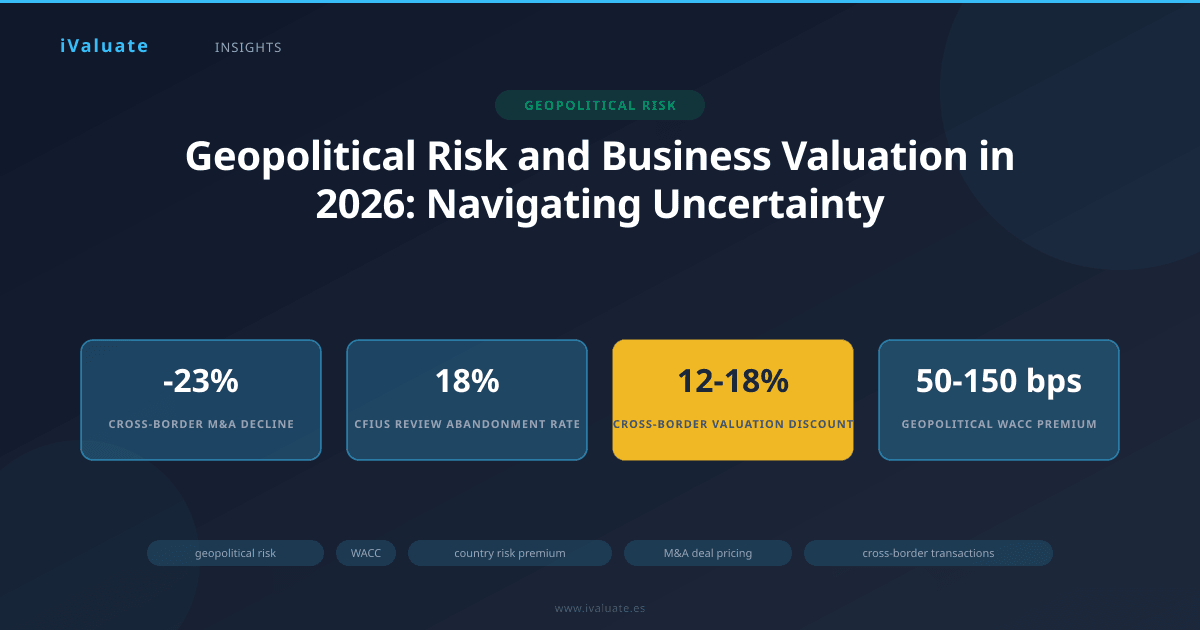
According to data from Refinitiv and PitchBook, global cross-border M&A volume declined 23% in 2025 compared to 2024, with the trend continuing into early 2026. This contraction reflects not just reduced deal count but also compressed valuation multiples as acquirers demand higher risk-adjusted returns.
02 Impact on WACC Construction and Discount Rates
The weighted average cost of capital remains the cornerstone of discounted cash flow valuation, and geopolitical risk directly impacts multiple WACC components. Valuation professionals in 2026 are making three critical adjustments:
Country Risk Premium Recalibration
The country risk premium (CRP) added to the equity risk premium has become more granular and dynamic. Traditional approaches using sovereign credit default swap spreads or Damodaran country ratings remain foundational, but practitioners are now layering additional adjustments for specific bilateral trade relationships.
For a European company with significant U.S. revenue exposure, advisors are adding 50-150 basis points to the standard CRP to reflect tariff uncertainty and potential supply chain disruption. For Chinese companies seeking Western acquisitions, the premium has expanded to 200-350 basis points above the base country risk, reflecting both regulatory approval uncertainty and potential forced divestiture risk.
A representative example: In a recent valuation of a German automotive supplier with 40% revenue from U.S. exports, the advisory team increased the discount rate from a pre-tariff 8.2% to 9.1%, incorporating a 90 basis point geopolitical risk adjustment. This seemingly modest change reduced enterprise value by approximately 11% in the DCF model, materially impacting negotiation dynamics.
Beta Adjustments for Trade-Exposed Sectors
Equity betas for companies in trade-sensitive industries have exhibited elevated volatility. Analysis of public company betas in the automotive, steel, semiconductor, and agricultural equipment sectors shows average beta increases of 0.15-0.25 points between 2024 and 2026. This reflects both higher stock price volatility and increased correlation with broader market movements during geopolitical events.
Valuation professionals are now conducting sensitivity analyses showing enterprise value ranges under different beta assumptions, recognizing that historical betas may understate current systematic risk. For private company valuations where beta estimation relies on public comparables, this requires careful consideration of which peer companies best reflect the subject company's geopolitical exposure profile.
Terminal Value Considerations
Perhaps most significantly, the assumption of stable, perpetual growth in terminal value calculations has come under scrutiny. For companies with cross-border supply chains or significant export exposure, advisors are either reducing terminal growth rates by 25-50 basis points or applying a higher terminal year discount rate to reflect persistent geopolitical uncertainty.
In one notable transaction involving a U.S. industrial manufacturer acquiring a Mexican production facility, the buyer's valuation team applied a terminal growth rate of 1.8% rather than the standard 2.5%, explicitly citing USMCA uncertainty and potential future tariff modifications. This adjustment reduced the terminal value contribution by 14%, creating significant negotiation leverage.
03 M&A Deal Pricing and Valuation Multiple Compression
Geopolitical risk has created observable patterns in transaction multiples across different deal types and geographies. Data from the first half of 2026 reveals several trends:
Cross-Border vs. Domestic Transactions
The valuation multiple discount for cross-border deals has widened substantially. In 2023-2024, cross-border transactions in developed markets typically traded at 5-8% lower EV/EBITDA multiples compared to domestic deals in the same sector. By early 2026, this discount has expanded to 12-18% for transactions involving parties from countries with active trade disputes.
Domestic U.S. middle-market M&A transactions in the industrial sector are currently achieving median multiples of 9.2x EBITDA, while comparable cross-border transactions involving European or Asian sellers are trading at 7.4x-7.8x EBITDA. This 15-20% discount reflects both buyer risk perception and reduced competitive tension as foreign strategic buyers face regulatory and financing challenges.
Sector-Specific Impacts
The energy sector provides a compelling case study in geopolitical valuation impact. Ongoing Middle East tensions, combined with the global energy transition and sanctions affecting Russian energy exports, have created extreme valuation bifurcation. Traditional oil and gas assets in geopolitically stable regions (North America, Norway, Australia) are commanding premium multiples of 6.5-7.5x EBITDA, while comparable assets in higher-risk jurisdictions trade at 3.5-4.5x EBITDA—a discount of approximately 40%.
Renewable energy assets have benefited from this dynamic, with solar and wind portfolios in OECD countries achieving record multiples of 14-18x EBITDA in 2025-2026, partly driven by their perceived geopolitical insulation. However, even this sector faces complexity: solar projects dependent on Chinese panel imports have seen valuation pressure due to tariff uncertainty, with some transactions delayed pending clarity on long-term trade policy.
Earnout Structures and Contingent Consideration
The use of earnout provisions and contingent consideration has increased dramatically as a mechanism to bridge valuation gaps created by geopolitical uncertainty. In cross-border technology transactions, earnout provisions now appear in approximately 47% of deals compared to 28% in 2023, according to SRS Acquiom data.
These structures typically tie 15-30% of total consideration to achievement of revenue or EBITDA targets over 2-3 years, effectively transferring geopolitical risk to sellers. In one representative transaction, a U.S. private equity firm acquiring a European software company with significant Chinese customer concentration structured 25% of the purchase price as an earnout contingent on maintaining Chinese revenue within 15% of baseline levels—directly addressing tariff and sanctions risk.
04 Regulatory Approval Risk and Deal Certainty
The Committee on Foreign Investment in the United States (CFIUS) and equivalent bodies in Europe and Asia have become increasingly assertive in reviewing cross-border transactions. In 2025, CFIUS reviewed 387 transactions, up from 286 in 2024, with an abandonment or restructuring rate of 18% compared to 11% in prior years.
This regulatory uncertainty directly impacts valuation through two mechanisms. First, buyers are demanding higher returns to compensate for execution risk, effectively reducing the price they're willing to pay. Analysis of announced versus completed transaction values shows an average 8-12% reduction in final purchase price for deals requiring CFIUS or EU regulatory approval, compared to 3-5% historically.
Second, the time value of money impact from extended regulatory review periods (now averaging 9-14 months for complex cross-border deals) reduces present value of consideration and increases deal costs. Sophisticated sellers are now demanding reverse break-up fees of 4-7% of transaction value for deals with significant regulatory risk, compared to 2-3% historically.
05 Case Study: Automotive Sector Valuation Dynamics
The automotive sector illustrates how multiple geopolitical factors converge to impact valuation. Consider a composite example based on several 2025-2026 transactions: A German Tier 1 automotive supplier with manufacturing facilities in Germany, Mexico, and China, serving customers globally.
Pre-tariff (2024) valuation parameters included: 8.5% WACC, 8.5x EV/EBITDA multiple, terminal growth rate of 2.5%. The company generated €2.4 billion in revenue with 22% EBITDA margins. Enterprise value was approximately €4.5 billion.
By mid-2026, valuation advisors adjusted for: (1) 25% U.S. tariffs on certain German imports, projected to reduce EBITDA margins by 180 basis points unless passed to customers; (2) potential 15% tariffs on Mexican imports under revised USMCA interpretation, creating supply chain uncertainty; (3) reduced China production utilization due to domestic market weakness and Western customer diversification.
Revised parameters: 9.3% WACC (80bp geopolitical premium), 7.2x EV/EBITDA multiple (reflecting sector compression), 2.0% terminal growth rate. Adjusted EBITDA projections showed €485 million (down from €528 million). Revised enterprise value: approximately €3.5 billion—a 22% reduction driven primarily by geopolitical factors.
This valuation compression forced the company to abandon a planned sale process and instead pursue a joint venture structure with a U.S. partner, illustrating how geopolitical risk reshapes not just valuations but entire transaction strategies.
06 Adjusting Valuation Methodologies for Geopolitical Risk
Leading valuation practices in 2026 incorporate several technical refinements to address geopolitical complexity:
Scenario-Based DCF Analysis
Rather than single-point WACC estimates, best practice now involves constructing multiple scenarios with probability-weighted outcomes. A typical framework includes:
- Base case (50-60% probability): Current tariff and trade policy continues with modest escalation
- Optimistic case (15-20% probability): Trade tensions de-escalate, tariffs reduced or eliminated
- Pessimistic case (20-30% probability): Significant escalation, additional tariffs, potential sanctions or market access restrictions
Each scenario receives distinct revenue projections, margin assumptions, and discount rates. The probability-weighted average provides a more robust enterprise value estimate than traditional single-scenario analysis. In practice, this approach typically produces valuation ranges 25-35% wider than pre-2024 methodologies, reflecting genuine uncertainty rather than false precision.
Real Options Analysis for Strategic Flexibility
For companies with significant operational flexibility—ability to shift production, diversify supply chains, or pivot markets—real options valuation frameworks are gaining traction. This approach values management's ability to respond to geopolitical developments, capturing option value that traditional DCF methods miss.
A U.S. medical device manufacturer with production capacity in both domestic and Asian facilities possesses valuable flexibility to shift production in response to tariff changes. Real options analysis might value this flexibility at 8-12% of base enterprise value, partially offsetting geopolitical risk discounts. However, this methodology requires sophisticated modeling and remains more common in strategic buyer analysis than financial sponsor valuations.
Enhanced Market Approach Adjustments
When using guideline public company or transaction multiples, valuation professionals are applying more granular adjustments for geopolitical exposure differences. This involves:
- Analyzing comparable companies' geographic revenue and supply chain exposure
- Quantifying the relationship between exposure metrics and trading multiples through regression analysis
- Applying specific adjustments based on the subject company's exposure profile relative to comparables
For example, if guideline public companies average 25% revenue from tariff-affected markets and trade at 8.5x EBITDA, while the subject company has 45% exposure, a 10-15% multiple discount may be warranted based on observed market relationships.
07 Cross-Border Transaction Volume and Strategic Responses
The decline in cross-border M&A volume masks important compositional shifts. While overall deal count is down 23%, certain transaction types are thriving:
Nearshoring and Friend-shoring Transactions: M&A activity focused on relocating production closer to end markets or to politically aligned countries has surged. U.S. acquisitions of Mexican manufacturing assets increased 34% in 2025, while European acquisitions in Eastern Europe and North Africa rose 28%. These transactions often command premium multiples (10-20% above domestic comparables) due to strategic value in de-risking supply chains.
Technology and IP Transactions: Cross-border deals focused on acquiring technology, intellectual property, or digital businesses with minimal physical trade exposure have proven more resilient, declining only 8% versus the overall 23% market contraction. These assets face lower tariff risk, though regulatory scrutiny remains intense.
Distressed and Opportunistic Situations: Private equity and distressed investors are finding opportunities in companies impaired by geopolitical factors but possessing underlying value. These transactions occur at significant discounts (40-60% below pre-crisis valuations) but offer substantial upside if geopolitical conditions normalize or if operational restructuring can mitigate exposure.
08 Practical Guidance for Valuation Professionals
For CFOs, M&A advisors, and valuation specialists navigating this environment, several practices have emerged as essential:
Conduct Explicit Geopolitical Risk Assessments: Before initiating formal valuation work, develop a structured assessment of the subject company's exposure to tariffs, sanctions, trade restrictions, and supply chain vulnerabilities. Quantify revenue and cost impacts under various policy scenarios. This analysis should inform all subsequent valuation assumptions.
Document Discount Rate Build-Up Rigorously: Given the scrutiny that geopolitical risk adjustments receive in negotiations and potential disputes, maintain detailed documentation of how country risk premiums, beta adjustments, and other risk factors were determined. Reference specific market data, comparable company analysis, and policy developments.
Expand Sensitivity Analysis: Present valuation conclusions as ranges rather than point estimates, with explicit sensitivity to key geopolitical assumptions. Show how enterprise value changes with different tariff scenarios, WACC adjustments, and terminal value assumptions. This transparency builds credibility and facilitates informed decision-making.
Consider Alternative Deal Structures: When valuation gaps emerge from geopolitical uncertainty, explore structures that allocate risk more efficiently: earnouts tied to trade policy outcomes, joint ventures that combine complementary geographic strengths, or staged acquisitions that allow reassessment as conditions evolve.
Monitor Leading Indicators: Establish processes to track policy developments, trade negotiation progress, and market indicators (currency movements, credit spreads, sector-specific trading multiples) that signal changing geopolitical risk. Quarterly reassessment of key assumptions may be necessary in volatile periods.
09 Looking Ahead: Geopolitical Risk as a Permanent Valuation Factor
The evidence from 2025-2026 suggests that elevated geopolitical risk is not a temporary aberration but a structural feature of the global economy for the foreseeable future. The post-Cold War era of deepening economic integration and declining trade barriers has given way to a more fragmented, multipolar system where political considerations increasingly override pure economic efficiency.
For valuation professionals, this requires a fundamental shift in mindset. Geopolitical risk can no longer be treated as an edge case or extraordinary item—it must be integrated into core valuation frameworks as a standard analytical dimension alongside financial, operational, and market risks.
The technical adjustments discussed in this article—enhanced country risk premiums, scenario-based DCF analysis, granular multiple adjustments, and sophisticated deal structuring—represent the profession's adaptation to this new reality. As these methodologies mature and become standardized, we can expect greater consistency in how geopolitical risk is quantified and priced into transactions.
However, significant challenges remain. The relationship between geopolitical events and valuation impacts is complex and non-linear. Small policy changes can trigger disproportionate market reactions, while major geopolitical developments sometimes have muted valuation effects. Distinguishing signal from noise requires judgment that cannot be fully systematized.
Moreover, the data infrastructure for geopolitical risk analysis remains underdeveloped compared to financial and operational risk. While credit ratings, financial ratios, and operational metrics benefit from decades of standardization and extensive databases, geopolitical risk assessment still relies heavily on qualitative judgment and fragmented data sources.
Professional valuation platforms are beginning to address this gap. Tools like iValuate are incorporating geopolitical risk modules that help advisors systematically assess exposure, model scenarios, and adjust discount rates based on current market conditions and policy developments. As these analytical capabilities become more sophisticated and widely adopted, the valuation profession will be better equipped to serve clients navigating an increasingly complex global landscape.
For business owners, investors, and corporate development professionals, the message is clear: geopolitical risk is now a first-order consideration in any significant transaction or valuation exercise. Engaging experienced advisors who understand both the technical valuation implications and the strategic options for managing these risks has never been more critical. Those who adapt their valuation frameworks and transaction strategies to this new reality will be better positioned to identify opportunities, avoid overpaying for risk, and structure deals that create value even in uncertain times.