Índice9 secciones
Debtor-in-possession (DIP) financing represents one of the most critical—and complex—elements of corporate restructuring. When a company files for Chapter 11 bankruptcy protection, its ability to secure new capital while continuing operations often determines whether it emerges as a viable entity or liquidates. For valuation professionals, understanding how DIP financing affects enterprise value is essential, as these facilities fundamentally reorder the capital structure and alter the risk-return profile for all stakeholders.
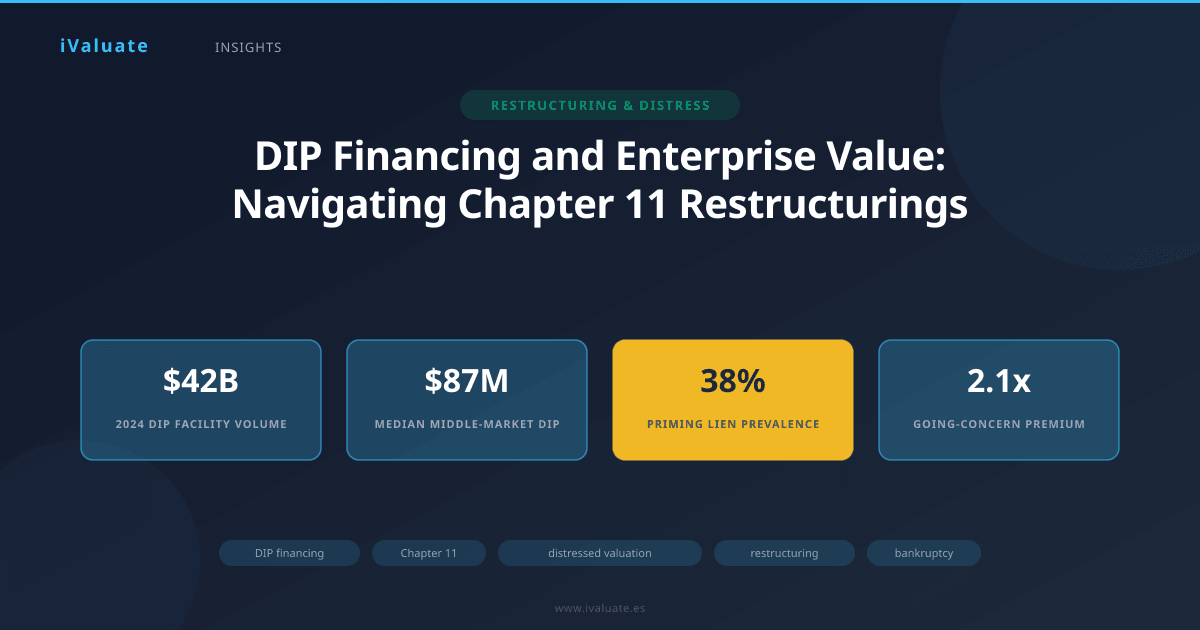
In 2025-2026, DIP financing has evolved considerably from its traditional role. With approximately $42 billion in DIP facilities extended across U.S. Chapter 11 cases in 2024—a 23% increase from 2023—the market has seen both larger facility sizes and more aggressive terms. The median DIP facility for middle-market companies now stands at $87 million, while mega-cases routinely secure facilities exceeding $2 billion. These dynamics create profound valuation implications that extend far beyond simple liquidity considerations.
01 The Mechanics of DIP Financing and Priority Status
DIP financing operates under a unique legal framework established by Section 364 of the U.S. Bankruptcy Code. Unlike conventional lending, DIP facilities receive extraordinary protections that fundamentally alter the creditor hierarchy. Understanding these mechanics is crucial for accurate enterprise valuation during restructuring proceedings.
Super-Priority Administrative Expense Status
At its most basic level, DIP financing receives super-priority administrative expense status under Section 364(c)(1). This means DIP lenders are paid before virtually all other creditors, including pre-petition secured lenders, in the event of liquidation. This priority status typically reduces the DIP lender's loss-given-default to 15-25%, compared to 40-60% for traditional secured lenders in distressed situations.
From a valuation perspective, this creates a critical inflection point. The enterprise value available to pre-petition creditors is reduced by the full amount of the DIP facility plus accrued interest and fees. In a typical middle-market restructuring with an $80 million DIP facility at 8.5% interest over an 18-month case, this represents approximately $90 million that must be satisfied before any distribution to pre-petition stakeholders.
Priming Liens and Adequate Protection
More controversially, Section 364(d) permits DIP financing to "prime" existing secured debt—essentially jumping ahead of pre-petition secured lenders in the priority waterfall. Courts grant priming liens only when existing secured creditors receive "adequate protection" of their interests, typically through replacement liens on post-petition assets, additional collateral, or periodic cash payments.
The priming lien mechanism has become increasingly common in 2025-2026, appearing in approximately 38% of DIP facilities compared to just 22% in 2020. This shift reflects both the negotiating leverage of DIP lenders and the deteriorated collateral positions of many pre-petition lenders. When a $150 million pre-petition term loan is primed by a $100 million DIP facility, the effective loan-to-value ratio for the pre-petition lender can increase from 60% to over 100% if enterprise value has declined—converting what appeared to be a secured position into an effectively unsecured claim.
Key Valuation Insight: Priming liens don't just reorder priority—they can fundamentally impair the recovery prospects of pre-petition secured creditors, often converting their claims from "in-the-money" to "out-of-the-money" and triggering significant mark-to-market losses.
02 Impact on Enterprise Value: Direct and Indirect Effects
DIP financing affects enterprise value through multiple channels, both immediate and longer-term. Valuation professionals must account for each dimension to arrive at accurate assessments.
Direct Capital Structure Effects
The most obvious impact is the addition of senior debt to the capital structure. Consider a retail company that enters Chapter 11 with the following pre-petition capital structure:
- First lien term loan: $200 million (secured by all assets)
- Second lien notes: $150 million
- Unsecured notes: $100 million
- Equity: nominal value
Upon securing a $125 million DIP facility with a priming lien, the effective priority structure becomes:
- DIP facility: $125 million (super-priority, priming lien)
- First lien term loan: $200 million (now primed, with adequate protection lien)
- Second lien notes: $150 million
- Unsecured notes: $100 million
- Equity: nominal value
If the enterprise value is determined to be $380 million through a going-concern analysis, the DIP facility consumes 33% of total value before any pre-petition creditor receives a distribution. The first lien lenders, previously secured by 100% of assets with a 53% loan-to-value ratio, now face a 86% effective LTV ratio ($325 million in senior claims against $380 million in value). This dramatically increases their risk profile and reduces their expected recovery from potentially 100 cents on the dollar to perhaps 75-80 cents.
Operational Continuity Premium
Paradoxically, while DIP financing reduces the enterprise value available to pre-petition creditors, it often increases total enterprise value by enabling continued operations. Without DIP financing, many Chapter 11 debtors would be forced into immediate liquidation, typically realizing only 30-50% of going-concern value.
A 2024 study of middle-market restructurings found that companies securing DIP financing achieved enterprise values averaging 2.1x their liquidation values, compared to just 1.3x for companies that attempted to restructure without new money. This 62% premium reflects the value of operational continuity, customer retention, and the ability to execute a value-maximizing sale or reorganization process.
In the case of a specialty manufacturing company that filed for Chapter 11 in early 2025, the initial liquidation analysis suggested asset values of $145 million. However, a $65 million DIP facility enabled the company to continue operations, maintain key customer contracts, and ultimately achieve a going-concern sale for $312 million—a 115% premium over liquidation value. Even after satisfying the DIP facility, pre-petition creditors recovered substantially more than they would have in liquidation.
Timeline Extension and Process Optionality
DIP financing extends the runway for restructuring, which has ambiguous effects on enterprise value. On one hand, additional time allows for more thorough marketing processes, operational improvements, and value-maximizing transaction structures. The median time-in-bankruptcy for companies with DIP financing is 14.3 months, compared to 8.7 months for companies without new money facilities.
On the other hand, extended restructuring timelines consume value through professional fees, operational disruption, and customer attrition. In large Chapter 11 cases, monthly professional fees (legal, financial advisory, and consulting) typically range from $2-5 million. Over an 18-month restructuring, this represents $36-90 million in value destruction—often 5-15% of enterprise value for middle-market companies.
03 Valuation Methodologies in DIP-Financed Restructurings
Standard valuation approaches require significant modification when analyzing companies operating under DIP financing. The following frameworks have emerged as best practices in 2025-2026.
Adjusted Discounted Cash Flow Analysis
DCF analysis for DIP-financed companies must account for several unique factors. First, the discount rate should reflect the company's restructured risk profile, not its distressed pre-petition state. However, it should also incorporate execution risk associated with the plan of reorganization. In practice, this typically means applying discount rates 200-400 basis points above comparable healthy companies in the same sector.
For a business services company in Chapter 11, while comparable public companies trade at implied WACCs of 9.5-10.5%, the appropriate discount rate for the debtor might be 12.5-13.5%. This premium reflects ongoing business disruption, key employee retention risks, and uncertainty around the ultimate capital structure.
Second, cash flow projections must incorporate DIP facility costs, including interest (typically 7-11% in the current market), commitment fees (2-4%), and other charges. These costs are real economic drains that reduce enterprise value. A $100 million DIP facility at 9% interest with a 3% commitment fee costs approximately $12 million annually—a significant burden for a distressed company.
Third, the projection period should align with the expected emergence timeline. Many practitioners use a two-stage model: detailed projections through emergence (typically 12-24 months), followed by a stabilized terminal value calculation. This approach captures both the near-term restructuring dynamics and the longer-term normalized operating potential.
Comparable Company and Transaction Analysis
Market-based valuation methods require careful selection of comparables when analyzing DIP-financed companies. Using multiples from healthy companies often overstates value, while using only distressed comparables may understate the value of a company with a viable business model undergoing financial restructuring.
Best practice involves creating a tiered comparable set:
- Tier 1: Recently restructured companies in the same sector (3-5 year lookback)
- Tier 2: Healthy companies with similar business models, adjusted for restructuring discount
- Tier 3: Distressed M&A transactions involving similar assets
In the current market, restructured companies in most sectors trade at EV/EBITDA multiples 15-30% below their healthy peers, reflecting lingering concerns about customer relationships, employee retention, and operational disruption. For example, while healthy industrial distribution companies trade at 8.5-10.5x EBITDA, recently emerged companies in the same sector trade at 6.5-8.0x.
Recovery Analysis and Waterfall Modeling
Perhaps the most critical valuation tool in DIP-financed restructurings is detailed recovery analysis. This involves constructing a comprehensive waterfall model that shows how enterprise value flows to different creditor classes under various scenarios.
A robust recovery analysis includes:
- Multiple enterprise value scenarios (base case, upside, downside)
- Detailed claims register showing all DIP and pre-petition obligations
- Administrative expense estimates (professional fees, priority tax claims, etc.)
- Adequate protection payment calculations
- Potential make-whole claims or other contingent liabilities
In a recent healthcare services restructuring, the recovery analysis revealed that under the base case enterprise value of $425 million, the $180 million DIP facility and $65 million in administrative expenses consumed 58% of total value before any distribution to the $340 million in pre-petition secured debt. This analysis was instrumental in negotiating a consensual plan that provided the secured lenders with a combination of cash, new debt, and equity in the reorganized company.
04 Market Dynamics and Pricing Trends in 2025-2026
The DIP financing market has experienced significant evolution over the past 18 months, with important implications for valuation professionals.
Pricing and Terms
Current DIP financing typically prices at SOFR plus 550-850 basis points for traditional bank-led facilities, with non-bank lenders commanding spreads of 700-1,100 basis points. This represents a 75-125 basis point increase from 2023 levels, reflecting both higher base rates and increased risk premiums as the restructuring cycle has matured.
Commitment fees have similarly increased, now ranging from 2.5-4.5% of facility size compared to 1.5-3.0% in 2022-2023. For a $150 million DIP facility at SOFR + 700 bps (approximately 9.3% all-in) with a 3.5% commitment fee, the first-year cost is approximately $19.25 million—a substantial value drain that must be incorporated into enterprise value calculations.
Lender Composition and Motivations
The DIP lending market has seen a notable shift in participant composition. Traditional banks now provide only 42% of DIP facilities by dollar volume, down from 61% in 2020. Non-bank lenders—including credit funds, distressed debt specialists, and private equity sponsors—have filled the gap, often with more aggressive terms but also more flexible structures.
This shift matters for valuation because different lender types have different motivations. Bank lenders typically seek to protect existing exposures and facilitate orderly workouts. Credit funds and distressed specialists often pursue "loan-to-own" strategies, providing DIP financing with the expectation of converting to equity ownership through the plan of reorganization. These differing motivations affect negotiating dynamics and ultimate enterprise value realization.
In one notable 2025 case, a distressed debt fund provided a $220 million DIP facility to a struggling restaurant chain, then used its super-priority position to negotiate a plan that gave DIP lenders 75% of the reorganized equity in exchange for converting their claims. Pre-petition unsecured creditors received just 12 cents on the dollar, despite the company emerging with an enterprise value of $580 million. The DIP lenders' strategic positioning—and willingness to provide capital when others wouldn't—enabled them to capture the majority of the reorganization value.
05 Adequate Protection and Its Valuation Implications
The concept of adequate protection deserves special attention, as it creates complex valuation challenges and often becomes a flashpoint in contested DIP financing motions.
Forms of Adequate Protection
Courts recognize several forms of adequate protection for pre-petition secured creditors whose collateral is being primed or used by the debtor:
- Replacement liens: Liens on post-petition assets or unencumbered pre-petition assets
- Periodic cash payments: Payments equal to the decrease in collateral value during the case
- Additional or replacement collateral: Supplemental security to offset collateral degradation
- Administrative expense claims: Super-priority claims for any deficiency in collateral value
The valuation challenge lies in determining whether proposed adequate protection truly protects the secured creditor's interest. This requires ongoing collateral valuation—often monthly or quarterly—to assess whether the "cushion" of collateral value over debt is being maintained.
Consider a secured lender with a $250 million claim against collateral initially valued at $310 million (24% cushion). If the DIP financing primes this lien and collateral values decline to $280 million over six months due to inventory liquidation and receivables collection, the cushion has narrowed to 12%. The secured lender may argue that adequate protection is insufficient and demand additional protections or payments.
Adequate Protection Payments and Cash Flow Impact
When adequate protection takes the form of periodic cash payments, it creates a direct drain on enterprise value. These payments—typically calculated based on depreciation, amortization, or collateral value decline—can range from $500,000 to $5 million monthly in middle-market cases.
A manufacturing company in Chapter 11 during 2025 was required to make monthly adequate protection payments of $1.8 million to its pre-petition secured lenders, representing the estimated monthly decline in machinery and equipment values. Over a 16-month restructuring, these payments totaled $28.8 million—nearly 8% of the ultimate enterprise value. Valuation professionals must incorporate these payments into cash flow projections and recovery analyses.
06 Case Study: Multi-Location Retail Restructuring
A practical example illustrates how DIP financing affects enterprise value in complex restructurings. In mid-2024, a specialty retail chain with 340 locations filed for Chapter 11 with the following pre-petition capital structure:
- ABL facility: $185 million (secured by inventory and receivables)
- Term loan: $275 million (secured by all assets, second priority)
- Unsecured notes: $150 million
- Trade claims: $45 million
Initial liquidation analysis suggested the company could realize $420 million through an orderly wind-down. However, management believed a going-concern reorganization could preserve substantially more value. The company secured a $140 million DIP facility from a consortium of credit funds, with the following terms:
- Priming lien on all assets
- Interest rate: SOFR + 775 bps (approximately 9.5%)
- Commitment fee: 3.5%
- 18-month maturity
- Adequate protection: replacement liens and monthly cash payments of $1.2 million to ABL and term loan lenders
The DIP facility enabled the company to continue operations, rationalize its store footprint (closing 125 underperforming locations), and execute a comprehensive marketing process. After 14 months, the company achieved a going-concern sale to a strategic buyer for $615 million—a 46% premium over liquidation value.
The recovery waterfall illustrated the impact of DIP financing:
- DIP facility (principal, interest, fees): $158 million (100% recovery)
- Administrative expenses (professional fees, adequate protection payments): $47 million
- ABL facility: $185 million (100% recovery)
- Term loan: $225 million (82% recovery, $50 million deficiency claim)
- Unsecured notes and trade claims: $0 (converted to equity in stalking horse bidder structure)
While the DIP financing consumed $158 million of enterprise value and adequate protection payments added another $17 million in costs, the facility enabled value creation of $195 million above liquidation. Pre-petition secured creditors recovered substantially more than in liquidation, though the term loan lenders experienced a $50 million impairment due to the priming structure.
07 Emerging Trends and Future Considerations
Several trends are shaping how DIP financing affects enterprise value in 2025-2026 and beyond.
Increased Use of Priming Structures
As noted earlier, priming liens have become more prevalent, appearing in nearly 40% of DIP facilities. This trend reflects the deteriorated collateral positions of many pre-petition lenders following the pandemic and subsequent economic volatility. For valuation professionals, this means more complex priority analyses and greater potential for inter-creditor disputes that can affect timeline and costs.
ESG-Linked DIP Facilities
An emerging development is the incorporation of environmental, social, and governance (ESG) metrics into DIP financing. Several 2025 cases have featured DIP facilities with pricing adjustments tied to emissions reductions, diversity metrics, or governance improvements. While these provisions have minimal direct impact on enterprise value, they signal lender focus on sustainable restructuring and may influence long-term value creation.
Cryptocurrency and Digital Asset Complications
The bankruptcy of several cryptocurrency platforms and digital asset companies in 2023-2024 has created novel DIP financing challenges. Valuing digital assets, determining appropriate collateral, and structuring adequate protection for volatile crypto holdings requires specialized expertise. These cases have generally seen higher DIP financing costs (spreads of 900-1,200 bps) reflecting the unique risks and valuation uncertainties.
Cross-Border Restructuring Complexity
With increasing globalization, more restructurings involve multi-jurisdictional proceedings. DIP financing in these cases must navigate different legal frameworks, currency risks, and inter-company claim structures. A European retailer with U.S. operations that filed Chapter 11 in 2025 required a $95 million DIP facility split between U.S. and European tranches, with complex inter-company mechanics that affected enterprise value allocation across jurisdictions.
08 Practical Implications for Valuation Professionals
For CFOs, M&A advisors, and valuation specialists navigating DIP-financed restructurings, several practical considerations emerge:
First, always model multiple enterprise value scenarios and corresponding recovery waterfalls. The difference between a $400 million and $450 million enterprise value might mean the difference between full recovery and significant impairment for certain creditor classes. Sensitivity analysis is essential.
Second, carefully analyze DIP facility terms beyond just interest rates. Commitment fees, minimum liquidity requirements, milestones, and covenant structures all affect both cash flow and strategic flexibility. A facility with a 15-month maturity and strict milestones creates different value dynamics than one with an 18-month maturity and flexible covenants.
Third, engage early with all stakeholder groups to understand their perspectives and motivations. DIP lenders pursuing loan-to-own strategies will have different negotiating positions than those seeking to protect existing exposures. Understanding these dynamics helps predict likely outcomes and value distributions.
Fourth, maintain rigorous documentation of all valuation assumptions, methodologies, and conclusions. DIP financing and related adequate protection determinations are frequently contested, and valuation opinions may be subject to intense scrutiny from multiple parties and the bankruptcy court.
Professional Insight: In contested DIP financing motions, the quality and defensibility of valuation work often determines outcomes. Courts rely heavily on expert testimony regarding enterprise value, collateral values, and adequate protection—making rigorous, well-documented analysis essential.
09 Conclusion: Navigating Complexity with Precision
DIP financing represents a critical tool for preserving enterprise value in corporate restructurings, but it fundamentally reshapes the capital structure and alters value distribution among stakeholders. The super-priority status, priming lien capabilities, and adequate protection requirements create complex valuation challenges that demand sophisticated analysis and deep restructuring expertise.
In the current market environment of 2025-2026, with elevated restructuring activity, aggressive DIP terms, and diverse lender motivations, valuation professionals must bring both technical rigor and practical judgment to their analyses. The difference between a $500 million and $550 million enterprise value determination might seem modest in percentage terms, but it can mean the difference between recovery and wipeout for certain creditor classes—and billions of dollars in aggregate value across the restructuring landscape.
As the restructuring cycle continues to evolve, the interplay between DIP financing and enterprise value will remain a critical focus area. Professionals who master these dynamics—understanding not just the mechanics but the strategic implications—will be best positioned to guide companies, creditors, and investors through the complexities of distressed situations.
For those seeking to perform these analyses efficiently and accurately, platforms like iValuate provide the sophisticated modeling capabilities and scenario analysis tools necessary to navigate DIP-financed restructurings. In an environment where precision matters and stakeholder dollars are at stake, having the right analytical infrastructure can make all the difference between a successful restructuring and a value-destructive outcome. The combination of deep restructuring expertise and modern valuation technology enables professionals to deliver the insights that drive optimal outcomes in even the most complex distressed situations.