Índice10 secciones
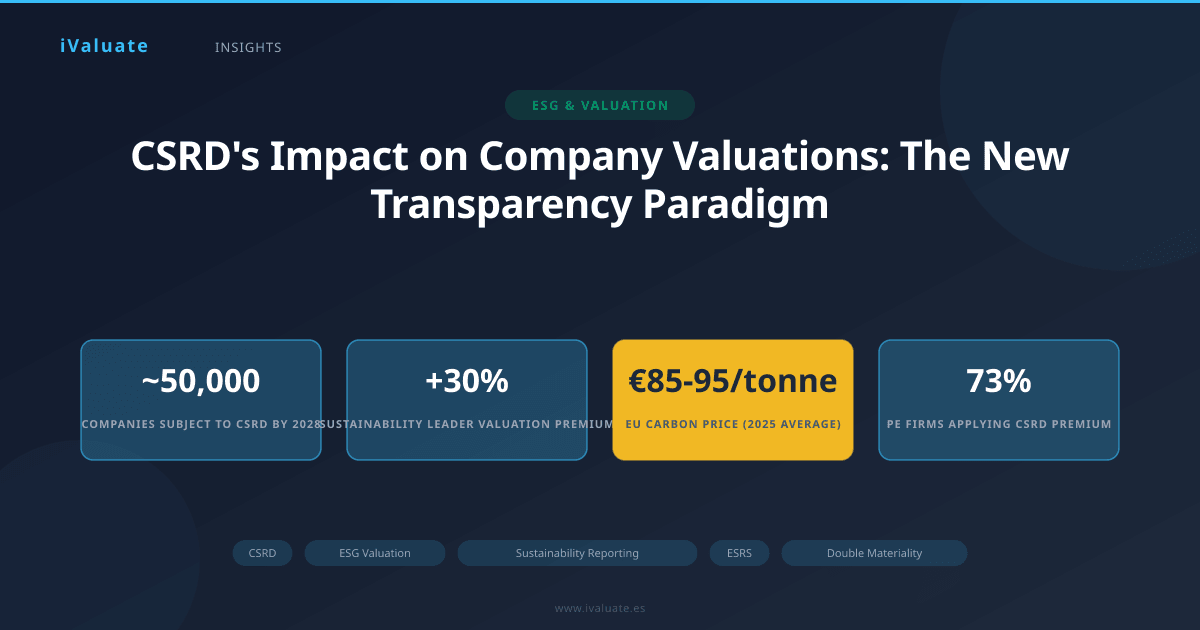
The European Union's Corporate Sustainability Reporting Directive (CSRD), which began phased implementation in January 2024, represents the most comprehensive overhaul of corporate sustainability reporting in history. By 2026, approximately 50,000 companies operating in or with the EU will be required to disclose detailed sustainability information under the European Sustainability Reporting Standards (ESRS). This regulatory shift is not merely a compliance exercise—it fundamentally alters how investors, acquirers, and valuation professionals assess company value.
For valuation practitioners, the CSRD introduces a critical inflection point. The directive's double materiality principle requires companies to report both how sustainability issues affect their financial performance (financial materiality) and how their operations impact society and the environment (impact materiality). This bidirectional framework transforms previously "soft" ESG factors into quantifiable value drivers and risks that must be integrated into discounted cash flow models, comparable company analyses, and transaction multiples.
01 Understanding CSRD's Scope and Timeline
The CSRD replaces the Non-Financial Reporting Directive (NFRD) with a significantly expanded mandate. The phased rollout follows a deliberate timeline:
- January 2024: Companies already subject to NFRD (approximately 11,700 large public-interest entities with 500+ employees) began reporting under CSRD for fiscal year 2024, with first reports published in 2025
- January 2025: Large companies meeting two of three criteria (250+ employees, €50M+ revenue, €25M+ balance sheet total) commenced CSRD compliance for fiscal 2025
- January 2026: Listed SMEs, small credit institutions, and captive insurance undertakings will begin reporting
- January 2028: Non-EU companies with significant EU operations (€150M+ EU revenue) must comply
This cascading implementation means that by mid-2026, the vast majority of mid-market and larger European transactions will involve at least one party subject to CSRD. The directive's extraterritorial reach also captures numerous US, UK, and Asian multinationals, making CSRD a de facto global standard.
02 Double Materiality: Redefining Value Drivers
The cornerstone of CSRD's valuation impact lies in its double materiality assessment. Traditional financial materiality asks: "How do environmental and social factors affect our company's cash flows and enterprise value?" Impact materiality inverts this: "How do our operations affect the environment and society?"
This dual lens creates four critical valuation implications:
1. Enhanced Risk Identification and Quantification
Under CSRD, companies must disclose transition risks (regulatory changes, technology shifts, market evolution) and physical risks (climate events, resource scarcity) with unprecedented granularity. The ESRS standards require scenario analysis aligned with climate pathways, including 1.5°C and 2°C warming scenarios mandated by the Paris Agreement.
For valuators, this means access to company-specific climate risk assessments that directly inform discount rate adjustments. A European automotive supplier, for instance, must now disclose its exposure to potential combustion engine phase-outs, stranded asset risks, and capital expenditure requirements for electrification. In a recent mid-market transaction, this disclosure revealed €47 million in previously unquantified retooling costs over five years, reducing the target's valuation by approximately 8% and lowering the final EV/EBITDA multiple from 9.2x to 8.5x.
2. Operational Efficiency and Cost Structure Transparency
ESRS E1 (Climate Change) requires detailed energy consumption data, Scope 1, 2, and 3 greenhouse gas emissions, and energy efficiency metrics. ESRS E2-E5 cover pollution, water, biodiversity, and circular economy. This operational transparency allows valuators to benchmark efficiency, identify cost reduction opportunities, and project future operating margins with greater precision.
A 2025 analysis of 340 European manufacturing companies subject to early CSRD reporting found that those in the top quartile for energy efficiency traded at a 1.4x premium on EV/EBITDA multiples compared to bottom-quartile peers, controlling for size, growth, and sector. This "efficiency premium" reflects both lower operating costs and reduced regulatory risk.
3. Revenue Quality and Growth Sustainability
CSRD's social standards (ESRS S1-S4) require disclosure on workforce conditions, value chain labor practices, community impacts, and consumer welfare. For companies with significant B2B exposure, this creates transparency around customer concentration risks and supply chain resilience.
Consider a European food ingredients manufacturer serving major consumer packaged goods companies. Its CSRD disclosures revealed that 68% of revenue came from customers with published net-zero commitments requiring supplier emissions reductions. This triggered a detailed analysis of the company's decarbonization pathway and associated capital requirements, ultimately leading to a 12% reduction in terminal value assumptions due to margin compression from necessary green investments.
4. Intangible Asset Recognition
CSRD disclosures on governance (ESRS G1), business conduct (ESRS G2), and stakeholder engagement provide quantifiable proxies for previously hard-to-value intangibles like reputation, social license to operate, and organizational resilience. Companies demonstrating robust governance and stakeholder management increasingly command premium multiples, particularly in sectors facing regulatory scrutiny or social opposition.
03 Impact on Valuation Methodologies
The integration of CSRD data into valuation practice requires methodological evolution across all three primary approaches: income, market, and asset-based.
Discounted Cash Flow Adjustments
CSRD-mandated disclosures enable more sophisticated DCF modeling through:
Revenue Projections: Social and governance metrics inform customer retention assumptions and market access risks. A technology company with poor labor practices disclosed under ESRS S1 may face higher customer churn in B2B segments where procurement increasingly incorporates ESG criteria.
Operating Costs: Energy, water, and waste data from ESRS E1-E5 allow precise modeling of carbon pricing impacts, resource cost inflation, and efficiency improvement trajectories. With EU carbon prices averaging €85-95 per tonne in 2025 and expected to exceed €100 by 2027, Scope 1 emissions data directly translates to quantifiable cost headwinds.
Capital Expenditure: CSRD requires disclosure of CapEx plans related to sustainability, including climate adaptation and mitigation investments. This transforms previously discretionary "green" spending into mandatory cash outflows that must be reflected in free cash flow projections.
Discount Rates: The risk-free rate and equity risk premium remain anchored to market data, but company-specific risk adjustments increasingly incorporate CSRD-disclosed transition and physical risks. A chemical manufacturer with high Scope 3 emissions and limited decarbonization progress might warrant a 50-150 basis point premium to its weighted average cost of capital relative to a cleaner peer.
Market Approach Evolution
Comparable company analysis and precedent transaction multiples are being recalibrated as CSRD creates standardized sustainability metrics. Valuation professionals can now adjust multiples based on:
- Emissions intensity (tonnes CO2e per €1M revenue)
- Energy efficiency (MWh per unit of production)
- Water consumption in water-stressed regions
- Workforce diversity and safety metrics
- Supply chain due diligence scores
A 2025 study of European M&A transactions above €100 million found that targets with above-median performance on CSRD climate metrics commanded an average 0.7x premium on EV/EBITDA multiples. In the renewable energy and clean technology sectors, this premium expanded to 1.2x, reflecting both operational advantages and strategic value to acquirers pursuing their own sustainability targets.
The standardization of sustainability reporting under CSRD eliminates a major friction point in valuation: the lack of comparable, audited ESG data. For the first time, valuators can benchmark sustainability performance with the same rigor applied to financial metrics.
Asset-Based Considerations
CSRD impacts asset-based valuations through enhanced transparency on:
Stranded Asset Risk: Detailed disclosure of carbon-intensive assets, their expected useful lives, and alignment with transition pathways allows for more accurate impairment assessments. A European utility's CSRD reporting might reveal coal generation assets with book values exceeding discounted future cash flows under plausible carbon price scenarios.
Environmental Liabilities: ESRS E2 (Pollution) and E3 (Water) require disclosure of contamination, remediation obligations, and potential fines. This brings previously off-balance-sheet environmental liabilities into the valuation calculus.
Intangible Assets: While CSRD doesn't create new accounting for intangibles, its governance and social disclosures provide better inputs for valuing brand equity, customer relationships, and human capital in purchase price allocations.
04 Sector-Specific Valuation Impacts
CSRD's effects vary significantly by industry, with the most pronounced impacts in carbon-intensive and resource-dependent sectors.
Energy and Utilities
Energy companies face the most extensive CSRD disclosure requirements. ESRS E1 mandates detailed reporting on fossil fuel assets, renewable energy transition plans, and climate scenario analysis. In 2025, European utilities with aggressive decarbonization pathways traded at an average 11.3x EV/EBITDA, compared to 8.7x for peers with slower transition plans—a 30% valuation premium directly attributable to sustainability positioning.
Manufacturing and Industrials
Manufacturing companies must disclose Scope 3 emissions across their value chains, creating transparency on supplier risks and customer dependencies. A German automotive tier-1 supplier's 2025 CSRD report revealed that 89% of its Scope 3 emissions originated from purchased steel and aluminum. This disclosure prompted a detailed analysis of supplier transition risks and potential cost increases, resulting in a 6% reduction in five-year EBITDA projections.
Financial Services
Banks, insurers, and asset managers face unique CSRD requirements around financed emissions and investment portfolio sustainability. A mid-sized European bank's first CSRD report in 2025 disclosed that 34% of its corporate loan book consisted of high-transition-risk sectors. This transparency enabled more precise credit risk modeling and revealed potential loan loss provisions that reduced the bank's valuation by approximately 4%.
Technology and Services
While often perceived as "light" industries, technology and professional services companies face significant CSRD disclosure requirements around Scope 3 emissions (particularly from cloud infrastructure and business travel), workforce metrics, and data governance. A European SaaS company's CSRD reporting revealed employee turnover rates 40% above sector medians, triggering questions about organizational sustainability and customer relationship stability that compressed its revenue multiple from 4.2x to 3.8x in a 2025 transaction.
05 The Assurance Premium: Audited Sustainability Data
A critical but often overlooked aspect of CSRD is its assurance requirement. Initially, companies must obtain limited assurance on sustainability reporting (similar to a review), with a transition to reasonable assurance (equivalent to a financial audit) expected by 2028.
This assurance requirement creates a "reliability premium" in valuations. Audited sustainability data carries significantly more weight in valuation models than unaudited or self-reported ESG metrics. In due diligence processes, CSRD-compliant companies with assured reporting require less extensive verification work, reducing transaction costs and timeline risks.
A 2025 survey of 120 private equity firms active in Europe found that 73% applied higher valuation multiples to targets with CSRD-assured sustainability reporting, with the premium averaging 0.4-0.6x EV/EBITDA. This reflects both data quality and reduced integration risk for portfolio companies that must ultimately consolidate sustainability reporting.
06 Practical Implications for Valuation Professionals
The CSRD era requires valuation professionals to develop new competencies and adapt established methodologies:
Enhanced Due Diligence Protocols
Standard due diligence checklists must now incorporate detailed CSRD data requests, including:
- Complete ESRS disclosures (or progress toward compliance for companies not yet subject to CSRD)
- Double materiality assessment documentation and supporting analysis
- Sustainability governance structures and decision-making processes
- Third-party assurance reports and any qualifications or exceptions
- Sustainability-linked financing agreements and associated covenants
Scenario Analysis Integration
CSRD's requirement for climate scenario analysis provides a template for incorporating sustainability factors into valuation scenarios. Best practice now includes:
- Base case aligned with current policies and disclosed transition plans
- Accelerated transition scenario (1.5°C pathway) reflecting potential policy tightening
- Delayed transition scenario with higher physical risks and abrupt policy shifts
- Probability-weighted valuation ranges incorporating scenario outcomes
Stakeholder Engagement
CSRD disclosures on stakeholder engagement (ESRS G1) provide insights into social license risks and community relations. Valuators should incorporate stakeholder mapping into risk assessments, particularly for projects requiring permits, expansions into new geographies, or industries with significant externalities.
07 Cross-Border M&A Considerations
CSRD's extraterritorial reach creates complexity in cross-border transactions. A US private equity firm acquiring a German mid-market manufacturer must consider:
- The target's existing CSRD compliance status and associated costs
- Potential CSRD obligations for the combined entity if it meets EU revenue thresholds
- Alignment (or conflicts) between CSRD and other reporting frameworks like SEC climate rules or ISSB standards
- Post-acquisition integration costs for sustainability reporting systems
In a notable 2025 transaction, a US industrial conglomerate's acquisition of a French competitor included a €12 million purchase price adjustment to account for CSRD compliance infrastructure buildout costs, including IT systems, personnel, and third-party assurance fees over three years.
08 The Convergence with Other Frameworks
While CSRD is EU-specific, it exists within a broader ecosystem of sustainability reporting standards. The International Sustainability Standards Board (ISSB) released its inaugural standards in 2023, and many jurisdictions are adopting or adapting these frameworks. The UK's Sustainability Disclosure Requirements, effective for large companies in 2025, draw heavily from both ISSB and CSRD.
For valuators, this convergence creates both opportunities and challenges. Standardization improves comparability across geographies, but differences in scope, materiality thresholds, and assurance requirements require careful navigation. A global valuation of a multinational corporation must reconcile CSRD disclosures for European subsidiaries with ISSB-aligned reporting in other jurisdictions and legacy frameworks in markets without mandatory sustainability reporting.
09 Looking Forward: The 2026 Landscape
As we move through 2025 and into 2026, several trends are reshaping the CSRD-valuation nexus:
Data Quality Improvements: First-year CSRD reports revealed significant data gaps, estimation uncertainties, and methodological inconsistencies. Second and third-year reports show marked improvement as companies invest in measurement systems and reporting processes. This quality enhancement makes sustainability data increasingly reliable for valuation purposes.
Market Differentiation: Early evidence suggests that CSRD is accelerating market segmentation between sustainability leaders and laggards. Companies with strong CSRD performance increasingly access lower-cost capital, command premium valuations, and win competitive bids. This "ESG alpha" is becoming quantifiable and persistent.
Regulatory Evolution: The European Commission continues to refine ESRS standards based on implementation feedback. Sector-specific standards for high-impact industries are under development, which will further enhance valuation precision in those sectors.
Technology Integration: Valuation platforms and financial analysis tools are rapidly integrating CSRD data. Advanced analytics, including AI-driven sustainability risk scoring and automated scenario modeling, are becoming standard features in professional valuation software.
The transformation from voluntary, inconsistent ESG disclosure to mandatory, standardized, and assured sustainability reporting represents a permanent shift in corporate transparency. Valuation methodologies must evolve accordingly, integrating sustainability factors with the same rigor applied to traditional financial metrics.
10 Conclusion: A New Valuation Paradigm
The Corporate Sustainability Reporting Directive marks an inflection point in corporate valuation practice. By mandating comprehensive, standardized, and assured sustainability disclosures grounded in double materiality, CSRD transforms previously opaque ESG factors into quantifiable value drivers and risks. The directive's phased implementation through 2028 ensures that sustainability transparency will become universal for companies of meaningful scale operating in or with Europe.
For valuation professionals, CSRD creates both challenges and opportunities. The learning curve is steep—mastering ESRS standards, understanding sector-specific sustainability dynamics, and integrating new data streams into established methodologies requires significant investment. However, those who successfully navigate this transition will deliver more accurate, defensible valuations that better reflect the full spectrum of value creation and risk in the modern economy.
The companies that embrace CSRD as a strategic opportunity rather than a compliance burden are already seeing valuation benefits. Enhanced transparency builds investor confidence, standardized reporting reduces due diligence friction, and demonstrated sustainability performance commands premium multiples. Conversely, companies that lag in CSRD compliance or reveal significant sustainability risks through mandatory disclosure face valuation headwinds that will only intensify as carbon prices rise, regulations tighten, and stakeholder expectations evolve.
As the volume of CSRD-compliant data grows through 2025 and 2026, valuation professionals have unprecedented access to sustainability information. The challenge lies in converting this data into actionable insights—adjusting discount rates for climate transition risks, benchmarking operational efficiency against standardized metrics, and incorporating stakeholder dynamics into strategic value assessments. Professional platforms like iValuate are evolving to integrate CSRD data streams, enabling practitioners to perform sophisticated sustainability-adjusted valuations efficiently and consistently.
The CSRD era demands that valuation professionals expand their analytical toolkit, deepen their understanding of sustainability dynamics, and embrace a more holistic conception of corporate value. Those who rise to this challenge will not only produce more accurate valuations but will also help allocate capital toward companies building genuinely sustainable competitive advantages in a resource-constrained, climate-conscious economy. The future of valuation is sustainable, transparent, and grounded in the comprehensive disclosure framework that CSRD has established as the new global standard.