Índice8 secciones
In the volatile fundraising environment of 2025-2026, bridge rounds and extension financings have become increasingly prevalent as companies navigate the gap between major equity rounds. What was once considered a sign of distress has evolved into a sophisticated capital management tool, though the valuation implications remain complex and consequential for all stakeholders.
Bridge rounds—interim financings designed to extend runway between primary rounds—now represent approximately 23% of all venture transactions in 2025, up from just 6.8% in 2022. This dramatic shift reflects fundamental changes in how companies approach capital efficiency, valuation management, and investor relations. For valuation professionals, understanding the mechanics and implications of these structures has become essential to providing sound advisory services.
01 The Anatomy of Bridge and Extension Financings
Bridge rounds and extension rounds, while often used interchangeably, represent distinct financing structures with different valuation implications. A bridge round typically refers to a smaller financing raised between major institutional rounds (Series A, B, C, etc.) intended to extend runway by 6-18 months. These rounds may involve new investors, existing investors, or a combination of both.
An extension round, by contrast, represents additional capital raised at or near the same valuation as the previous round, often from existing investors. Extension rounds are frequently labeled with an additional letter designation—for example, "Series B-1" or "Series B Extension"—to distinguish them from the primary round while signaling continuity in valuation.
Key Structural Characteristics
Bridge and extension rounds typically exhibit several common features that differentiate them from standard equity rounds:
- Smaller size relative to primary rounds: Bridge rounds average $2.8M to $8.5M depending on stage, compared to $15M-$40M for full Series B or C rounds in 2025
- Shorter diligence timelines: 3-6 weeks versus 8-16 weeks for major rounds
- Higher participation from existing investors: 72% of bridge rounds include pro-rata or super-pro-rata participation from current cap table holders
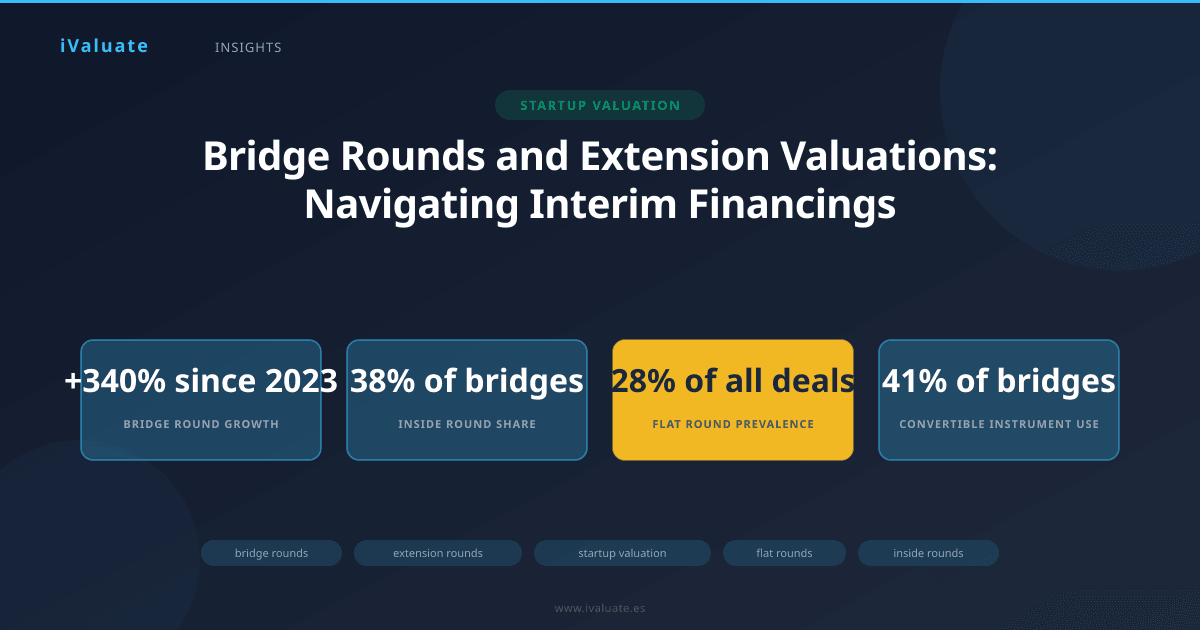
- Convertible or hybrid instruments: 41% of bridge financings use convertible notes or SAFEs rather than priced equity
- Enhanced investor protections: Including ratchets, additional board seats, or information rights to compensate for perceived increased risk
02 Valuation Mechanics: Inside Rounds, Flat Rounds, and Pricing Dynamics
The valuation treatment of bridge and extension rounds varies significantly based on structure, investor composition, and market conditions. Understanding these mechanics is critical for accurate company valuation and cap table modeling.
Inside Rounds and Valuation Signaling
An inside round occurs when a financing is led or dominated by existing investors rather than new external capital. In 2025, inside rounds account for 38% of all bridge financings, up from 24% in 2023. While inside rounds provide crucial runway extension, they carry important valuation implications.
From a valuation perspective, inside rounds present a mixed signal. On one hand, they demonstrate existing investor confidence and commitment. On the other hand, the absence of new investor validation can suggest challenges in attracting external capital at the desired valuation. This dynamic typically results in one of three valuation outcomes:
- Flat round pricing: Maintaining the previous round's valuation (54% of inside rounds in 2025)
- Modest step-up: 10-25% valuation increase to reward existing investors for additional support (31% of cases)
- Down round or structure: Reduced valuation or valuation protection mechanisms (15% of cases)
The valuation methodology for inside rounds requires careful consideration of the fair market value standard versus the investment value to the specific insider group. When existing investors have strategic motivations, information advantages, or portfolio construction reasons to participate, the price they pay may not reflect true fair market value—a critical distinction for 409A valuations, financial reporting, and tax purposes.
Flat Rounds: Valuation Stagnation or Strategic Positioning?
A flat round—financing at the same pre-money valuation as the previous round—has become increasingly common in the current market environment. In Q4 2024 through Q1 2025, flat rounds represented 28% of all venture financings, compared to just 11% during the 2020-2021 boom period.
The valuation implications of flat rounds extend beyond the nominal price per share. Consider the following analytical framework:
Key Consideration: A flat round at the same price per share actually represents a dilutive event for existing shareholders. If a company raises $5M at a $50M pre-money valuation (same as the prior round), existing shareholders experience dilution without corresponding value creation, effectively reducing their economic interest in the enterprise.
For valuation professionals, flat rounds require careful analysis of several factors:
- Time elapsed since prior round: A flat round 24 months after the previous financing implies negative value creation, while a flat round after 6 months may simply reflect insufficient time for meaningful progress
- Market conditions: Flat rounds during market downturns may actually represent relative outperformance compared to peer companies facing down rounds
- Operational progress: Revenue growth, customer acquisition, and product development since the prior round provide context for whether flat pricing reflects fair value
- Alternative financing options: The availability (or lack thereof) of external capital at higher valuations informs whether flat pricing represents market clearing or insider accommodation
Convertible Instruments and Valuation Deferral
Approximately 41% of bridge rounds in 2025 utilize convertible notes or SAFEs (Simple Agreements for Future Equity) rather than priced equity. These instruments defer the valuation question to a future qualified financing, typically with a valuation cap and discount rate to compensate bridge investors for their earlier risk.
The valuation implications of convertible bridge instruments are nuanced:
Valuation caps effectively set a maximum valuation at which the bridge investment converts, typically ranging from 15-30% below the anticipated next round valuation. For example, a bridge round with a $75M valuation cap that converts into a Series C priced at $100M provides bridge investors with a 25% discount, resulting in more shares per dollar invested.
Discount rates, typically 15-25%, provide an additional conversion benefit. A 20% discount means bridge investors convert at 80% of the next round's price per share. When combined with valuation caps, these mechanisms can create substantial dilution for common shareholders and complexity for valuation analysis.
For 409A and financial reporting purposes, convertible bridge instruments require probability-weighted scenario analysis. Valuation professionals must model multiple potential outcomes—successful up round, flat round, down round, or liquidation—and assess the likely conversion terms under each scenario. This analysis typically employs option pricing models or scenario-based discounted cash flow approaches.
03 Real-World Case Studies: Bridge Round Valuation in Practice
Case Study 1: SaaS Company Extension Round
A B2B SaaS company that raised a $25M Series B at a $150M post-money valuation in Q2 2023 found itself needing additional capital in Q4 2024. The company had grown revenue from $8M ARR to $18M ARR (125% growth) but was burning $2.5M monthly and needed 12 additional months of runway to reach profitability.
The company raised a $10M "Series B-1" extension round from existing investors at a $165M post-money valuation—a modest 10% step-up from the Series B. While the company had achieved strong revenue growth, the valuation reflected several factors:
- Compressed SaaS multiples in 2024-2025 (median public SaaS trading at 6.2x revenue versus 12.8x in 2021)
- Increased capital requirements beyond initial projections
- Absence of new investor validation
- Desire to avoid a down round that would trigger anti-dilution provisions
From a valuation perspective, the extension round pricing represented a compromise. The revenue multiple actually decreased from 18.8x at the Series B ($150M / $8M ARR) to 9.2x at the extension ($165M / $18M ARR), reflecting both multiple compression in public markets and the reality that the company's growth trajectory, while strong, had not exceeded initial projections.
For 409A purposes, the valuation firm engaged by the company applied a 25% discount for lack of marketability to the extension round price, resulting in a common stock valuation of approximately $0.68 per share versus $0.92 for the preferred stock, a critical distinction for employee option pricing.
Case Study 2: Biotech Bridge to Series C
A clinical-stage biotechnology company that had raised a $40M Series B at a $200M post-money valuation in early 2023 required a bridge round in mid-2025 to fund the completion of Phase 2 trials before raising a larger Series C.
The company raised a $12M bridge round using convertible notes with a $280M valuation cap and 20% discount rate. The structure reflected several considerations:
- Uncertainty around Phase 2 trial results precluded definitive valuation
- Existing investors wanted to support the company but required downside protection
- The company preferred to defer valuation discussions until trial data was available
- Convertible structure provided flexibility for either up round or strategic transaction
The valuation cap of $280M represented a 40% step-up from the Series B, reflecting 24 months of clinical progress and successful patient enrollment, but remained conservative relative to comparable public biotech companies (trading at 3.5-5.0x projected peak sales for similar indications).
When the Phase 2 data proved successful and the company raised a $60M Series C at a $350M post-money valuation six months later, the bridge investors converted at the $280M cap (20% discount to the Series C), receiving approximately 4.3% of the company versus the 3.4% they would have received at the Series C price. This 0.9% difference, while seemingly modest, represented $3.15M in additional value on a $350M valuation.
Case Study 3: Down Round Bridge Financing
A consumer marketplace company that raised a $50M Series C at a $400M post-money valuation in late 2021 faced significant challenges by 2024. Revenue growth had stalled at $35M annually, the company was burning $4M monthly, and the path to profitability remained unclear.
Unable to raise a Series D at an up valuation, the company negotiated a $15M bridge round from a combination of existing investors (60%) and new investors (40%) at a $280M post-money valuation—a 30% reduction from the Series C.
This down round structure included several protective provisions:
- Full ratchet anti-dilution protection for bridge investors
- Additional board seat for new investor group
- Liquidation preference of 2x for bridge round investors
- Pay-to-play provisions requiring existing investors to participate pro-rata or face conversion to common stock
The valuation analysis for this bridge round required careful consideration of the company's distressed circumstances. Using a scenario-based approach, the valuation firm modeled four potential outcomes: (1) successful turnaround and future up round (25% probability), (2) flat/modest growth and eventual M&A exit at 1.0-1.5x revenue (40% probability), (3) continued decline and distressed sale (25% probability), and (4) liquidation (10% probability).
The probability-weighted valuation suggested a fair market value range of $220M-$260M for the enterprise, with the $280M bridge round pricing representing a modest premium that reflected the new investors' negotiating leverage and the enhanced protective provisions they received.
04 Valuation Methodology Considerations for Bridge and Extension Rounds
Valuing companies that have raised bridge or extension rounds requires adapting traditional valuation methodologies to account for the unique characteristics of these transactions.
Market Approach Adjustments
When using recent financing rounds as a valuation benchmark (the "backsolve" or "current value method"), bridge and extension rounds require careful adjustment:
- Investor composition analysis: Inside rounds from existing investors may not represent true fair market value and require adjustment for insider information advantages or strategic motivations
- Terms and conditions: Enhanced protective provisions, liquidation preferences, or anti-dilution rights must be valued separately using option pricing models
- Time and progress assessment: The relationship between operational progress and valuation change must be analyzed to determine if pricing reflects fair value or accommodation
- Market conditions normalization: Bridge rounds during market dislocations may require adjustment to reflect normalized market conditions for certain valuation purposes
Income Approach Considerations
Discounted cash flow analysis for companies with bridge or extension financings must incorporate several additional considerations:
The discount rate applied to projected cash flows should reflect the company's current risk profile, which may differ from the risk profile at the time of the prior major round. Companies requiring bridge financing often face elevated execution risk, competitive pressures, or market headwinds that warrant higher discount rates—typically 25-35% for venture-stage companies with bridge financings versus 20-30% for companies with successful primary rounds.
The probability of success in achieving projected milestones becomes particularly critical. Bridge rounds often fund companies toward specific value inflection points—product launch, profitability, regulatory approval, or customer acquisition targets. The likelihood of achieving these milestones directly impacts valuation, requiring careful scenario analysis and probability weighting.
Asset Approach and Liquidation Analysis
For companies in distressed bridge situations, the asset approach and liquidation value analysis become more relevant. This analysis considers:
- Net tangible asset value (cash, receivables, equipment) less liabilities
- Intellectual property value in liquidation versus going concern scenarios
- Customer relationships and contracts that could be sold or transferred
- Tax attributes (NOLs, R&D credits) that may have value to an acquirer
In the current market environment, liquidation values for venture-backed companies typically range from 10-30% of the most recent post-money valuation for early-stage companies, and 30-60% for later-stage companies with substantial revenue and assets.
05 Impact on Cap Table Dynamics and Future Rounds
Bridge and extension rounds create lasting implications for cap table structure and future financing dynamics that extend well beyond the immediate valuation impact.
Dilution Cascade Effects
Each bridge or extension round creates incremental dilution for existing shareholders, particularly common stockholders (founders and employees). Consider a typical scenario:
A company with 10M shares outstanding post-Series B raises a $5M bridge round at a $50M pre-money valuation, issuing 1M new shares (9.1% dilution). If the company subsequently raises a $20M Series C at a $100M pre-money valuation, it issues an additional 2.2M shares (16.7% dilution). Founders and employees who owned 40% of the company post-Series B now own approximately 30.4% post-Series C—a 24% reduction in ownership percentage.
This dilution cascade becomes particularly acute when bridge rounds include anti-dilution provisions or ratchets that provide downside protection to bridge investors at the expense of common shareholders.
Signaling Effects on Future Valuations
Bridge and extension rounds create valuation anchoring effects that influence future financing discussions. A flat or modest step-up bridge round signals to future investors that the company's valuation trajectory has plateaued, potentially constraining Series C or D valuations even if the company subsequently achieves strong operational performance.
Data from 2024-2025 shows that companies that raised bridge rounds experienced Series C valuations averaging 2.1x their Series B valuations, compared to 3.4x for companies that proceeded directly from Series B to Series C without interim financing. This 38% valuation differential persists even after controlling for revenue growth, market conditions, and sector.
06 Strategic Considerations for Different Stakeholders
For Founders and Management Teams
Founders considering bridge or extension rounds should carefully weigh the valuation implications against alternative strategies:
- Operational efficiency improvements: Reducing burn rate by 20-30% may eliminate the need for bridge financing and preserve valuation momentum
- Strategic partnerships: Non-dilutive capital through partnerships, grants, or debt facilities may provide runway extension without valuation impact
- Timing optimization: Delaying fundraising by 3-6 months to achieve key milestones may enable a stronger valuation in the next primary round
- Transparent communication: Proactively engaging investors about bridge needs 6-9 months in advance provides more negotiating leverage than emergency fundraising
For Investors
Investors participating in bridge and extension rounds must balance portfolio support with return optimization:
- Pro-rata protection: Maintaining ownership percentage through bridge participation preserves upside in successful outcomes
- Valuation discipline: Avoiding overvaluation in bridge rounds protects against future down rounds and anti-dilution triggers
- Enhanced terms negotiation: Bridge rounds provide opportunities to negotiate improved liquidation preferences, board representation, or information rights
- Portfolio signaling: Bridge participation demonstrates conviction to other investors and potential acquirers
For Valuation Professionals
Valuation advisors analyzing companies with bridge or extension financings should employ rigorous analytical frameworks:
- Conduct thorough analysis of investor composition, motivations, and terms
- Perform independent market and income approach valuations to validate transaction pricing
- Apply appropriate discounts for lack of marketability and minority interests
- Model multiple scenarios with probability weighting for companies with uncertain outcomes
- Document the rationale for any adjustments to transaction pricing in valuation reports
07 Current Market Trends and Future Outlook
The bridge and extension round landscape continues to evolve rapidly in response to macro conditions and market dynamics. Several trends are shaping the current environment in 2025-2026:
Increased acceptance and sophistication: Bridge rounds have shed much of their historical stigma, with 67% of venture investors in a recent survey indicating they view bridge rounds as a normal part of capital management rather than a sign of distress. This normalization has led to more favorable terms and less valuation penalty for companies raising bridge financings.
Debt and hybrid instruments: Venture debt has emerged as a popular bridge financing tool, with venture debt volume reaching $18.2B in 2024, up 34% from 2023. Debt instruments provide runway extension without immediate dilution or valuation impact, though they create fixed obligations and may include warrants that provide equity upside to lenders.
Special purpose vehicles (SPVs): Some companies are using SPVs to allow employees and early investors to achieve liquidity without a full secondary transaction, reducing pressure for premature primary rounds and enabling companies to extend time between major financings.
Valuation reset environment: The correction in venture valuations from 2021-2022 peaks has created a cohort of companies with inflated valuations that require bridge rounds to extend runway until they can "grow into" their valuations. This dynamic is particularly acute for late-stage companies (Series D+) that raised at peak valuations.
08 Conclusion: Navigating Bridge Rounds in Today's Market
Bridge rounds and extension financings have become a structural feature of the venture capital ecosystem, reflecting longer paths to liquidity, increased capital efficiency requirements, and more disciplined valuation practices. For founders, investors, and advisors, understanding the valuation mechanics and strategic implications of these interim financings is essential to making informed decisions.
The key to successfully navigating bridge and extension rounds lies in rigorous valuation analysis, transparent stakeholder communication, and strategic timing. Companies that approach bridge financings proactively—engaging investors early, demonstrating clear paths to value inflection points, and maintaining realistic valuation expectations—achieve significantly better outcomes than those forced into reactive, distressed financings.
For valuation professionals, bridge and extension rounds require sophisticated analytical frameworks that go beyond simply accepting transaction pricing at face value. Careful consideration of investor composition, terms and conditions, market context, and alternative valuation methodologies ensures that valuations reflect true fair market value rather than insider accommodation or distressed circumstances.
As the venture capital market continues to mature and normalize following the exceptional conditions of 2020-2021, bridge and extension rounds will likely remain prevalent, particularly for companies navigating the challenging middle stages between product-market fit and clear paths to profitability or exit. Professional valuation platforms like iValuate provide the analytical tools and frameworks that enable CFOs, advisors, and investors to model these complex financing structures, assess their valuation implications, and make data-driven decisions in an increasingly sophisticated capital markets environment.
The companies and investors that master the strategic and valuation dynamics of bridge financings will be best positioned to navigate the current market cycle and emerge with strong positions for future growth and value creation. In an environment where capital efficiency and valuation discipline have replaced growth-at-all-costs mentality, bridge rounds represent not a failure of strategy but rather a sophisticated tool for optimizing capital structure and timing in pursuit of long-term value maximization.