Índice8 secciones
The venture capital landscape of 2025-2026 has witnessed a fundamental shift in financing patterns. As the era of abundant capital and aggressive growth-at-all-costs strategies has given way to a more disciplined environment, bridge rounds and extension financings have become increasingly prevalent. These interim capital events—occurring between traditional Series A, B, or C rounds—carry significant implications for company valuation, cap table dynamics, and future fundraising prospects.
For CFOs, M&A advisors, and private equity professionals evaluating startup investments or exit opportunities, understanding the mechanics and valuation implications of bridge rounds is no longer optional—it's essential. This article examines the technical aspects of bridge financing structures, their impact on valuation methodologies, and the strategic considerations that separate value-preserving interim financings from problematic dilution events.
01 The Bridge Round Landscape: Market Context and Prevalence
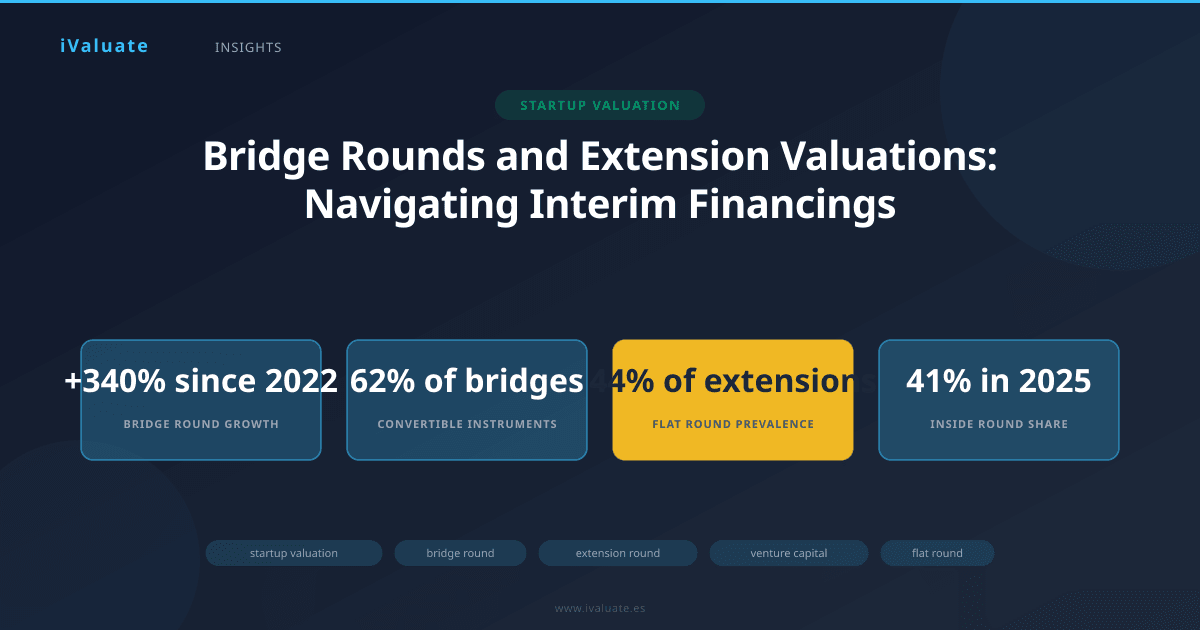
Bridge rounds—defined as interim financings that occur between major equity rounds—have experienced explosive growth. According to PitchBook data through Q1 2026, bridge and extension rounds now represent approximately 28% of all venture financings, up from just 8% in 2021. This 340% increase reflects a fundamental recalibration in venture markets.
The drivers behind this surge are multifaceted. First, the median time between institutional rounds has extended from 18 months in 2021 to 26 months in 2025, creating cash flow gaps that necessitate interim financing. Second, the valuation correction that began in late 2022 has created a substantial cohort of companies whose last-round valuations exceed what current market conditions would support—making traditional up-rounds challenging or impossible.
Third, the increased scrutiny on unit economics and path to profitability has forced many companies to extend their runways while demonstrating improved metrics before attempting a full institutional round. A company that raised a Series B at a $400 million valuation in 2021 might need 18-24 additional months to grow into metrics that justify a $600 million Series C in today's environment.
Defining the Terminology
Precision in terminology is critical when analyzing these transactions:
- Bridge Round: A financing explicitly designed as temporary capital to extend runway until a larger institutional round. Typically ranges from 3-9 months of operating expenses and may include convertible instruments or equity with specific conversion mechanics tied to the next round.
- Extension Round: Additional capital raised at the same or similar terms as the previous round, effectively extending that round's lifecycle. Often denoted as "Series B-1" or "Series B Extension." Generally larger than bridge rounds (6-18 months of runway) and may include new investors alongside existing ones.
- Inside Round: A financing led or dominated by existing investors, typically occurring when outside investors are unavailable or unwilling to participate at the company's preferred valuation. May occur at flat, down, or modestly up valuations.
- Flat Round: A financing at the same price per share as the previous round, indicating neither valuation growth nor decline. Often structured as extensions or inside rounds.
These categories frequently overlap. An inside round might also be a bridge round at a flat valuation, for instance. The key distinction lies in the strategic intent, investor composition, and structural mechanics of the financing.
02 Valuation Mechanics in Bridge and Extension Financings
The valuation implications of interim financings are more nuanced than traditional equity rounds. While a Series A or B typically establishes a clear post-money valuation through straightforward price-per-share calculations, bridge and extension rounds introduce complexity through various structural mechanisms.
Convertible Instruments and Valuation Ambiguity
Approximately 62% of bridge rounds in 2025 utilized convertible notes or SAFEs (Simple Agreements for Future Equity) rather than priced equity, according to Carta data. These instruments create valuation ambiguity that requires careful analysis.
Consider a company that raised a Series B at a $300 million post-money valuation in early 2024. By Q4 2025, the company needs additional capital but isn't ready for a Series C. The company raises a $10 million bridge using convertible notes with a 20% discount and a $400 million valuation cap.
From a valuation perspective, this structure avoids explicitly marking down the company's valuation while providing investors with downside protection. However, the implied valuation is complex:
- If the next round occurs at $500 million, the bridge converts at $400 million (the cap), implying the bridge investors valued the company at $400 million—a 33% increase from Series B.
- If the next round occurs at $300 million (flat to Series B), the bridge converts at $240 million (20% discount), implying the bridge investors actually valued the company at $240 million—a 20% decrease from Series B.
- The actual valuation impact depends on future outcomes, creating uncertainty for 409A valuations, employee equity value, and M&A scenarios.
This structural ambiguity serves both parties: founders avoid the stigma and employee morale impact of an explicit down round, while investors receive enhanced terms that compensate for increased risk. However, for valuation professionals, this requires modeling multiple scenarios and understanding the embedded optionality in these instruments.
Priced Extension Rounds: The Flat Round Phenomenon
When companies raise extension rounds as priced equity, the most common outcome in 2025-2026 has been the flat round—same price per share as the previous financing. Analysis of 847 extension rounds in 2025 shows that 44% occurred at flat valuations, 31% at modest increases (0-25%), 18% at down valuations, and only 7% at traditional venture-scale increases (25%+).
The flat round represents a delicate negotiation between maintaining valuation credibility and acknowledging market realities. A company that raised Series B at $15.00 per share might raise a Series B-1 at $15.00-16.50 per share, providing minimal dilution while avoiding a down round.
From a valuation methodology perspective, flat rounds present several analytical challenges:
Time Value Disconnect: A flat round 18 months after the previous financing implies zero value creation during that period, which may or may not reflect operational reality. The company may have grown revenue from $10 million to $25 million ARR, but if market multiples compressed from 15x to 6x ARR, a flat valuation actually represents significant operational progress offset by market headwinds.
Signaling Effects: Flat rounds send mixed signals to the market. They avoid the negative signal of a down round but also fail to demonstrate the momentum typically expected in venture-backed companies. This can impact employee retention, customer perception, and future fundraising.
409A Implications: For US companies, flat rounds complicate 409A valuations for employee stock options. While the preferred stock trades at a flat valuation, the common stock value (which determines strike prices) may need to be adjusted based on the changing liquidation preferences, time to liquidity, and market conditions.
03 The Inside Round: Investor Dynamics and Valuation Pressure
Inside rounds—where existing investors provide the majority or entirety of new capital—have become increasingly common, representing 41% of all bridge and extension financings in 2025 compared to 23% in 2021. These transactions carry distinct valuation implications that require careful analysis.
The Pro-Rata Protection Paradox
Most institutional venture investors negotiate pro-rata rights in their initial investments, allowing them to maintain their ownership percentage in subsequent rounds. However, when these investors are the only participants in a subsequent round, the dynamics shift dramatically.
Consider a scenario: A company raised a $30 million Series B led by Firm A (leading $20 million) and Firm B ($10 million) at a $120 million post-money valuation. Eighteen months later, the company needs $15 million but cannot attract new investors at an acceptable valuation. Firm A and Firm B agree to provide the capital as a Series B-1 at $125 million post-money—a modest 4% increase.
On the surface, this appears benign: a small valuation increase, supportive existing investors, extended runway. However, the valuation implications are more complex:
- Absence of Price Discovery: Unlike a competitive round with multiple new investors conducting independent diligence, an inside round lacks true price discovery. The valuation is a negotiated outcome between parties with existing relationships and information asymmetries.
- Investor Leverage: Existing investors hold significant leverage in inside rounds. They can impose terms (increased liquidation preferences, ratchets, board control) that wouldn't be acceptable in a competitive process. These terms affect the economic value of the equity even if the headline valuation appears stable.
- Adverse Selection Signal: The inability to attract new investors signals potential concerns about the business, market, or valuation. Sophisticated analysts discount inside round valuations by 15-30% compared to externally validated rounds when building valuation models.
Structural Terms That Affect Economic Value
Inside rounds and bridge financings frequently include enhanced terms that affect the economic distribution of value even when headline valuations remain stable or increase modestly. Key provisions include:
Participating Preferred Stock: Rather than standard non-participating preferred (where investors choose between their liquidation preference or converting to common), participating preferred allows investors to receive their preference and participate in remaining proceeds. In a flat or modest-up inside round, existing investors may negotiate participating preferred for the new money, fundamentally altering the value allocation in exit scenarios.
Multiple Liquidation Preferences: While 1x liquidation preferences are standard, bridge and inside rounds may carry 1.5x or 2x preferences, providing investors with enhanced downside protection. A $10 million investment with a 2x preference effectively has priority over $20 million of the company's value in a liquidation scenario.
Ratchet Provisions: Full ratchet or weighted-average anti-dilution provisions protect investors if subsequent rounds occur at lower valuations. These provisions can dramatically increase dilution to founders and employees in down-round scenarios.
Pay-to-Play Provisions: These provisions penalize investors who don't participate in the bridge/extension round, often converting their preferred stock to common or eliminating anti-dilution protection. While designed to ensure investor support, they can create pressure for inside rounds even when valuations are unfavorable.
A 2025 analysis of 200 inside rounds by Cooley LLP found that 67% included at least one enhanced term beyond standard preferred stock provisions, compared to just 23% of competitive rounds with multiple new investors. The median value transfer from these enhanced terms was estimated at 8-12% of the company's equity value.
04 Case Studies: Bridge Rounds in Practice
Case Study 1: The Successful Bridge to Strategic Exit
A B2B SaaS company in the marketing technology sector raised a $25 million Series B in early 2023 at a $200 million post-money valuation (8x ARR multiple on $25 million ARR). By mid-2025, the company had grown to $45 million ARR but faced a challenging fundraising environment where comparable companies traded at 4-5x ARR multiples.
Rather than raise a Series C at a down or flat valuation ($180-225 million based on market multiples), the company raised a $12 million bridge from existing investors using a convertible note with a $275 million cap and 15% discount. The bridge provided 15 months of runway.
During this period, the company focused on improving unit economics, achieving Rule of 40 compliance (30% growth + 10% EBITDA margin), and engaging in strategic discussions with potential acquirers. Ten months after the bridge, the company was acquired by a strategic buyer for $320 million in cash.
The bridge investors converted at the $275 million cap (the lower of the cap or acquisition price with discount), receiving approximately 4.4% of the company for their $12 million investment—a 1.3x return in 10 months. The structure avoided down-round stigma, preserved employee morale, and provided sufficient runway to execute a strategic exit at a valuation that rewarded all stakeholders.
Case Study 2: The Extension Round That Preceded a Down Round
A consumer technology company raised a $50 million Series C in late 2021 at a $600 million post-money valuation (20x revenue multiple on $30 million revenue). By early 2025, despite growing to $65 million in revenue, the company faced a dramatically different market environment where comparable companies traded at 3-4x revenue.
Unable to raise a Series D at an acceptable valuation, the company raised a $25 million Series C-1 extension from existing investors at $625 million post-money—a modest 4% increase. The extension included 1.5x liquidation preferences and participating preferred terms for the new money.
Fifteen months later, with revenue at $85 million but continued cash burn, the company raised a $40 million Series D at a $340 million post-money valuation—a 46% decrease from the Series C/C-1 valuation. The down round triggered anti-dilution provisions, significantly diluting founders and employees. The Series C-1's enhanced terms meant those investors recovered their capital preference before other stakeholders in the eventual exit.
This case illustrates the risk of extension rounds that delay inevitable valuation corrections. While the extension avoided immediate down-round consequences, it ultimately increased dilution and created a more complex cap table structure.
Case Study 3: The Flat Round as Validation
An enterprise infrastructure software company raised a $35 million Series B in mid-2023 at a $280 million post-money valuation (10x ARR on $28 million ARR). By late 2025, the company had grown to $52 million ARR with improving margins and strong net revenue retention (125%).
The company raised a $20 million Series B-2 extension at $290 million post-money—essentially flat to the Series B. However, this flat valuation occurred in a context where the company's ARR had grown 86% while market multiples had compressed from 10x to approximately 5-6x for comparable companies.
The flat round was led by a new institutional investor who conducted full diligence and brought strategic value through enterprise customer relationships. The participation of a new investor at a flat valuation—despite strong operational performance—validated that the company was executing well in a challenging market environment.
Six months later, the company raised a $60 million Series C at a $475 million post-money valuation (approximately 7.5x ARR on projected $63 million ARR), representing a 64% increase from the Series B-2. The flat extension round had provided runway to demonstrate continued execution and reach metrics that justified a meaningful up-round despite market headwinds.
05 Valuation Methodologies for Companies with Bridge/Extension Rounds
When valuing companies that have raised bridge or extension rounds, valuation professionals must adapt traditional methodologies to account for the unique characteristics of these financings.
Discounted Cash Flow Adjustments
In DCF analyses, bridge and extension rounds provide important signals about risk and timing. The need for interim financing often indicates that the path to cash flow positivity or exit is longer than initially projected. Valuation models should incorporate:
- Extended time horizons to liquidity events (typically adding 12-24 months to base case projections)
- Increased discount rates reflecting demonstrated execution risk (typically 100-300 basis points above comparable companies without interim financings)
- Scenario analysis incorporating the possibility of future down rounds or additional dilutive financings
Market Multiple Approaches
When applying market multiples to companies with bridge/extension rounds, several adjustments are warranted:
Comparable Company Selection: Companies with similar financing histories (bridge rounds, flat rounds, extended time between institutional rounds) provide more relevant comparables than high-growth companies with consistent up-rounds.
Valuation Discounts: Empirical analysis suggests that companies with bridge/extension financing history trade at 12-18% discounts to otherwise comparable companies in M&A transactions, reflecting concerns about momentum and execution.
Liquidation Preference Adjustments: Enhanced liquidation preferences and participating preferred structures in bridge rounds require careful modeling of value distribution across different exit scenarios. A company with a $300 million headline valuation but $100 million in liquidation preferences with 1.5x multiples and participation rights may have common equity worth significantly less than the headline suggests.
Option Pricing Models for Convertible Instruments
When bridge rounds utilize convertible notes or SAFEs, option pricing models (typically Black-Scholes or binomial models) can value the embedded optionality. Key inputs include:
- Expected time to conversion event (next equity round or exit)
- Volatility of company value (typically 40-70% for venture-stage companies)
- Discount rate reflecting the risk-free rate plus company-specific risk premium
- Valuation cap and discount parameters from the instrument terms
These models reveal that a convertible note with a 20% discount and valuation cap can be worth 15-35% more than the face value of the investment, depending on the company's growth trajectory and volatility—value that comes from dilution of other stakeholders.
06 Strategic Implications for Founders and Investors
The decision to pursue a bridge or extension round versus waiting for a full institutional round carries significant strategic implications that extend beyond immediate capital needs.
For Founders: The Runway vs. Valuation Tradeoff
Founders face a fundamental tradeoff: accept interim financing with potentially unfavorable terms or risk running out of cash while pursuing a more favorable institutional round. Key considerations include:
Milestone Achievement: If the company is 6-9 months away from achieving metrics that would justify a significantly higher valuation (e.g., reaching $10 million ARR, achieving profitability, launching a major product), a bridge round may be strategically optimal despite dilution or enhanced terms.
Market Timing: In deteriorating market conditions, accepting a flat or modest-down extension round may be preferable to waiting 6-12 months for conditions that could be even worse. Conversely, in improving markets, the cost of interim financing may be worthwhile to reach better conditions.
Employee Impact: Bridge rounds using convertible instruments or flat valuations minimize the negative signal to employees compared to explicit down rounds. However, extended periods without valuation increases can impact recruiting and retention.
For Investors: Risk-Adjusted Return Optimization
For investors considering participation in bridge or extension rounds, the analysis differs from traditional venture rounds:
Information Advantage: Existing investors have superior information about the company's operations, challenges, and prospects. This information advantage can justify participation at valuations that might appear unattractive to outside investors, provided the investor has conviction in the eventual outcome.
Portfolio Construction: Bridge rounds allow investors to increase position sizes in higher-conviction portfolio companies at potentially attractive valuations. A $5 million bridge investment in a company where the investor already holds $15 million can meaningfully impact fund returns if the company succeeds.
Enhanced Terms as Compensation: The enhanced terms typical in bridge rounds (liquidation preferences, participation rights, anti-dilution protection) provide downside protection that can make these investments attractive on a risk-adjusted basis even at flat or modest-up valuations.
07 The 2026 Market Environment and Future Outlook
As we progress through 2026, several trends are shaping the bridge and extension financing landscape:
Increased Acceptance: Bridge and extension rounds have lost much of their stigma as they've become more common. Companies and investors increasingly view them as legitimate financing tools rather than signs of distress.
Structural Innovation: New structures are emerging, including "growth equity bridges" where late-stage companies raise capital from growth equity or private equity investors at modest valuations with path-to-IPO or acquisition timelines, and "venture debt bridges" where companies use debt financing to extend runway while preserving equity value.
Improved Terms for Founders: As bridge rounds have become more common, founders have gained negotiating leverage to resist the most onerous terms. The median liquidation preference multiple in bridge rounds declined from 1.8x in 2023 to 1.3x in 2025, according to Fenwick & West data.
Regulatory Considerations: Increased SEC scrutiny of valuation practices, particularly for companies approaching IPO, has created pressure for more conservative and defensible valuation methodologies in bridge rounds.
08 Conclusion: Navigating Interim Financings with Analytical Rigor
Bridge rounds and extension financings have evolved from exceptional circumstances to standard components of the venture capital lifecycle. For valuation professionals, understanding the mechanics, implications, and strategic context of these transactions is essential for accurate company valuation and informed investment decisions.
The key insights for practitioners are clear: First, headline valuations in bridge and extension rounds often obscure the true economic value distribution due to enhanced terms and structural provisions. Second, the absence of competitive price discovery in inside rounds requires discounting valuations relative to externally validated financings. Third, the strategic context—why the company needed interim financing and what milestones it aims to achieve—is as important as the financial terms in assessing valuation implications.
For companies navigating these decisions, the optimal approach depends on specific circumstances: market conditions, proximity to value-inflection milestones, existing investor support, and alternative financing options. There is no universal "right" answer, but there are frameworks for making analytically rigorous decisions that balance immediate capital needs with long-term value creation.
As the venture ecosystem continues to mature and normalize around more sustainable growth expectations, bridge and extension rounds will remain important tools for companies managing the gap between traditional institutional rounds. Valuation professionals who develop expertise in analyzing these transactions—understanding both the technical mechanics and strategic implications—will provide significant value to clients navigating an increasingly complex financing landscape.
For CFOs, advisors, and investors seeking to perform rigorous analysis of companies with bridge or extension financing histories, platforms like iValuate provide the analytical tools and frameworks necessary to model complex cap tables, scenario-test different exit outcomes, and generate defensible valuations that account for the unique characteristics of interim financings. As these transaction types become increasingly prevalent, the ability to efficiently analyze their valuation implications will separate sophisticated practitioners from those relying on outdated methodologies designed for simpler capital structures.